Scientists locate exact source of Stonehenge stone but how did they get there?

19 12 2011

Scientists have located the exact source of the rock believed to have been used to create some of Stonehenge’s first stone circle.

Researchers have been able to match fragments of stone from around the 5,000 year old monument with an outcrop of rock in south-west Wales.

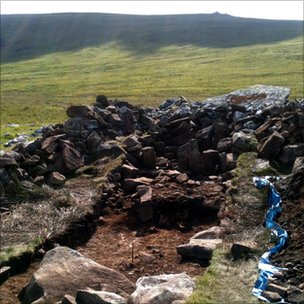
Stonehenge Bluestone

Photo: ALAMY

The work – carried out by geologists Robert Ixer of the University of Leicester and Richard Bevins of the National Museum of Wales – has identified the source as a site called Craig Rhos-y-Felin, near Pont Saeson in north Pembrokeshire.

It is the first time that an exact source has been found for any of the stones thought to have been used to build Stonehenge.

The discovery has re-invigorated a long running debate as to whether the smaller standing stones of Stonehenge were quarried and brought from Pembrokeshire by prehistoric humans or whether they were carried all or part of the way to Wiltshire by glaciers hundreds of thousands of years earlier.

Archaeologists tend to subscribe to the ‘human transport’ theory, while geomorphologists often favour the glacial one.

The debate is solely about Stonehenge’s smaller standing stones which are sometimes known collectively as bluestones. The larger stones, or sarsens, are accepted to have been incorporated into the monument several centuries later.

The remarkable find has been reported in the journal Archaeology in Wales and opens up the possibility of finding archaeological evidence of quarrying activity at Craig Rhos-y-Felin which would indicate humans rather than glaciers were responsible for transporting the stone.

Research over recent years by Tim Darvill of Bournemouth University and Geoffrey Wainwright, a former chief archaeologist at English Heritage, suggests that the Pembrokeshire stones may have had a particular ideological significance.

The outcrops where some of the stones come from are thought to have been associated with sacred springs and local Welsh stone circles.

By bringing those particular rocks the 160 miles from Pembrokeshire to Wiltshire, the builders of Stonehenge may have thought they were obtaining more than just plain rock.

Experts have suggested they may have regarded the stone as having supernatural powers.

By DailTelegraph Reporter – http://www.telegraph.co.uk/earth/environment/8964899/Scientists-locate-exact-source-of-Stonehenge-stone.html

Sponsored by ‘The Stonehenge Tour Company’ – www.StonehengeTours.com

Merlin says: “Surely experts can establish if they were moved by glaciers or man power?”

Merlin @ Stonehenge
The Stonehenge Stone Circle Website


Archaeological discovery provides evidence of a celestial procession at Stonehenge

27 11 2011
BIRMINGHAM.- Archaeologists led by the University of Birmingham with the Ludwig Boltzmann Institute for Archaeological Prospection have discovered evidence of two huge pits positioned on celestial alignment at Stonehenge. Shedding new light on the significant association of the monument with the sun, these pits may have contained tall stones, wooden posts or even fires to mark its rising and setting and could have defined a processional route used by agriculturalists to celebrate the passage of the sun across the sky at the summer solstice.

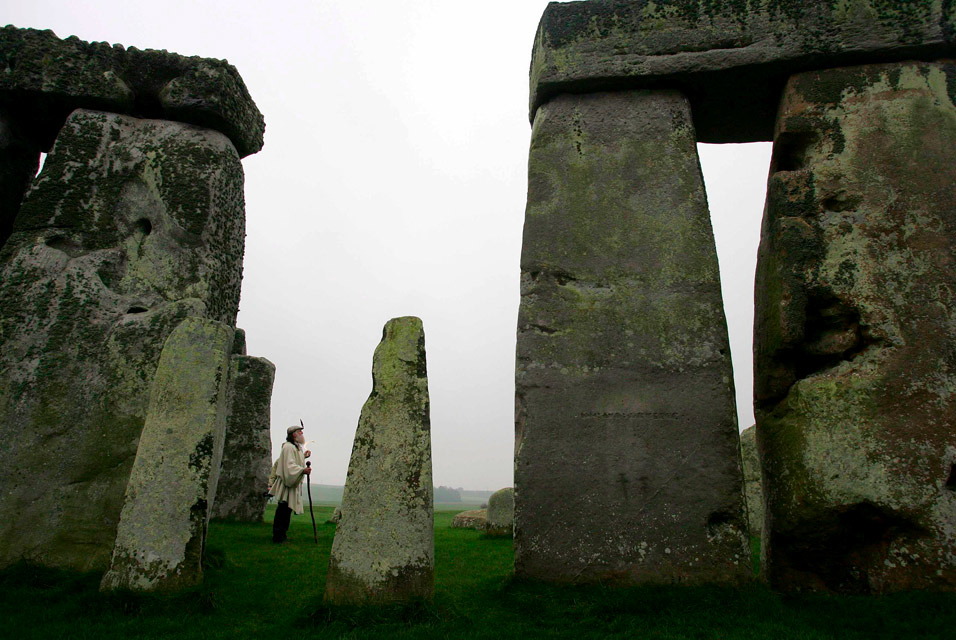
 photograph showing Arch Druid Keeper of the Stones Terry Dobney inspecting the famous British landmark Stonehenge in Wiltshire, south west England.

photograph showing Arch Druid Keeper of the Stones Terry Dobney inspecting the famous British landmark Stonehenge in Wiltshire, south west England.

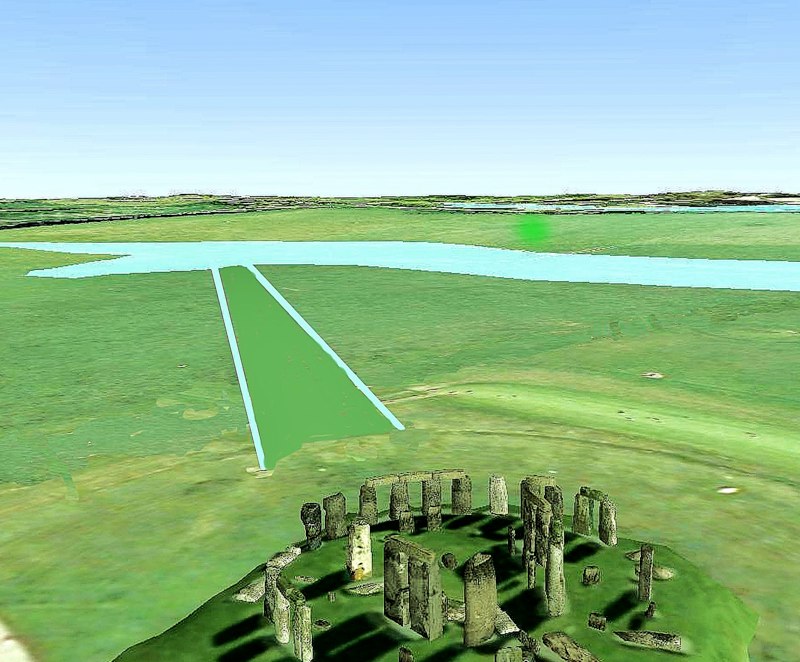
Positioned within the Cursus pathway, the pits are on alignment towards midsummer sunrise and sunset when viewed from the Heel Stone, the enigmatic stone standing just outside the entrance to Stonehenge. For the first time, this discovery may directly link the rituals and celestial phenomena at Stonehenge to activities within the Cursus.

The international archaeological survey team, led by the University of Birmingham’s IBM Visual and Spatial Technology Centre (VISTA), with the Ludwig Boltzmann Institute for Archaeological Prospection and Virtual Archaeology in Vienna (LBI ArchPro) have also discovered a previously unknown gap in the middle of the northern side of the Cursus, which may have provided the main entrance and exit point for processions that took place within the pathway. Stretching from west to east, the Cursus is an immense linear enclosure, 100 metres wide and two and a half kilometres across, north of Stonehenge.

Professor Vince Gaffney, archaeologist and project leader from the IBM Visual and Spatial Technology Centre at the University of Birmingham, explains: “This is the first time we have seen anything quite like this at Stonehenge and it provides a more sophisticated insight into how rituals may have taken place within the Cursus and the wider landscape. These exciting finds indicate that even though Stonehenge was ultimately the most important monument in the landscape, it may at times not have been the only, or most important, ritual focus and the area of Stonehenge may have become significant as a sacred site at a much earlier date.

“Other activities were carried out at other ceremonial sites only a short distance away. The results from this new survey help us to appreciate just how complex these activities were and how intimate these societies were with the natural world. The perimeter of the Cursus may well have defined a route guiding ceremonial processions which took place on the longest day of the year.”

Archaeologists have understood for a long time that Stonehenge was designed to mark astronomical events, built by farming societies whose everyday concerns with growing crops linked their daily lives to the passage of the seasons and in particular the sun, on which their livelihoods depended. This new evidence raises exciting questions about how complex rituals within the Stonehenge landscape were conducted and how processions along or around the Cursus were organised at the time Stonehenge was in use.

Professor Gaffney adds: “It now seems likely that other ceremonial monuments in the surrounding landscape were directly articulated with rituals at Stonehenge. It is possible that processions within the Cursus moved from the eastern pit at sunrise, continuing eastwards along the Cursus and, following the path of the sun overhead, and perhaps back to the west, reaching the western pit at sunset to mark the longest day of the year. Observers of the ceremony would have been positioned at the Heel Stone, of which the two pits are aligned.”

Dr Henry Chapman, Senior Lecturer in Archaeology and Visualisation observes: “If you measure the walking distance between the two pits, the procession would reach exactly half-way at midday, when the sun would be directly on top of Stonehenge. This is more than just a coincidence, indicating that the exact length of the Cursus and the positioning of the pits are of significance.”

Stonehenge, while certainly the most important monument in the later Neolithic and Bronze Age landscape, was surrounded by a dense concentration of other sacred sites, some of which were already ancient when Stonehenge itself was built. The team has also revealed a new horseshoe arrangement of large pits north-east of Stonehenge which may have also contained posts and, together with the henge-like monument discovered last year and a number of other small monuments, may have functioned as minor shrines, perhaps serving specific communities visiting the ceremonial centre.

Paul Garwood, Lecturer in Prehistory at the University of Birmingham, comments: “Our knowledge of the ancient landscapes that once existed around Stonehenge is growing dramatically as we examine the new geophysical survey results. We can see in rich detail not only new monuments, but entire landscapes of past human activity, over thousands of years, preserved in sub-surface features such as pits and ditches. This project is establishing a completely new framework for studying the Stonehenge landscape.”

These new discoveries have come to light as part of the Stonehenge Hidden Landscape Project, which began in summer 2010 as the world’s biggest-ever virtual excavation using the latest geophysical imaging techniques to reveal and visually recreate the extraordinary prehistoric landscape surrounding Stonehenge.

Professor Wolfgang Neubauer, Director of the Ludwig Boltzmann Institute, adds: “The LBI provides the best academics, technicians and young researchers in a team of 20 people and uses multiple systems designed for use on projects where the scale of work was previously unachievable. The use of non-invasive technologies provides information for virtual archaeologies that can be disseminated to the public via the web, iPad or mobile phone.”

Dr Christopher Gaffney, lecturer in Archaeological Geophysics at the University of Bradford, concludes:

“Building on our work from last year we have added even more techniques and instruments to study this remarkable landscape. It is clear that one technique is not adequate to study the complexity of the monuments and landscape surrounding our most important archaeological monument and the battery of techniques used here has significantly increased the certainty of our interpretation.”

Link: http://www.artdaily.org

Sponsored by ‘The Stonehenge Tourv Company’ – www.StonehengeTours.com

Merlin @ Stonehenge
The Stonehenge Stone Circle Website


Secret history of Stonehenge revealed

26 11 2011

 Ancient site may have been place of worship 500 years before the first stone was erected

Extraordinary new discoveries are shedding new light on why Britain’s most famous ancient site, Stonehenge, was built – and when.
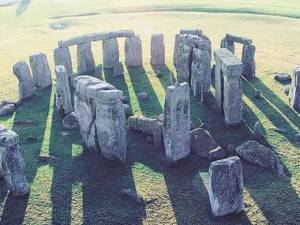
Current research is now suggesting that Stonehenge may already have been an important sacred site at least 500 years before the first Stone circle was erected – and that the sanctity of its location may have determined the layout of key aspects of the surrounding sacred landscape.

What’s more, the new investigation – being carried out by archaeologists from the universities’ of Birmingham, Bradford  and Vienna – massively increases the evidence linking Stonehenge to pre-historic solar religious beliefs. It increases the likelihood that the site was originally and primarily associated with sun worship

The investigations have also enabled archaeologists  to putatively reconstruct the detailed route of a possible religious procession or other ritual event which they suspect may have taken place annually to the north of Stonehenge.

That putative pre-historic religious ‘procession’ (or, more specifically, the evidence suggesting its route) has implications for understanding Stonehenge’s prehistoric religious function – and suggests that the significance of the site Stonehenge now occupies emerged earlier than has previously been appreciated.

The crucial new archaeological evidence was discovered during on-going survey work around Stonehenge in which archaeologists have been ‘x-raying’ the ground, using ground-penetrating radar and other geophysical investigative techniques. As the archaeological team from Birmingham and Vienna were using these high-tech systems to map the interior of a major prehistoric enclosure (the so-called ‘Cursus’) near Stonehenge, they discovered two great pits, one towards the enclosure’s eastern end, the other nearer its western end.

When they modelled the relationship between these newly-discovered Cursus pits and Stonehenge on their computer system, they realised that, viewed from the so-called ‘Heel Stone’ at Stonehenge, the pits were aligned with sunrise and sunset on the longest day of the year – the summer solstice (midsummer’s day). The chances of those two alignments being purely coincidental are extremely low.

The archaeologists then began to speculate as to what sort of ritual or ceremonial activity might have been carried out at and between the two pits. In many areas of the world, ancient religious and other ceremonies sometimes involved ceremonially processing round the perimeters of monuments. The archaeologists therefore thought it possible that the prehistoric celebrants at the Cursus might have perambulated between the two pits by processing around the perimeter of the Cursus.

Initially this was pure speculation – but then it was realized that there was, potentially a way of trying to test the idea. On midsummer’s day there are in fact three key alignments – not just sunrise and sunset, but also midday (the highest point the sun reaches in its annual cycle). For at noon the key alignment should be due south.

One way to test the ‘procession’ theory (or at least its route) was for the archaeologists  to demonstrate that the midway point on that route had indeed a special relationship with Stonehenge (just as the two pits – the start and end point of the route – had).  The ‘eureka moment’ came when the computer calculations revealed that the midway point (the noon point) on the route aligned directly with the centre of Stonehenge, which was precisely due south.

This realization that the sun hovering over the site of  Stonehenge at its highest point in the year appears to have been of great importance to prehistoric people, is itself of potential significance. For it suggests that the site’s association with the veneration of the sun was perhaps even greater than previously realized.

But the discovery of the Cursus pits, the discovery of the solar alignments and of the putative ‘processional’ route, reveals something else as well – something that could potentially turn the accepted chronology of the Stonehenge landscape on its head.

For decades, modern archaeology has held that Stonehenge was a relative latecomer to the area – and that the other large monument in that landscape – the Cursus – pre-dated it by up to 500 years.

However, the implication of the new evidence is that, in a sense, the story may have been the other way round, i.e. that the site of Stonehenge was sacred before the Cursus was built, says Birmingham archaeologist, Dr. Henry Chapman, who has been modelling the alignments on the computerized reconstructions of the Stonehenge landscape

The argument for this is simple, yet persuasive. Because the ‘due south’ noon alignment of the ‘procession’ route’s mid-point could not occur if the Cursus itself had different dimensions, the design of that monument has to have been conceived specifically to attain that mid-point alignment with the centre of Stonehenge.

What’s more, if that is so, the Stonehenge Heel Stone location had to have been of ritual significance before the Cursus pits were dug (because their alignments are as perceived specifically from the Heel Stone).

Those two facts, when taken together, therefore imply that the site, later occupied by the stones of Stonehenge, was already sacred before construction work began on the Cursus. Unless the midday alignment is a pure coincidence (which is unlikely), it  would imply  that the Stonehenge site’s sacred status is at least 500 years older than previously thought – a fact which raises an intriguing possibility.

For 45 years ago, archaeologists found an 8000 BC Mesolithic (‘Middle’ Stone Age) ritual site in what is now Stonehenge’s car park. The five thousand year gap between that Mesolithic sacred site and Stonehenge itself meant that most archaeologists thought that ‘sacred’ continuity between the two was inherently unlikely. But, with the new discoveries, the time gap has potentially narrowed. Indeed, it’s not known for how long the site of Stonehenge was sacred prior to the construction of the Cursus. So, very long term traditions of geographical sanctity in relation to Britain’s and the world’s best known ancient monument, may now need to be considered.

The University of Birmingham  Stonehenge area survey – the largest of its type ever carried out anywhere in the world – will take a further two years to complete, says Professor Vince Gaffney, the director the project.

Virtually every square meter in a five square mile area surrounding the world most famous pre-historic monument will be examined geophysically to a depth of  up to two metres, he says.

It’s anticipated that dozens, potentially hundreds of previously unknown sites will be discovered as a result of the operation.

The ongoing discoveries in Stonehenge’s sacred prehistoric landscape – being made by Birmingham’s archaeologists and colleagues from the University of Vienna’s Ludwig Boltzmann Institute – are expected to transform scholars’ understanding of the famous monument’s origins, history and meaning.

Full Article: http://www.independent.co.uk/life-style/history/secret-history-of-stonehenge-revealed-6268237.html

Sponsored by the Stonehenge Tour Company – www.StonehengeTours.com

Merlin @ Stonehenge
The Stonehenge Stone Circle Website
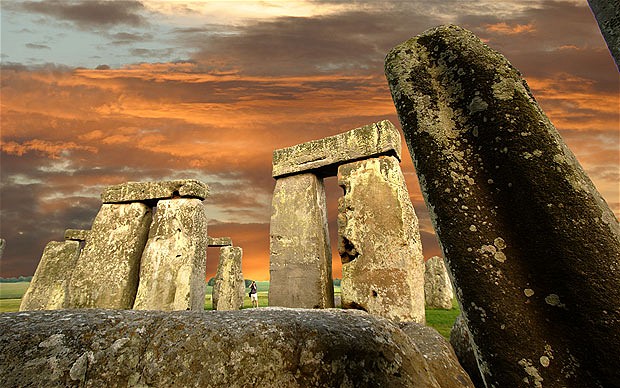


‘Stonehenge is just scaffolding’ claim experts

24 11 2011

After many tens of years of investigation, the meaning behind the ancient monument of Stonehenge may finally have been discovered. Professor Mike Smith and his Oxford University team have concluded that the stones are not the final construction but just the scaffolding to allow work to take place.

Stonehenge‘The missing piece of the puzzle was put in place when I employed some roofers to re-tile over the bathroom and spare bedroom’ he explained. ‘They seemed keen and put up the scaffolding very quickly, but then vanished once the deposit had been paid. One evening the sunlight beamed through the metal pipework from the kitchen door to the cactus collection on the study windowsill, and I saw that this scaffolding was essentially the same structure as at Stonehenge, only not as well put together.’

After the initial discovery the team worked tirelessly to test their new hypothesis, and to work out what final structure was to have been built at the site. ‘The clues led us to the nearest comparable stone age building of Silbury Hill, and a ‘Silbury 2’ constructed on the plain would have been a towering white elephant on the scale of the Millennium Dome or High Speed Rail 2’ claimed the Professor. ‘It was essentially a huge temple to the capacity of a centralised organisation to waste millions of man hours in pointless endeavour. It was obviously planned to be a national piece of work as well – the scaffolding was produced by a sub-contractor from South Wales, which shows that the Government paid lip-service to allocating work in areas of economic deprivation 4000 years ago as well.’

‘We will never be fully sure as to why the Stonehenge hill was not completed but it is likely to have been an early impact of the current government funding cuts’ he concluded.

Professor Smith’s roof has still not been fixed.

‘Spoof ‘Article from  http://www.newsbiscuit.com

Sponsored by The Stonehenge Tour Company – www.StonehengeTours.com

Its not all serious……………………

Merlin @ Stonehenge


Digging up a new look of a famous old site

24 09 2011

Startling new evidence of one of the most famous ancient sites in the world has been uncovered by a mid-Somerset archaeologist – without setting foot on site.

Wells-based digital archaeologist Henry Rothwell has been working on a reconstruction of the entire site of Stonehenge, to show visitors what it would have looked like at various intervals in its long history.

It was when he turned his attention to recently discovered Bluehenge, sited between Stonehenge and the river Avon, that he made the startling discovery – it would not have been a circle at all but an oval.

If correct, Bluehenge would echo the oval circle already known to be at the centre of the famous Stonehenge.

And it raises an intriguing possibility: did the neolithic builders uproot Bluehenge, drag it a mile up the avenue and reconstruct it within Stonehenge itself?

It is certainly a possibility, according to Henry, who is a very modern-day archaeologist.

Any fan of TV archaeology programmes such as Time Team know that archaeologists are usually found in ditches, using trowels to peel back the layers of time to uncover the secrets of the past.

But not Henry Rothwell.

He might have a degree in archaeology but it is a computer mouse that is his chosen tool of trade as he sets about bringing back to life some of the most famous sites in the world from the comfort of his office chair at his base in Wells.

Thanks to his popular website Digital Digging, his reconstructions of wood and stone henges have helped archaeologists and the general public to visualise how such monuments would have once looked.

Using his extensive knowledge of prehistory, pouring over excavation reports and using CAD technology, he tracks where each stone or wooden post would have been and constructs diagrams showing how each monument would have looked set into the ancient landscape.

The latest breakthrough at Bluehenge came as he worked on a new initiative, to make a digital application for people to view Stonehenge via their mobile telephones.

Henry has joined forces with world-renowned photographer Adam Stanford, who uses a camera attached to a 70ft telescopic mast on the top of a 4×4 to take unique perspectives of famous sites, and well-known archaeologist, writer and broadcaster Julian Richards, from TV’s Meet The Ancestors to produce the app.

It was as they were working on The Journey To Stonehenge app – which it is hoped to be ready for iPhones and other smartphones by the mid-winter solstice – that Henry and Adam made the discovery.

“We were using a low-level aerial image taken by Adam that showed the full extent of the Stonehenge Riverside Project excavation of 2009, including the socket holes of Bluehenge, into which the Stonehenge Riverside Project team had placed upturned black buckets,” explained Henry.

“We started constructing the model, but then realised we had missed another bucket on the far right. Initially we tried expanding the circumference to make it fit but it would have been put Bluehenge into the river.

“By going back and tracing each of the socket sites again, it made the overall design of Bluehenge an oval – exactly as the one inside Stonehenge would have looked.”

The new monument was 10m (33ft) in diameter and surrounded by a henge – a ditch with an external bank.

When the Bluehenge’s stones were removed by Neolithic people, it is possible that they were dragged along the route of the Avenue to Stonehenge, to be incorporated within its major rebuilding around 2500 BC.

After posting his findings on archaeological websites last week, Henry’s views soon received the backing of influential archaeologists.

One of the first was renowned Stonehenge expert Mike Pitts, who explained that it matters if it is oval because it strengthens links between Bluehenge, Stonehenge and Woodhenge which also has an oval henge.

“The point is, if Bluehenge was an oval, it matters to how we think about it,” he wrote.

“Which makes finding out what really does happen to the rest of it under the ground important.”

To see the Bluehenge reconstruction and read more see Henry’s http://digitaldigging.co.uk/blog/2011/09/13/bluestone-henge-twin website.
Article: http://www.thisissomerset.co.uk

Sponsored by the Stonehenge Tour Company – www.StonehenegTours.com

Merlin at Stonehenge
The Stonehenge Stone Circle Website


Stonehenge Architect Linked With Welsh Burial Cairn?

8 09 2011

An impressive tomb discovered in Wales is believed to belong to an important figure involved with the construction of Stonehenge.

The burial chamber is located in the Preseli Hills in Pembrokeshire, Wales, and sits on top of a ceremonial monument.

Nearby, a pair of standing stones embedded in a bank bear a strong resemblance to the pair-arrangement of the stones at Stonehenge, the famous prehistoric monument in Wiltshire, southern England.

Stonehenge features earthworks encompassing a circular arrangement of large standing stones. These are mainly two types of rock—the large sarsen stones (a type of sandstone), and a variety of smaller igneous rocks called bluestones (natural columns of while-spotted dolerite).

The excavation of the tomb in the Carn Menyn region of west Wales was led by Tim Darvill from Bournemouth University, and Geoffrey Wainwright from the Society of Antiquaries.

The archeologists believe the 80 bluestones at Stonehenge originated from the same area as the tomb and were transported around 160 miles (nearly 260 kilometers) to the Wiltshire plains about 4,500 years ago (around 2,300BC).

Uncovering the reason for this epic journey will unlock the mystery behind Stonehenge’s existence

Darvill and Wainwright first suggested in 2008 that Stonehenge may have been built as a major healing center, rather like a prehistoric version of Lourdes or Santiago de Compostela. They think the bluestones, not the sarsen, were believed to convey healing powers.

The Preseli area has many springs linked with ritual healing in prehistory, and this could explain why the bluestones were quarried for Stonehenge, despite being so far away.

“We went back to the Preselis and started doing excavations up there,” says Wainright, according to The Guardian. “The first site we explored was a big burial cairn in the shadow of Carn Menyn, where the Stonehenge bluestones come from.”

The excavation team discovered a stone circle underneath the cairn, built of bluestone, and organic material is being carbon dated.

“Then this stone circle was covered with the huge burial cairn with a chamber in the middle,” Wainright added. “The space turned from a public ceremonial space defined by the stone circle into the burial spot of a very important person.”

“We have obviously got a very important person who may have been responsible for the impetus for these stones to be transported,” Wainwright BBC News.

“It can be compared directly with the first Stonehenge, so for the first time we have a direct link between Carn Menyn—where the bluestones came from—and Stonehenge, in the form of this ceremonial monument.”

Sponsored by the Stonehenge Tour Company – www.StonehengeTours.com

Merlin @ Stonehenge
The Stonehenge Stone Circle Website


Tomb found at Stonehenge quarry site

1 09 2011

The tomb for the original builders of Stonehenge could have been unearthed by an excavation at a site in Wales.

The Carn Menyn site in the Preseli Hills is where the bluestones used to

The central site had already been disturbed so archaeologists chose to excavate around the edges

The central site had already been disturbed so archaeologists chose to excavate around the edges

construct the first stone phase of the henge were quarried in 2300BC.

Organic material from the site will be radiocarbon dated, but it is thought any remains have already been taken.

Archaeologists believe this could prove a conclusive link between the site and Stonehenge.

The remains of a ceremonial monument were found with a bank that appears to have a pair of standing stones embedded in it.

The bluestones at the earliest phase of Stonehenge – also set in pairs – give a direct architectural link from the iconic site to this newly discovered henge-like monument in Wales.

The tomb, which is a passage cairn – a style typical of Neolithic burial monument – was placed over this henge.

The link between the Welsh site and Stonehenge was first suggested by the geologist Herbert Thomas in 1923.

This was confirmed in 2008 when permission was granted to excavate inside the stone circle for the first time in about 50 years.

The bluestones had been transported from the hills over 150 miles to the plain in Wiltshire to create Stonehenge, the best known of all Britain’s prehistoric monuments.

Two of the leading experts on Stonehenge, Prof Geoff Wainwright and Prof Timothy Darvill, have been leading the project.

They are now excavating at the site of a robbed out Neolithic tomb, built right next to the original quarry.

They knew that the tomb had been disturbed previously, so rather than excavate inside, they placed their small trench along its outer edge.

Prof Darvill said: “It’s a little piece of keyhole surgery into an important monument, but it has actually lived up to our expectations perfectly.”

There are many springs in the area, which may be have been associated with ritual healing in prehistoric times, and also the reason why these particular stones were quarried for another monument so far away.

Prof Wainwright said: “The important thing is that we have a ceremonial monument here that is earlier than the passage grave.

“We have obviously got a very important person who may have been responsible for the impetus for these stones to be transported.

“It can be compared directly with the first Stonehenge, so for the first time we have a direct link between Carn Menyn – where the bluestones came from – and Stonehenge, in the form of this ceremonial monument.”

Sponsored by ‘The Stonehenge Tour Company’ www.StonehengeTours.com

Merlin @ Stonehenge
The Stonehenge Stone Circle Website
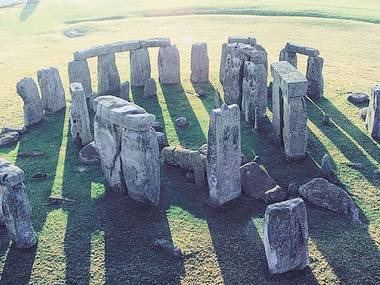


The Stonehenge Enigma – An inconvenient truth

30 08 2011

Robert Langdon’s new book, sheds new light on the evidence found in Stonehenge’s Visitors Car Park, which has subsequently been buried for over 40 years, that proves Stonehenge is really 5000 years older than we believe!

The Stonehenge Enigma, has unearthed evidence that has been kept from public scrutiny for over 40 years. Current theories on the discovery of the four post holes in a line found during excavation work on the visitors car park in 1966 are simple and dismissive – they are ‘totem poles’ claim English Heritage in their book ‘Stonehenge in its landscape’ by Cleal et al. 1995.

However, analysis of the claim simply does not stand up to scrutiny. “They are likely to be individual uprights, perhaps reminiscent of those of the American Indian (totem poles).” The problem is that ‘totem poles’ survive less than 100 years, if they are made of hard wood – pine is softwood and rots much quicker. So when you start to look at the carbon dating evidence on when each post whole was cut a whole new story emerges.

For the first post hole would have been constructed around 8275BC the second one (next to the first) was erected about 7035BC some 1240 years later! By then the first post would have rotted away and the first post hole completely lost. The third post hole we cannot date as the charcoal that was found was lost or not processed, which is no surprise as all three samples were stored away for 10 years before some eagle eyed researcher realised that pine wood did not exist in the late Neolithic (2500BC), which the original date archaeologists claimed these poles were erected (to match the building date of Stonehenge) before packing the samples away into oblivion, without getting them tested. Yet, another post hole on the same alignment was found in 1989 some 75m away from the three original post holes. This was accurately dated to about 7890BC, 385 years after the first post but 855 years before the second.

So English Heritage asks us to accept that a group of hunter-gatherers went to the Stonehenge site in 8275BC and placed a ‘totem pole’ in a valley away from the high ground (where Stonehenge sits today) which was at this time in history surrounded by a tall pine forest. These people then disappeared for about 400 years, returning to place a second ‘totem pole’ 75 yards away from the first, finally to return 855 years later and place a third pole next to the first with the fourth (of unknown date) in an alignment. Moreover, these people left no trace of their 1200 year occupation of this site until they returned 5,000 years later in 3000BC to build Stonehenge phase 1.

Why has this absurd theory not have the scrutiny that it desires? Why was the evidence buried in a vault for 10 years? And why do they still insist that these post holes are ‘totem poles’? In his book, Langdon shows that these structures played a more significant role than has previously been believed. Not only does he reveal what these post holes were for, but he also gives a more plausible explanation on what really happened at Stonehenge including, WHO built the Monument, WHEN they built the monument and WHY they built the monument.

For the full article on ‘The Stonehenge Enigma – An inconvenient truth’ including photo’s and academic references visit this web site at www.the-stonehenge-enigma.info – all rights to duplicate and extract information or photographs with reference to source and author is granted.

A video promo is available on: http://youtu.be/PVRIBpg-fIE

Details and extracts from the book – The Stonehenge Enigma at: www.prehistoric-britain.co.uk

Sponsored by ‘The Stonehenge Tour Company’ www.StonehengeTours.com

Merlin @ Stonehenge
The Stonehenge Stone Circle Website
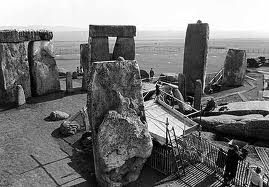


Chichen Itza points to Stonehenge – GPS research proves

26 07 2011

Jarome Vahai’s research on early GPS devices fascinated a group of students and scholars at this year’s Stanford Honors Research Symposium

Pyramids and monoliths around the world perform four functions that modern GPS devices perform, according to a newly released study by Jarome Vahai. The ancient navigational device researcher recently told a captivated audience at the 2011 Stanford Honors Research Symposium that ancient structures helped societies tell time, measure the circumference of the earth, pinpoint their location on the earth and identify their location during travel—just like modern GPS devices.

GPS systems are used for many things, including exploration, expanding territories, and conducting import/export trade and commerce over great distances.

“Early civilizations thought the same way we think now,” said Jarome Vahai. “We use GPS devices to locate where we are and how to get to other places—and so did they.” Vahai notes that as tools have improved, building structures like the pyramids has become unnecessary.

Many of the ancient landmarks that are still in existence are positioned in ways that mark the longest and shortest days of the year by the patterns of shadows they cast at equinox. In addition to showing calendar position, shadows could also be used to tell time during the day.

The Giza pyramids and shadows were also used by Eratosthenes to calculate the circumference of the earth. Ancient civilizations understood they were on a round, turning planet because their stone markers line up with one another around the globe. Some even line up with other planets and constellations, says Vahai.

Vahai’s research shows that markings identified at the pyramid at Chichen Itza point to the pyramids at Giza; others point to Stonehenge, the pyramids in China, and the great Cambodian temple Angkor Wat. He has also found that the stone markers of Ha’amonga, known as Tonga’s Stonehenge, line up with Fiji, Hawaii, Samoa, New Zealand and the Cook Islands.

“These ancient structures were lasting landmarks that told people where they are located in relation to other parts of the world,” said Vahai.

The usefulness of landmarks in the ancient world cannot be understated. Rulers had expansive empires that covered huge amounts of land, and protecting those lands could be challenging. Babylon and Giza are located in places that are difficult to find and get to, probably for security reasons. The large structures were helpful landmarks.

“I am very proud that Stanford selected my research; they only accept about 20% of submissions,” said Vahai. “The audience was extremely engaged—the moderator was so wrapped up in the topic, we ended up going over the time limit.”

Sponsored by ‘The Stonehenge Tour Company’ www.StonehengeTours.com

Merlin at Stonehenge
The Stonehenge Stone Circle Website



Marlborough mound mystery solved – after 4,400 years

1 06 2011

Hill in Wiltshire school grounds nicknamed Silbury’s little sister revealed as important neolithic monument

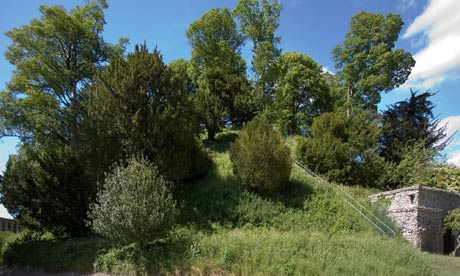
Ancient mound in the grounds of Marlborough College, Wiltshire. Photograph: Steven Vaux /Marlborough College

For generations, it has been scrambled up with pride by students at Marlborough College. But the mysterious, pudding-shaped mound in the grounds of the Wiltshire public school now looks set to gain far wider acclaim as scientists have revealed it is a prehistoric monument of international importance.

After thorough excavations, the Marlborough mound is now thought to be around 4,400 years old, making it roughly contemporary with the nearby, and far more renowned, Silbury Hill.


The new evidence was described by one archeologist, an expert on ancient ritual sites in the area, as “an astonishing discovery”. Both neolithic structures are likely to have been constructed over many generations.

The Marlborough mound had been thought to date back to Norman times. It was believed to be the base of a castle built 50 years after the Norman invasion and later landscaped as a 17th-century garden feature. But it has now been dated to around 2400BC from four samples of charcoal taken from the core of the 19 metre-high hill.

The samples prove it was built at a time when British tribes were combining labour on ritual monuments in the chalk downlands of Wiltshire, including Stonehenge and the huge ditches and stone circle of Avebury.

History students at the college will now have the chance to study an extraordinary example just a stone’s throw from their classroom windows. Malborough’s Master Nicholas Sampson said: “We are thrilled at this discovery, which confirms the long and dramatic history of this beautiful site and offers opportunity for tremendous educational enrichment.”

The Marlborough mound has been called “Silbury’s little sister”, after the more famous artificial hill on the outskirts of Avebury, which is the largest manmade prehistoric hill in Europe.

Marlborough, at two-thirds the height of Silbury, now becomes the second largest prehistoric mound in Britain; it may yet be confirmed as the second largest in Europe.

Jim Leary, the English Heritage archeologist who led a recent excavation of Silbury, said: “This is an astonishing discovery. The Marlborough mound has been one of the biggest mysteries in the Wessex landscape. For centuries, people have wondered whether it is Silbury’s little sister, and now we have an answer. This is a very exciting time for British prehistory.”

 The dating was carried out as part of major conservation work amid concerns that tree roots could be destabilising the structure.

Sponsored by the The Stonehenge Tour Company – www.StonehengeTours.com

Merlin @ Stonehenge
The Stonehenge Stone Circle Website