Discovery adds to the mystery of Stonehenge

26 07 2010

Scientists scouring the area around Stonehenge said last week that they had uncovered a circular structure only a few hundred yards from the world-famous monument.

There’s some debate about what exactly has been found. The survey team that uncovered the structure said it could be the foundation for a circle of freestanding pieces of timber, a wooden version of Stonehenge.

But Tim Darvill, a professor of archaeology at Bournemouth University in southern England, expressed skepticism, saying he believed it was more likely a barrow, or prehistoric tomb.

Darvill also said the circle was one of an expanding number of discoveries being made around Stonehenge, which “really shows how much there is still to learn and how extensive the site really was.”

“In its day, Stonehenge was at the center of the largest ceremonial center in Europe,” he said.

Deep pits and a ring of holes

Although antiquarians have been poking around the area since the 18th Century, excavations are now tightly restricted. So archeologists have been scanning surrounding fields and pastures with magnetic and radar sensors that tractors or quad bikes pull across the grass.

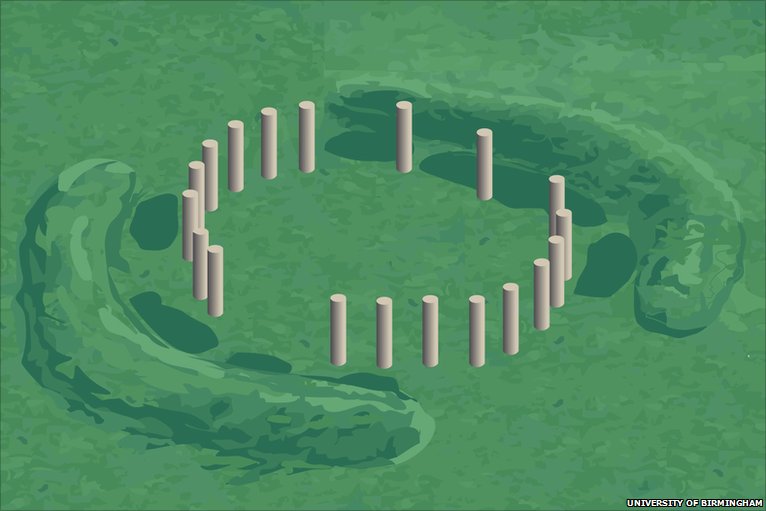
The new structure was found when scans identified a cluster of deep pits surrounded by a ring of smaller holes about 900 yards from Stonehenge and within sight of its famous standing stones.

University of Birmingham archaeologist Henry Chapman said he was convinced the small holes were used to secure a circle of wooden poles that stood possibly 10 or more feet high.

The timber henge — a name given to prehistoric monuments surrounded by a circular ditch — would have been constructed and modified at the same time as its more famous relative and probably had some allied ceremonial or religious function, Chapman said.

Exactly what kind of ceremonies those were is unclear. The new henge joins a growing complex of tombs and mysterious Neolithic structures found across the area.

Still more to explore

Last year, researchers said they had found a small circle of stones on the banks of the nearby River Avon. Experts speculated the stone circle — dubbed Bluehenge because it was built with bluestones — may have served as the starting point of a processional walk that began at the river and ended at Stonehenge.

Chapman’s team is still in the early stages of its work, having surveyed only about 1 1/2 square miles of the 6 square miles it eventually plans to map.

The University of Birmingham and the Austria-based Ludwig Boltzmann Institute for Archaeological Prospection and Virtual Archaeology are leading the survey, with support from other institutions and researchers from Germany, Norway and Sweden.

Henges of various descriptions exist throughout Britain — from the Standing Stones o’ Stenness on the northern island of Orkney to the Maumbury Rings in the southern English county of Dorset.

Stonehenge, a World Heritage Site, remains the best-known.

Exciting times at Stonehenge
Merlin @ Stonehenge
The Stonehenge Stone Circle Website


Archaeologists unearth Neolithic henge at Stonehenge

22 07 2010

Archaeologists unearth Neolithic henge at Stonehenge

An image detailing the new 'henge'
Archaeologists say the find is “exceptional”

Archaeologists have discovered a second henge at Stonehenge, described as the most exciting find there in 50 years.

 The circular ditch surrounding a smaller circle of deep pits about a metre (3ft) wide has been unearthed at the world-famous site in Wiltshire.

 Archaeologists conducting a multi-million pound study believe timber posts were in the pits.

 Project leader Professor Vince Gaffney, from the University of Birmingham, said the discovery was “exceptional”.

 The new “henge” – which means a circular monument dating to Neolithic and Bronze Ages – is situated about 900m (2,950ft) from the giant stones on Salisbury Plain.

It’s a timber equivalent to Stonehenge”

 End Quote Professor Vince Gaffney University of Birmingham

Images show it has two entrances on the north-east and south-west sides and inside the circle is a burial mound on top which appeared much later, Professor Gaffney said.

 ”You seem to have a large-ditched feature, but it seems to be made of individual scoops rather than just a straight trench,” he said.

 ”When we looked a bit more closely, we then realised there was a ring of pits about a metre wide going all the way around the edge.

 ”When you see that as an archaeologist, you just looked at it and thought, ‘that’s a henge monument’ – it’s a timber equivalent to Stonehenge.

 ”From the general shape, we would guess it dates backs to about the time when Stonehenge was emerging at its most complex.

 ”This is probably the first major ceremonial monument that has been found in the past 50 years or so.

 ’Terra incognita’

“This is really quite interesting and exceptional, it starts to give us a different perspective of the landscape.”

 Data from the site is being collected as part of a virtual excavation to see what the area looked like when Stonehenge was built.

 Speculation as to why the 4,500-year-old landmark was built will continue for years to come, but various experts believe it was a cemetery for 500 years, from the point of its inception.

 In 2008, the first excavation in nearly half a century was carried out at the iconic site on Salisbury Plain.

 This latest project is being funded by the Ludwig Boltzmann Institute for Archaeological Prospection and Virtual Archaeology, in Vienna, and the University of Birmingham, and is assisted by the National Trust and English Heritage.

 Professor Gaffney said he was “certain” they would make further discoveries as 90% of the landscape around the giant stones was “terra incognita” – an unexplored region.

 ”The presumption was this was just an empty field – now you’ve got a major ceremonial monument looking at Stonehenge,” he said.

Merlin at Stonehenge
The Stonehenge Stone Circle Website


Astro-Archaeology at Stonehenge

15 07 2010

Its more than a pile of old stones…………….
The Revd. Edward Duke was the first person to associate astronomy with Stonehenge, describing it as a planetarium full of significant astronomical alignments – although he named none. Unfortunately most of his ideas on the subject were rather fanciful and over-imaginative, and not very scientific.

Sir Norman Lockyer (1836 – 1920) was the first person to identify the reason for the orientation of Stonehenge. He realised that on the summer solstice the sun rose at the end of the main axis (as it would have done in the second and third millenniums BC). He published these findings in a book in 1906. However, Lockyer made many errors and incorrect assumptions, which made archaeologists suspicious of the possibility of astronomical alignments.

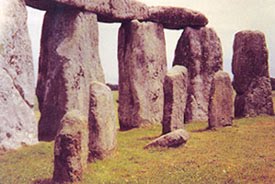
Stonehenge, looking West (7 KB) - links to a larger 38 KB version

Therefore, it was not until the second half of the 20th Century that astro-archaeology became a major science in its own right. Gerald Hawkins, an American astronomer, published the results of an intense study of Stonehenge’s astronomical alignments in Nature in 1963. In the article he described how he had used a computer to prove that alignments between Stonehenge and 12 major solar and lunar events was extremely unlikely to have been a coincidence (Castleden, 1993). His book, Stonehenge Decoded, containing the fully developed theory, appeared in Britain in 1966. He described how he had found astronomical alignments among 165 points of Stonehenge associated purely with the Sun and the Moon, and not with any stars or the five naked-eye planets (Mercury, Venus, Mars, Jupiter and Saturn). He discovered that lunar eclipses could be predicted through a system of moving stones around the circle of Aubrey Holes.

Controversially, he went on to suggest that Stonehenge was an ancient computer. The 1960’s were still early in the computer revolution, and the Harvard-Smithsonian IBM had produced some fantastic results for him. This was merely Hawkins’ way of paying a high compliment to the architects and builders of Stonehenge (Castleden, 1993).

There are indeed a large number of astronomical alignments, prediction and measuring devices, and representative features to be found among the megalithic stones and holes of Stonehenge. Gerald Hawkins discovered many of them, and most of his discoveries are commonly accepted.

Stonehenge III

M. W. Postins wrote a booklet entitled Stonehenge: Sun, Moon, Wandering Stars in 1982. Postins built two scale models, which he called the ‘Temple model’ (Stonehenge III) and the ‘Enclosure model’ (which shows outlying features such as the Aubrey Holes and Station Stones of Stonehenge I and II). ‘Table 1’ below outlines the astronomical alignments from Stonehenge III. (Also see Figure 1.)

TABLE 1: Stonehenge III (Temple) Astronomical Alignments

Astronomical Event Alignment Stones From… …to between sarsens Summer solstice sunrise Altar Stone 30 + 1 Summer solstice sunset Northern Low Trilithon gap 23 + 24 Winter solstice sunrise Eastern Low Trilithon gap 6 + 7 Winter solstice sunset Great Trilithon gap 15 + 16 Summer solstice moonrise, major standstill Southern Intermediate Trilithon gap 9 + 10 Summer solstice moonrise, minor standstill Southern Intermediate Trilithon gap 8 + 9 Winter solstice moonrise, major standstill Altar Stone 29 + 30 Winter solstice moonrise, minor standstill Altar Stone 1 + 2 Winter solstice moonset, major standstill Western Intermediate Trilithon gap 21 + 22 Winter solstice moonset, minor standstill Western Intermediate Trilithon gap 20 + 21

Trilithons

In his booklet, Postins states that the five trilithons represented the planets visible with the naked eye.

Mercury and Venus are the two planets in the sky that keep in closest association with the Sun. The eastern and northern lowest trilithons have alignments through the sarsen circle relating directly to the Sun (see Figure 1). Therefore, Postins suggested that these two lowest trilithons represented Mercury and Venus.

The two intermediate trilithons represented Mars and Jupiter because they are associated with lunar alignments. Mars and Jupiter are associated with the Moon due to their paths through the Zodiac. Because of this they are not linked to sunrise and sunset events like Mercury and Venus, but may be observed close to the Moon as they all follow similar paths along the ecliptic. The two intermediate trilithons align with major and minor positions of the Moon, which the Altar Stone (stone 80) also does through gaps in the sarsen circle (see Figure 1).

The Great trilithon represented Saturn because Saturn moves very slowly across the sky compared to the other four planets. This stately pace may have indicated to the people who built Stonehenge that Saturn held some sort of ‘senior’ position in the heavens.

FIGURE 1: Stonehenge III (Temple) Astronomical Alignments

Stonehenge III alignments (30 KB) - links to a larger 50 KB version

The Sun-aligned low trilithons cannot be differentiated in order to determine which planet (Mercury or Venus) each represents. The same problem exists with the Moon-aligned intermediate trilithons representing Mars and Jupiter. Postins speculates that there could have been carvings on the trilithons, now long eroded from existence, which indicated which trilithon represented which planet.

All of the astronomical alignments within the sarsen circle are present in older parts of the monument, including the Station Stones, Heel Stone and the numerous holes and posts. See Figure 2, which illustrates all of the astronomical alignments among the features of Stonehenge.

The alignments are extremely precise, which illustrates the high level of knowledge possessed by the builders of Stonehenge. Such knowledge must have been gathered over decades or centuries of observations of the sky (during which the behaviour and interaction of the heavenly bodies was noted), before the idea of Stonehenge was even conceived.

Station Stones

The four Station Stones (SS), 91, 92, 93 and 94 formed a perfect rectangle, which is remarkable considering that the long axis of the rectangle is around 300 ft in length. The sarsen ring formed a circle 97 ½ ft across in which every upright was, on average, less than 3 inches out of position!

This geometric precision was investigated in around three hundred megalithic monuments all over Britain by Alexander Thom. He deliberately investigated large numbers of megalithic monuments prior to visiting Stonehenge (in 1973) in order to prevent obtaining a biased view. It would have been easy to see Stonehenge as the perfect example of a Megalithic monument and then proceed to examine other monuments with this assumption in mind.

During his study of these monuments he came across two standard units of measurement, which he called the ‘Megalithic Fathom’ (equivalent to 1.6 m or 5.44 ft) and the ‘Megalithic Yard’ (equivalent to 0.83 m or 2.72 ft – 8 ½ inches short of a standard English yard). Thom found that the Megalithic Yard had been used at Stonehenge, in the spacing and positioning on the sarsen circle uprights. With these commonly recognised units, it is understandable how the Neolithic peoples that built Stonehenge achieved such a level of precision – and hence produce a very accurate astronomical observatory. Figure 2, below, illustrates the many alignments among the stones of Stonehenge I and Stonehenge III.

FIGURE 2: Stonehenge I and III Astronomical Alignments

Stonehenge I and III alignments (40 KB) - links to a larger 64 KB version

Figure 2 shows that an observer looking from SS92 (Station Stone 92) over SS91 would see the summer solstice sunrise, as he would if standing behind the Altar Stone (stone 80) and looking over stones C and B in the Avenue, just to the left of the remaining Heel Stone. Many of the alignments are at exact right angles. This is due to latitude at which Stonehenge was built. The exact rectangle of alignments through the Station Stones can only be achieved on (or very close to) 51° North. Once again, this demonstrates the astronomical knowledge the Neolithic populations possessed.

TABLE 2: Stonehenge I Astronomical Alignments

Astronomical Event Alignment Stones From… …to… Summer solstice sunrise SS 93 SS 94 SS 92 SS 91 Summer solstice sunset Stone G SS 94 Winter solstice sunrise SS 94 Stone G Winter solstice sunset SS 91 SS 92 SS 94 SS 93 Summer solstice moonrise, major standstill SS 93 SS 92 Summer solstice moonrise, minor standstill SS 93 SS 91 Winter solstice moonset, major standstill SS 91 SS 94 Winter solstice moonset, minor standstill SS 91 SS 93 Most southerly moonrise SS 94 SS 91 Most northerly moonset SS 92 SS 93 Equinox sunrise SS 94 Stone C Equinox moonrise SS 94 Stone B [ SS = Station Stone ]

Bluestone Horseshoe

Consisting of 19 stones, the bluestone horseshoe (just inside the 5 sarsen trilithons) had a couple of possible uses.

They could be used for counting the period from a full moon on a particular day of the year to the next full moon that falls on that day of the year, which would be 19 years later. Known as the Metonic cycle (after Meton, a 5th Century BC Greek astronomer), this is correct to around 2 hours. (Postins, 1982)

It could also be used to follow the nodal cycle of the Moon, which has a period of 18.61 years. The extremes of the Moon’s position on the horizon are marked on Figure 1, with the two intermediate trilithons and stones 8, 9, 10, and 20, 21, 22 of the sarsen circle.

The Bluestone Horseshoe (inside the five trilithons) can also be used to predict eclipses. There are 19 of these stones, which again relate to the 18.61-year cycle of the Moon’s wandering rising and setting points on the horizon, and therefore also eclipses. “Due to the way in which the lunar nodes move around the Zodiac, it takes somewhat less than a year for the Sun to return to the same position in relation to the nodes. This period is 346.62 days, and is connected with the repetition of eclipses. It is known as an ‘eclipse year’. 19 eclipse years and 223 lunar months [each of 29.53 days] have the following relationship: –

19 x 346.62 = 6585.78 days,
and
223 x 29.53 = 6585.32 days.”

(Postins, 1982)

This means that to predict an eclipse, 223 full Moons must be counted before the Earth, Moon and Sun are again in the same positions as at the beginning of that time. This period of time is called the Saros, and it is possible that Stonehenge III people discovered it. However, not all eclipses would be predicted by this method of counting the bluestones in the horseshoe because eclipses occur quite frequently, except with slightly different positions of the Earth, Moon and Sun.

Aubrey Holes

Gerald Hawkins’ theory on the use of the 56 Aubrey Holes to predict lunar events was workable but imprecise. At intervals of 9, 9, 10, 9, 9, 10, you could place 6 alternately black and white marker stones around the Aubrey Hole (AH) circle, and move them clockwise or anti-clockwise around the ring one hole per year. (Castleden, 1993.) Aubrey Holes 51, 56 and 5 were fixed markers. See Figure 3 below, which illustrates the concept.

If a white marker arrived at AH56 the full Moon would rise over the Heel Stone that year. The next astronomical event would occur when a white marker arrived at AH51. At its extreme declination, in that year the winter solstice Moon rose over the alignment to hole D from the centre of the monument, along the alignment from SS94 to SS91, and was framed in the southern intermediate trilithon. The summer solstice Moon rose along the alignment from SS93 to SS92, and was framed in the western intermediate trilithon. (Castelden, 1993)

Hawkins successfully demonstrated that several important lunar alignments occurred in 1549 BC. He suggested that the astronomers at Stonehenge knew these alignments would take place when a white marker arrived at AH51 that year.

FIGURE 3: Gerald Hawkins’ Eclipse Predictor

Hawkins' Eclipse Predictor using the 56 Aubrey Holes (13 KB)

Eclipses of the Moon occur every 18.61 years. The reason why there are 56 Aubrey Holes is because 18.61 x 3 = 55.83 (or 56 to the nearest integer). Eclipses of the Moon in summer or winter took place when any marker stone arrived at AH56 or AH28, the two holes that lie on the main axis of Stonehenge. When a white marker reached AH5 or AH51, equinox eclipses would occur.

There are 30 uprights in the sarsen circle. A full Moon occurs every 29.53 days. A seventh marker stone (a Moon marker, shown in Figure 3) would be moved once a day around the sarsen circle to keep track of the phases of the Moon.

In the 1960’s many British Stonehenge archaeologists were frustrated that an American astronomer had determined the reasoning behind the monument’s structure, having barely laid a foot in Stonehenge! As Hawkins’ highly plausible ideas went down badly in the British archaeological circles, Glyn Daniel (the editor of Antiquity) sought assistance from Fred Hoyle, the current Professor of Astronomy at Cambridge University. Hoyle studied Hawkins’ work, and produced his own theories on lunar predictions using Stonehenge. In his scenario, Stonehenge became a Solar System model with Earth at the centre. Rather than seven stones, Hoyle chose 3 stones representing the Sun, Moon, and one node of the Moon’s orbit. The 3 stones were moved around the Aubrey Hole ring at their real rates relative to each other. When the 3 markers lay close together or almost opposite each other, eclipse seasons took place. Actual eclipses occurred in these seasons only when the Moon stone moved close to the Sun stone, or was diametrically opposed to it (i.e. precisely on the opposite side of the Aubrey Hole ring).

Stonehenge, looking East (7 KB) - links to a larger 36 KB version

Hoyle’s method is much more accurate than Hawkins’ because the actual day of the eclipse was predicted, as well as the eclipse season. It is also much simpler to operate on the ground.

Hoyle also studied other astronomical alignments, and came to the conclusion that, surprisingly, Stonehenge I was much more sophisticated than Stonehenge III, although the later monument was undoubtedly more architecturally impressive. (Castleden, 1993)

Even after Hoyle’s more rational efforts, many archaeologists remained unconvinced. Today it is regarded as remarkable that Hawkins’ eclipse prediction method was seen as such an impressive step towards understanding parts of Stonehenge. It is believed that his use of the Harvard-Smithsonian IBM computer made his theory ‘infallible’ at the time. After all, it is highly unlikely that even the people of Stonehenge I would have been satisfied knowing only the year in which an eclipse would occur!

Merlin @ Stonehenge
The Stonehenge Stone Circle Website

Tours of Stonehenge
The Stonehenge Tour Company
HisTOURies UK
Salisbury Guided Tours


Bryan builds his own henge

25 06 2010

IT’S Hampshire’s own answer to Stonehenge.

Bryan builds his own henge

Alone in a rural setting stands an eerie circle of stones, each painstakingly positioned in such a way as to celebrate the earth’s natural calendar.

But, unlike the world-famous monument on Salisbury Plain, it took just one person to build this modern version.

The 24 stone towers are made out of fly-tipped waste and they have been erected over a decade by a man fascinated with Britain’s ancient history.

Bryan Raines started his Millennium Circle in 2000, each year arranging the monuments in line with specific times in the year such as summer and winter solstice and the spring equinox.

The circle, in Bryan’s field near Awbridge Village Hall, surrounds a barrow constructed of soil.

The 55-year-old conservationist believes the site lies on an ancient ley line running from the Isle of Man to the Isle of Wight.

Bryan, who lives in Michelmersh, said: “I was in the process of collecting builder’s rubbish that I had accumulated and I thought I would use it for a stone circle.

“Some of the stones are between five and six feet high but, unfortunately, cows keep knocking them over.

“I’ve ended up with a sort of 24-hour sundial. It’s a good 50 metres across.

“I’m quite proud of it, actually. I have had quite a few people who were surprised about it.”

The lowdown on ley lines

Some people believe sites of geographical interest and ancient monuments and megaliths are connected by straight lines, known as ley lines.

Their existence was suggested in 1921 by the amateur archaeologist, Alfred Watkins, in his book, The Old Straight Track.

Those who believe in them think that the lines and their intersection points resonate a special psychic or mystical energy.

Watkins believed that, in ancient times, when Britain was far more densely forested, the country was crisscrossed by a network of straight-line travel routes on which prominent landmarks were used as navigation points.

Since then, ley lines have become the subject of magical and mystical theories.

Two British dowsers, Captain Robert Boothby and Reginald A. Smith, of the British Museum, linked the appearance of ley lines with underground streams and magnetic currents. HisTOUries UK offer guided tours of Stonehenge and Avebury abd demonstrate the ancien art of dowsing.

Merlin @ Stonehenge
The Stonehenge Stone Circle Website


Stonehenge: How Did The Stones Get There?

14 05 2010
We  explain how the myth of the stones transported from south Wales to Salisbury Plain arose and why it is wrong.

History is full of enjoyable myths but Stonehenge has too many. They mutate. Hardly had modern scholars got rid of the pre-Roman druids than those soothsayers reappeared in the guise of 3rd-millennium BCE astronomer-priests who are said to have designed the great circle as a celestial computer for the prediction of eclipses.

There are other common fallacies. The Greek explorer, Pytheas of Marseilles, who provided the first written account of Britain when he visited the islands c.300 BCE, is sometimes said to have visited Stonehenge. In fact, he landed near the splendid circle of Callanish in the Outer Hebrides 500 miles to the north. Just as mistakenly, Stonehenge is  described as a British stone circle though it is not this at all, but rather an imitation in stone of a lintelled timber ring, with architectural influences from Brittany.

Perhaps the most persistent of these myths is that men ferried scores of enchanted Welsh stones hundreds of miles. Returning across the Irish Sea from the Wicklow mountains to their home in southern Britain some time after 3000 BCE, a group of gold- and copper-prospectors are said to have steered towards the landmark of the Preseli mountain range in south-west Wales. Regarding the Preselis as magical and their bluestones life-enhancing, the crews felt compelled to plunder them one by one for an intended megalithic sanctuary on Salisbury Plain. The romance has been repeated ….
Hear all the latest theories, myths and legends from a Stonehenge tour guide – try the excellent  local based ‘HisTOURies UK’ private tour company or Premium Tours based in London

Merlin @ Stonehenge
The Stonehenge Stone Circle Website


Two great hoaxes: Piltdown Skull and Bluestone Quarry?

10 05 2010

Some see a bluestone quarry — others don’t.
Some see a Missing Link — others see a hoax.


There was a piece on the telly the other day about the Piltdown Man hoax of 1912. One thing struck me in the commentary — namely the “fertile ground” which existed in Britain at the time, providing perfect conditions for the hoax to take root, to flourish and eventually (in spite of the reservations of some experts) to become part of mainstream thinking. This is what one web site says about the hoax:

“Perhaps the most famous hoax was Piltdown man. In 1912, at a time when Darwin’s evolutionary theory was new, and people were looking for missing links between humans and apes, someone planted two fake skulls which came to be known as Piltdown Man.
The part medieval man, part Orang-utang fossil was found, in the very English village of Piltdown in Sussex. Piltdown man’s scientific name, Eoanthropus dawsoni, reflected its finder’s name Dawson. To get a flavour of those times, the British Empire was still riding high, and Germany had their Heidelberg man fossil, Britain was desperate for a more important ‘ missing link’ between man and monkey.”

The key to this is national pride, and a desire in Britain to demonstrate that whatever important discoveries there were in Germany, Britain had even better ones, showing the world what wonderful ancient civilizations we had here, and what brilliant archaeologists we had to uncover them and to expound new theories of evolution to the world…… OK, petty, nationalistic, xenophobic and even absurd, but that was the world around the time of the First World War. Germany had Neanderthal Man, and now Britain had the “Missing Link” — even more important.

So what about HH Thomas and the bluestones? Well, I have suspected for some time that Thomas might have been guilty of simplification and selective citation of his samples and his rock identifications, in order to flag up the Carn Meini area as the source of the bluestones. I have also expressed my amazement in earlier posts that he “got away with murder” in that NOBODY seems to have seriously examined his evidence or questioned his wacky idea that the stones had been hauled by tribesmen all the way from Presely to Stonehenge in a totally unique feat of Stone Age long-distance transport. And why did people not scrutinize his theory more closely? Why, because there had been great discoveries about megalithic structures in Germany, and because British archaeologists were desperate to show that in these islands we had even more advanced prehistoric civilisations and even cleverer engineers and technicians.

Sounds absurd? I don’t think so — and a number of other authors have suggested that Thomas’s idea was carefully put together around the time of the First World War as part of a national “feel good” strategy, and that the whole nation (and not just the archaeologists) just loved the idea when he announced it, and were disinclined to examine it carefully.

So Thomas became famous, then the bluestones became famous, and the “bluestone transport story” entered the mythology of Britain. It is still trotted out ad infinitum, even though there is even less evidence for it now than there was in 1920. And anybody who dares to question it, or to undermine our cosy assumptions about the extraordinary skills of our Neolithic ancestors, is likely to get short shrift from the archaeology establishment. Look at what happened to poor Geoffrey Kellaway…….

So was the Carn Meini / bluestone quarry / human transport story all a hoax? I think it’s a distinct possibility. How much longer will it be before the whole mad idea about human transport is finally consigned to the scrapheap? Not long, I suspect, since the new geology being done by Rob Ixer and colleagues in the Stonehenge area is revealing so many new sources for the stones and fragments at Stonehenge that we are going to have to talk about 20 quarries all over western Britain, rather than one. And that would be to stretch things to a rather extraordinary degree……

All hoaxes have their day, and eventually bite the dust, leaving senior academics looking very foolish.

Merlin @ Stonehenge
The Stonehenge Stone Circle Website


Do Dartmoor’s ancient stones have link to Stonehenge?

27 04 2010

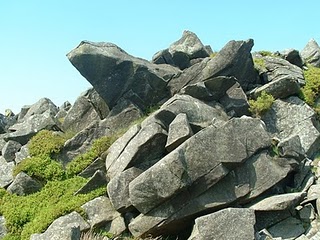
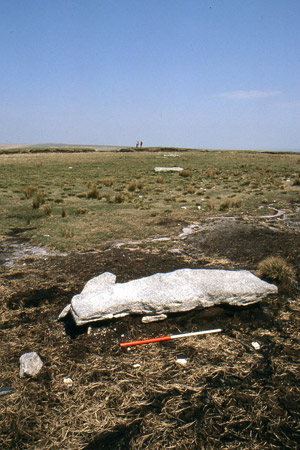
LITTERED across the hills of Dartmoor in Devon, southern England, around 80 rows and circles of stones stand sentinel in the wild landscape. Now, striking similarities between one of these monuments and Stonehenge, 180 kilometres to the east, suggest they may be the work of the same people. The row of nine stones on Cut Hill was discovered in 2004 on one of the highest, most remote hills of Dartmoor national park. “It is on easily the most spectacular hill on north Dartmoor,” says Andrew Fleming, president of the Devon Archaeological Society. “If you were looking for a distant shrine in the centre of the north moor, that’s where you would put it.” Ralph Fyfe of the University of Plymouth and independent archaeologist Tom Greeves have now carbon-dated the peat surrounding the stones. This suggests that at least one of the stones had fallen – or been placed flat on the ground – by between 3600 and 3440 BC, and another by 3350 to 3100 BC (Antiquity, vol 84, p 55). That comes as a surprise to archaeologists, who, on the strength of artefacts found nearby, had assumed that Dartmoor monuments like Cut Hill and Stall Moor (pictured) dated from the Bronze Age, around 2100 to 1600 BC. Instead, Fyfe suggests that Cut Hill is from the Neolithic period, the same period that Stonehenge was built. Unlike Stonehenge, the 2-metre-tall Cut Hill stones lie flat on the ground, parallel to each other and between 19 metres and 34.5 metres apart, like the sleepers of a giant railway track. Packing stones discovered at the end of one of the megaliths suggest at least one of them stood erect at some point, but the regularity of their current layout makes it likely they were deliberately placed that way, Greeves says. What’s more, the stones’ alignment with the summer and winter solstices seems identical to that of Stonehenge, Newgrange in Ireland and Maes Howe in Scotland. “It could be coincidence, but it’s striking,” says archaeologist Mike Pitts.

Merlin @ Stonehenge
The Stonehenge Stone Circle website


The word ‘HENGE’ – What does it mean ?

12 04 2010
Dictionary meaning:
Henge definition
henge (henj)
noun
a Neolithic or Bronze Age monument of the British Isles, consisting of a circular bank or ditch enclosing, variously, stone or timber uprights, burial pits, etc.

What is a ‘Henge’ monument

Stone Henge – What is one?

Definition:

A henge is the term given to a large prehistoric earthwork, usually but not always circular, whether of stones, wood, or earth.

This word, interestingly, is a back-formation from Stonehenge. Additionally some spell it stone henge or stonehedge even though that is incorrect. Stonehenge was the Saxon name for the famous monument on the Salisbury plain, and the “henge” part is Old English for “hang,” not earthwork. Nonetheless, the term henge is in wide use in both popular and scientific literature to refer to megalithic monuments of the Neolithic and Bronze ages.

Whether you are thinking stone henge or Stonehenge, both are basically Megaliths. Megaliths are single large stones, or a group of “standing stones” usually arranged in a circular or semi-circular formation, and that archaeologists believe were religious temples or monuments. The earliest sites are thought to date back to the millenia. The word, “megalith” itself has Greek origins: “mega” meaning “great” and “lithos” meaning “stone”. Certain megalith sites, and there are thousands of them all around the world, were also known burial sites. England seems to have the greatest concentration of megaliths that carry names like Avebury, the Hurlers, the Merry Maidens, and the Rollright Stones. The most famous of these is, of course, Stonehenge.

People do commonly mistake the words stone henge for Stonehenge and should learn the difference so they may find the correct information.

Comments:
Titchmarsh on Telly the other evening in a prog on English buildings started with Stonehenge.
The ‘expert’ stated that the ‘henge’ element of the name ‘stonehenge’ meant, or referred to, the ditch and embankment surrounding Stonehenge.
I have always believed that ‘henge’ meant ‘hanging; ‘thus ‘Stonehenge means ‘hanging stones.’
That is ‘hanging,’ not in the sense of gallows where people were hung but, meaning ‘stones that appear to be suspended.’

The original sense is a difficult one to call: henge is obviously related to hangan. It could mean that even in ASJ times, some of the stones were leaning over (they were straightened dramatically in th C20th), or might be related to ME henge in the sense of “hinge” — possibly referring to the mortise-and-tenon joints. There again, “stone gallows” is a good description — ASJ gallows were two posts and an crossbeam , and we know it *was* used as a cwealmstow.
“Henge” was subsequently appropriated by the archæology-Johnnies to mean a monument with a ditch and bank like Stonehenge — though ironically, Stonehenge itself is no longer deemed to be a “henge” because the ditch is inside the bank…

The original sense is a difficult one to call: henge is obviously related to hangan. It could mean that even in ASJ times, some of the stones were leaning over (they were straightened dramatically in th C20th), or might be related to ME henge in the sense of “hinge” — possibly referring to the mortise-and-tenon joints. There again, “stone gallows” is a good description — ASJ gallows were two posts and an crossbeam , and we know it *was* used as a cwealmstow.
“Henge” was subsequently appropriated by the archæology-Johnnies to mean a monument with a ditch and bank like Stonehenge — though ironically, Stonehenge itself is no longer deemed to be a “henge” because the ditch is inside the bank…

Merlin @ Stonehenge
Stonehenge Stone Circle


Druids reburial appeal rebuffed

12 04 2010

Druids have lost a bid to have an ancient skeleton which was unearthed in Wiltshire reburied at one of the county’s most famous stone age sites.

The Council of British Druid Orders told an official consultation that the body of a neolithic child, found in 1929, should be reinterred at Avebury.

The druids contend that the remains which are on display in the village need to be treated with more respect.

But English Heritage, which owns the site, says the bones should be on show.

They say the public interest in viewing the skeleton – which is about 3,700 years old – outweighs the druids’ arguments.

Cultural link

The druids say the remains of the child, known as Charlie, should be reinterred within Avebury’s stone circle out of respect for the dead.

The Order says it has taken up the case because it feels it has a cultural link with pagan ancestors in the British Isles.

It is not known if Charlie, who was about three years old, was a boy or girl.

The remains were found at Windmill Hill, near Avebury, by eminent archaeologist Alexander Keiller. They are currently housed at the Alexander Keiller Museum.

Merlin @ Stonehenge
Stonehenge Stone Circle


Durrington Walls, Wiltshire: Walk of the week

13 03 2010

The first of our new series of weekly walks, provided by the National Trust, is a ramble around mysterious Durrington Walls in Wiltshire, with views towards Stonehenge.

View Durrington Walls: Walk of the week in a larger map
THE EXPERT’S VIEW

Mike Dando, Head Warden: “The walk starts at the largest henge monument in the country and takes you past ancient monuments such as Round Barrows and the ‘Cuckoo Stone’ where it is easy to imagine the landscape as it was some 4,000 years ago. The walk takes in beautiful grazed grassland, strips of mature Beech trees and offers fantastic views across the Stonehenge Landscape.

Download an OS map of this walk

“My favourite part of this walk would have to be walking past the New King Barrows, the large Bronze Age burial mounds. A stop here on a warm summers’ day, listening to the skylarks and the beech leaves rustling, is hard to beat, especially on top of the view over to Stonehenge itself.

“Unique to this walk is the sense of being in an ancient and sacred place; the combination of the natural and historic sights is simply spectacular. My top tip for first time walkers would be to bring binoculars to take in the wildlife and views.”

ESSENTIALS
Start: Woodhenge car park
Grid ref: SU151434
Map: OS Landranger 184

Getting there
Bike: National Cycle Network route 45 runs south-east of the property. See http://www.sustrans.org.uk

Bus: Wilts & Dorset 5 or 6, between Salisbury, Pewsey, Marlborough and Swindon. Service 16 from Amesbury, request stop at Woodhenge

Rail: Salisbury station, 9 miles from Woodhenge car park

Road: Woodhenge car park is 1¾ miles north of Amesbury, follow signs from A345

Distance, terrain and accessibility

4 mile (6.4km) across open access land, including Rights of Way, with gates, at several points. The ground is uneven in places, with a few short, steep slopes. Sheep graze the fields and there are ground-nesting birds, so please keep dogs under control.

Local facilities
Picnic area (not NT) and information panel at Woodhenge car park
WCs
Outdoor café
Picnic area (not NT) at Stonehenge car park, 0.75 miles from this walking route.
THINGS TO LOOK OUT FOR

Durrington Walls: The largest complete henge in Britain is 500m in diameter and encloses a natural valley. It once contained timber circles and what appear to have been shrines. The area outside the ditch and bank was once a settlement, perhaps containing hundreds of houses, making Durrington Walls potentially the largest village in north-west Europe at the time. People travelled for miles to feast and take part in ceremonies, probably at the midwinter solstice. Woodhenge stood nearby as an impressive timber circle surrounded by a bank and ditch.

The Cuckoo Stone: This standing stone now lies on its side, but over millennia it has been a focus for Bronze Age urn burials, an Iron Age boundary line and Roman remains. It is made of sarsen, a kind of sandstone, the same as the largest stones in the Stonehenge stone circle. The reason for its name remains a mystery.

The Stonehenge Avenue: A two mile long ceremonial way linking Stonehenge with the River Avon and crossing King Barrow Ridge. Interestingly, Durrington Walls is also connected to the river, leading experts to believe the Avon symbolically linked the two monuments, forming part of a ritual journey; maybe leading to the afterlife.

DIRECTIONS

Download an OS map of this walk

1. At Woodhenge car park, go through the gate nearest to you and into a field. Walk downhill into Durrington Walls (taking care of rabbit holes).

2. At the centre of Durrington Walls, looking around you, you can appreciate the nature of the henge as an enclosed valley. Standing here 4,500 years ago, you would have been viewing several “shrines” around the slopes. Next, turn left and walk to the corner of this field. Pass through gates either side of the road, heading towards a low rock.

3. The Cuckoo Stone is one of very few stones in the area that is made from sarsen – most local rock is chalk or flint. From here, continue forwards to the next gate.

4. You are now on the route of the old military railway between Amesbury and Larkhill; turn right and follow the path.

5. When you reach a crossroads and National Trust sign to King Barrow Ridge, turn left and follow the shaded bridleway.

6. At the junction, turn right through a gate to continue along the ridge, crossing the Stonehenge Avenue on your way to a line of 200-year-old beech trees and a fine view of Stonehenge. At winter solstice, Neolithic people may have marked the occasion of the midwinter sunset at Stonehenge, before travelling to Durrington Walls to celebrate the new sunrise.

7. Continue forward to New King Barrows, a fine row of Early Bronze Age burial mounds, originally capped in white chalk so they would have been visible from a far distance. Return to point 6, turn right and follow the stony track to point 8.

8. Take a left turn through a gap in the hedge, to join the old military railway once more. This leads back to the gate in the corner of the Cuckoo Stone field.

9. Head across the grassland to Woodhenge and back to Woodhenge car park.

STONEHENGE STONE CIRCLE