Stonehenge archaeologists reveal global warming theory behind crashed UFO remains

8 10 2010

Stonehenge, Wiltshire – (TinFoilHat Mess): Archaeologists excavating Stonehenge have found the remains of a pre-Atlanis era UFO which may have crashed during a flight from the Lunar base discovered by the moon-walking astronuts of the Apollo mission.

Stonehenge Quarantined

Stonehenge Quarantined

Much of the craft is believed to be intact with little corrosion to the mystery amalgam which makes up 90% of its structure.

Professor Tim Darvill of the Search for Extraterrestrial Intelligence (SETI) team that made the discovery said today that the next stage of the tricky operation would be entering the ancient craft and locating its cryogenic freezer units. ”

At this stage we don’t know if anything actually works inside,” Darvill commented, “but fingers crossed – we might be able to do a bit of thawing. “Without this intervention we’d have to wait for the natural phenomenon known as Global Warming to dictate the delicate process of unfreezing these alien remains.

 “Unfortunately we can’t wait that long. So our plan is to gently resurrect some of this advanced species – no blowtorches, microwaves or thermic lances, please chaps! – as well as any embryos and/or frozen infant offspring who clearly came here to seed our planet.” If the operation is successful the next stage will involve specialist scientists who are familiar with alien parenting techniques.

Professor Geoff Wainwright of the Yearling Extraterrestrial Intelligence (YETI) team in London’s Royal Freak Hospital will then take over while the Stonehenge site is quarantined.
Operation Homo erectus is being hailed as a triumph.

Now thats a story……………
Merlin @ Stonehenge Stone Circle


Stonehenge was not made from Preseli bluestones

6 10 2010

In the third of a series of Western Mail articles by speakers at this year’s Do Lectures, geologist and author Brian John debunks the ‘bluestone myth’ – the idea that prehistoric people travelled hundreds of miles in order to drag gigantic stones toSalisbury Plain 

THIS story is about the heroic neolithic tribesmen carrying scores of giant stones from the Preseli Hills to Stonehenge has now entered into British mythology. It has become gradually clearer, over the last decade or two, that there is no evidence to support this story. I want to inspire people to think very carefully about some of the myths that we as a community sign up for. 

A whole story has been developed over the years about this heroic human venture of tribesmen coming all the way to the Preselis to pick up the bluestones from a quarry – and then to carry those 80 stones all the way back to Stonehenge where they were going to be used as part of this amazing new monument. That has become a part of British mythology but is widely accepted as fact. It has become an immensely valuable story commercially for British tourism – a million people visit Stonehenge each year and nearly all of them are familiar with this heroic tale. That tale is used quite cynically, quite deliberately, by English Heritage and almost every other organisation that has anything to do with tourism in the promotion of Stonehenge, as a means of attracting even more visitors there 

The Questions? 

What I am trying to do is stand back from all that and question: what exactly is the evidence in support of this wonderful story?  When you start to dig a little bit you find that actually there is no evidence at all.  It is entirely a myth which was invented in 1922, immediately after the First World War. The myth received instant acceptance on the part of the British public because there was a desperate need for a feel-good factor after the war – national pride had been dented, the economy was in tatters and everybody needed a good news story. 

The story was invented by a Welsh geologist, Herbert Thomas. He gave a lecture which had purported to demonstrate that a lot of the bluestones had come from the Preselis. His geology was reasonably accurate. He was intent on telling this story of human transport.
His theory, once he had propounded it, was instantly grabbed hold of by everybody. It was a wonderful tale that showed us just how clever our neolithic ancestors were and they were a damn’ sight more clever than those ancestors on the Continent – especially in Germany. There was almost a strong, almost xenophobic element about this propaganda. 

No-one questioned this theory or seriously investigated it. 

It was just blown up from that point on. It has become one of the key beliefs of Britain, in the same way we believe about King Arthur and Glastonbury and Robin Hood in Sherwood Forest. It is now a part of British mythology. 

There is no evidence that the stones were taken from this so-called neolithic quarry at Carn Meini. In fact, there is no evidence of the quarry at all.  The stones which are supposed to have come from that one source actually came from many other places.  As the geology has advanced, with a lot of work from the Open University and many other geologists, we now know that the stones came from at least 20 other places. They haven’t come from the eastern end of the Preselis at all.  We know that at least two of the stones have come from the Newport area, quite possibly on the North Pembrokeshire coast. Another stone has come from the Brecon Beacons and some stones seem to have come from the Fishguard area. 

What the geologists say 

It was already known by some geologists in 1922 that during the Ice Age there had been an enormous glacier which had flowed across Pembrokeshire and had actually flowed up the Bristol Channel and into the coastlands of Somerset, Devon and Cornwall – we still don’t know how far east that glacier went, but it certainly did cross the Bristol Channel pressed up across the English coasts. A number of these old geologists had demonstrated this pretty clearly, but for reasons that I still don’t fully understand, Thomas in 1922 totally dismissed this theory in favour of his human transport theory. And still nobody has ever found any evidence as to how exactly the stones were moved, although of course there is endless speculation about it. There are literally thousands and thousands of pages on the internet devoted to precisely this question.  We should give more credence to scientific evidence and keep myths in the places they belong, namely mythology, and don’t let’s pretend that myths are telling us anything concrete about what happened in the past. 

The problem for archaeolo- gy is it has become involved in pedalling myths and seems to have lost its respect for evidence on the ground. People are so obsessed with making blockbuster TV programmes, for example, with support from National Geographic magazine and the Smithsonian Institute, that actually the archaeologists seem to be trying to out do each other on how spectacular their stories are. It has all become a little bit absurd. 

When we look at the hard science behind the bluestones story, there is quite a lot of evidence to support the idea that the bluestones at Stonehenge are no more than glacial erratics that were transported by the ice, maybe 450,000 years ago and then picked up somewhere in the Salisbury Plain in the East Somerset area – probably within easy striking distance of Stonehenge and that is where they were picked up from. 

The whole of the Stone- henge story is a complete fabrication. 

I have just put up a YouTube video called StoneHenge Unhinged in which I show that Stonehenge was probably never even finished. We have these wonderful reconstructions of Stonehenge, showing this incredible geometric arrangement of stones, and all the archaeologists and astronomers say this was a highly sophisticated astronomical observatory etc, but actually there is no evidence that it was ever finished. 

I think it was just an experiment. They tried to build something that was really rather ambitious but they really didn’t have enough stones to finish it. On the ground about half of the monument has never been excavated and 67 of the stones are totally missing, but people have just imagined that they were there without having any evidence to support that idea. 

Stonehenge has become a national icon and a key part of mythology with immense commercial value attached to it. Over and over again, people talk about the magical serenity of Stonehenge and the great feeling of power it gives you – which is wonderful, but I think people have been brought up to have this reverence for Stonehenge because it is such an iconic structure and that in itself creates a feeling of religious esteem or spirituality. 

I’m not saying Stonehenge is not wonderful. It is quite inspirational in the sense that it was a brave enterprise. The stones that are there are not very accurately placed and a lot of them are pretty rough and I think were just placed there as part of an ambitious building project

If you want to here all the theories why not organise a ‘Stonehenge special access’ tour with the English Heritage.  This enables you to go beyiond the fences before or after its open to the public.  The Stonehenge Tour Company and Histouries UK, based in Salisbury and Bath offer a ‘Rent a guide’ service. Salisbury guided Tours also offer specail access tours from Salisbury

Merlin @ Stonehenge
The Stonehenge Stone Circle Website 


Archaeologists debate Stonehenge future

5 10 2010

LEADING archaeologists got together at Salisbury & South Wiltshire Museum on Saturday for a Solve Stonehenge debate.

Professor Tim Darvill, Professor Mike Parker Pearson, Mike Pitts and Julian Richards, who have all directed work within the Stonehenge landscape over the last 30 years, were kept in order by Andrew Lawson as they shared their expertise, discussing such questions as Did Stonehenge have a roof?, Which is more important, Durrington Walls or Stonehenge? and Who built Stonehenge?.

The debate was part of a weekend conference to celebrate the museum’s 150th anniversary.

Merlin @ Stonehenge
The Stonehenge Stone Circle Website


Stonehenge a monumental attraction since prehistory

1 10 2010

Stonehenge may have been a top international tourist attraction in prehistoric times – just as it is today.

 Ongoing scientific research suggests that around 30 per cent of the wealthiest individuals buried around the neolithic and Bronze Age temple came from hundreds and, in some cases, thousands of miles away.

 Recent isotopic tests carried out by the British Geological Survey and announced yesterday reveal that one very high-status individual – a teenage boy – found buried near Stonehenge, had in fact come from somewhere along the north coast of the Mediterranean, potentially Spain, southern France or Italy.

 Another individual, whose origins were revealed a few years ago, came from the Alps – and others came from Brittany (or possibly Wales).

 The Alpine individual suffered from a painful leg condition and the Mediterranean teenager died aged 14 or 15 and is likely therefore to have also suffered from serious illness.

 Some archaeologists have therefore begun to speculate that Stonehenge attracted health tourists who went there to be cured – and ended up being buried there instead.

 Interestingly, a healing function for Stonehenge is hinted at by Arthurian legend, which holds that the monument was indeed an ancient healing centre. Even as late as the 18th century, the stones of Stonehenge were regarded as having magical healing powers – and visitors to the site often chipped bits off to take away as talismans.

 Certainly the monument was internationally known in ancient times – and appears to have been described by a fourth-century BC Greek geographer, centuries after it had actually gone out of use.

 Stonehenge’s international visitors were extremely wealthy. The Alpine man was buried with gold and copper objects – including three copper daggers and a pair of gold hair clasps.

 The Mediterranean teenager was buried wearing a necklace of around 90 amber beads.

 “Isotopic analyses of tooth enamel from both these people shows that the two individuals provide a contrast in origin, which highlights the diversity of people who came to Stonehenge from across Europe,” said Professor Jane Evans, head of archaeological science at the British Geological Survey.

 Merlin @ Stonehenge
The Stonehenge Stone Circle Website


Stonehenge boy ‘was from the Mediterranean’

29 09 2010

Chemical tests on teeth from an ancient burial near Stonehenge indicate that the person in the grave grew up around the Mediterranean Sea.
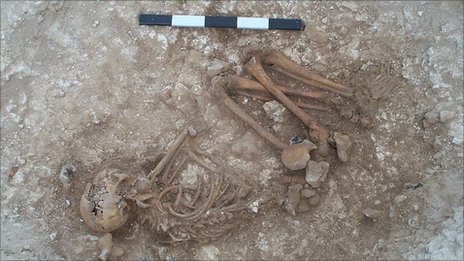
 

The bones belong to a teenager who died 3,550 years ago and was buried with a distinctive amber necklace.

 “The position of his burial, the fact he’s near Stonehenge, and the necklace all suggest he’s of significant status”

End Quote Professor Jane Evans British Geological Survey

The conclusions come from analysis of different forms of the elements oxygen and strontium in his tooth enamel.


Analysis on a previous skeleton found near Stonehenge showed that that person was also a migrant to the area.

 The findings will be discussed at a science symposium in London to mark the 175th anniversary of the British Geological Survey (BGS).

The “Boy with the Amber Necklace”, as he is known to archaeologists, was found in 2005, about 5km south-east of Stonehenge on Boscombe Down.

 The remains of the teenager were discovered next to a Bronze Age burial mound, during roadworks for military housing.

“He’s around 14 or 15 years old and he’s buried with this beautiful necklace,” said Professor Jane Evans, head of archaeological science for the BGS.

 “The position of his burial, the fact he’s near Stonehenge, and the necklace all suggest he’s of significant status.”

 Dr Andrew Fitzpatrick, of Wessex Archaeology, backed this interpretation: “Amber necklaces are not common finds,” he told BBC News.

“Most archaeologists would say that when you find burials like this… people who can get these rare and exotic materials are people of some importance.”

 Chemical record

Professor Evans likened Stonehenge in the Bronze Age to Westminster Abbey today – a place where the “great and the good” were buried.

 Tooth enamel forms in a child’s first few years, so it stores a chemical record of the environment in which the individual grew up.

Amber beads (BGS) The amber to make the beads almost certainly came from the Baltic Sea

Two chemical elements found in enamel – oxygen and strontium – exist in different forms, or isotopes. The ratios of these isotopes found in enamel are particularly informative to archaeologists.

Most oxygen in teeth and bone comes from drinking water – which is itself derived from rain or snow.

In warm climates, drinking water contains a higher ratio of heavy oxygen (O-18) to light oxygen (O-16) than in cold climates. So comparing the oxygen isotope ratio in teeth with that of drinking water from different regions can provide information about the climate in which a person was raised.

Most rocks carry a small amount of the element strontium (Sr), and the ratio of strontium 87 and strontium 86 isotopes varies according to local geology.

The isotope ratio of strontium in a person’s teeth can provide information on the geological setting where that individual lived in childhood.

By combining the techniques, archaeologists can gather data pointing to regions where a person may have been raised.

Tests carried out several years ago on another burial known as the “Amesbury Archer” show that he was raised in a colder climate than that found in Britain.

Analysis of the strontium and oxygen isotopes in his teeth showed that his most likely childhood origin was in the Alpine foothills of Germany.

Stonehenge People were visiting Stonehenge from afar during the Bronze Age

“Isotope analysis of tooth enamel from both these people shows that the two individuals provide a contrast in origin, which highlights the diversity of people who came to Stonehenge from across Europe,” said Professor Evans.

 The Amesbury Archer was discovered around 5km from Stonehenge. His is a rich Copper Age or early Bronze Age burial, and contains some of the earliest gold and copper objects found in Britain. He lived about 4,300 years ago, some 800 years earlier than the Boscombe Down boy.

 The archer arrived at a time when metallurgy was becoming established in Britain; he was a metal worker, which meant he possessed rare skills.

 “We see the beginning of the Bronze Age as a period of great mobility across Europe. People, ideas, objects are all moving very fast for a century or two,” said Dr Fitzpatrick.

 “At the time when the boy with the amber necklace was buried, there are really no new technologies coming in [to Britain]… We need to turn to look at why groups of people – because this is a youngster – are making long journeys.”

 He speculated: “They may be travelling within family groups… They may be coming to visit Stonehenge because it was an incredibly famous and important place, as it is today. But we don’t know the answer.”

 Other people who visited Stonehenge from afar were the Boscombe Bowmen, individuals from a collective Bronze Age grave. Isotope analysis suggests these people could have come from Wales or Brittany, if not further afield.

 Merlin @ Stonehenge
The Stonehenge Stone Circle Website
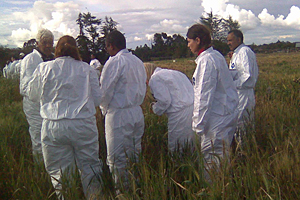


Solving Stonehenge – The experts gather……….

23 09 2010

LEADING experts on Stonehenge will be gathering in Salisbury to debate the monument’s purpose next weekend.

The event, called Solving Stonehenge, is part of Salisbury & South Wiltshire Museum’s 150th anniversary conference on October 2 and 3, 2010

The main speakers will be Professor Tim Darvill, Professor Mike Parker Pearson, Mike Pitts and Julian Richards.

The debate will be chaired by Andrew Lawson.

Museum director Adrian Green said: “This is the first time that all the leading Stonehenge archaeologists have been gathered together for a public debate in recent times.

“With all their conflicting opinions about the role of the monument, and the opportunity for the public to quiz the archaeologists, this promises to be a thought-provoking event.”

There will also be a paper about recent survey work at Stonehenge by English Heritage archaeologist David Field on Saturday afternoon and a tour of the Stonehenge landscape on Sunday afternoon.

Stonehenge has been a vital part of the history of Salisbury Museum. The first official guidebook to the stones was written by former curator and director Frank Stevens in 1916.

The museum’s collections contain finds from every major excavation at the site, and since Victorian times it has had permanent displays about the monument.

Tickets for the whole conference, including a buffet, are £60 for members and £75 for non-members. Separate tickets for the Stonehenge debate are £15.
Tickets on 01722 332151          museum@salisburymuseum.org.uk // <![CDATA[
document.write( '‘ );
// ]]>This e-mail address is being protected from spambots. // <![CDATA[
document.write( '’ );
// ]]>
For media enquiries speak to Administration and Marketing Officer Sara Willis.

See you there………

 Merlin @ Stonehenge
The Stonehenge Stone Circle Website


Secret Sounds of Stonehenge

30 08 2010

Trevor Cox reveals how the acoustic footprint of the world’s most famous prehistoric monument was measured 

 Echoes of the past: The sites and sounds of prehistory Just after sunrise on a misty spring morning last year, my fellow acoustician at the University of Salford, Bruno Fazenda, and Rupert Till of the University of Huddersfield, UK, could be found wandering around Stonehenge popping balloons. This was not some bizarre pagan ritual. It was a serious attempt to capture the “impulse response” of the ancient southern English stone circle, and with it perhaps start to determine how Stonehenge might have sounded to our ancestors. An impulse response characterises all the paths taken by the sound between its source – in this case a popping balloon – and a microphone positioned a few metres away. It is simply a plot of the sound pressure at the microphone in the seconds after the pop. The first, strongest peak on the plot represents the sound that travelled directly from the source to the microphone. Later, smaller peaks indicate the arrival of reflections off the stones. The recording and plot shows the impulse response Bruno and Rupert measured with a microphone positioned at the centre of Stonehenge and a popping balloon at the edge of the circle. This impulse response represents an acoustic fingerprint of the stones. Back in the lab, it can be used to create a virtual rendition of any piece of music or speech as it would sound within the stone circle. All that is needed is an “anechoic” recording of the raw music or speech – a recording made in a reflection-free environment such as the open air or, better, a specialist anechoic chamber such as we have at Salford. The anechoic recording and the impulse response can then be combined using a mathematical operation called convolution. We’ve done with with a recording of drumming: here is the anechoic original, and here it is convolved with the measured impulse response of Stonehenge. The difference is easily appreciable: there is more reverberation or ringing to the drumming sound thanks to the reflections off the stones. What’s more, the tonal balance of the sound is entirely different: it has become much deeper, as if the treble has been turned down.

Replica henge The popping of a balloon is not the standard or best way to measure an impulse response, but more sophisticated equipment was not allowed at Stonehenge. At a full-size replica of the monument at Maryhill, Washington state, however, Bruno and Rupert were able to use powerful loudspeakers and special test signals to get more accurate results. Maryhill also has the advantage that it is complete, whereas some of the stones of Stonehenge have fallen or disappeared over the years. That makes a noticeable difference to the drum sounds convolved with Maryhill’s impulse response: the more complete stone circle makes the sound echo for longer, with the extended reverberation being most noticeable after the last drum. Over many decades, a sophisticated understanding of how to interpret impulse responses has been built up. For example, we now know how features within the impulse response, such as the time it takes for reverberations to die away, relate to peoples’ perceptions of the nature of the sound. The hope is that by applying that expertise to ancient monuments such as Stonehenge, we can better appreciate their acoustical effects on our ancestors –and perhaps begin to answer the question whether these effects were the product of accident or design.

Sounding stones

We also know that our ancestors appreciated their ability to exploit their environment to make sound early on. The discovery of three flutes in 2009 in a cave in south-west Germany, the best preserved of them made from a vulture’s wing bone and containing five finger holes, pushes the origins of music back to the middle Palaeolithic era, 40,000 years ago.

Lithophones or rock gongs- stones that create a tone when hit- are found around the world. A cave at Fieux à Miers in the Midi-Pyrénées region of the south of France contains a 2-metre-tall feature which resonates like a gong when struck. Recalcified fractures on the lithophone indicating where it was struck can be dated back to the upper Palaeolithic, around 20,000 years ago (Oxford Journal of Archaeology, vol 4, p 31). Outdoor examples include Kupgal Hill in Karnataka state, southern India, where an outcrop of dolerite boulders emits loud ringing tones when hit with granite stones. Nicole Boivin of the University of Oxford suggests that shamans might have used the rock gongs during formal rituals. Dating the wear marks in boulders is impossible, but the presence of Neolithic rock art indicates that the site was used for many thousands of years (Antiquity, vol 78, p 38).

Imagery such as cave paintings, markings or etchings also provides tantalising clues to how prehistoric humans might have exploited their surroundings to make sound. Iegor Reznikoff of Nanterre University, Paris, has examined the caves of Rouffignac in the south of France and showed that paintings are located where the most interesting sound effects are heard. Devereux, in his book Stone Age Soundtracks, cites numerous other examples around the globe of seemingly premeditated placing of petroglyphs or pictographs, including sites where art is painted on concave rock walls that give distinct echoes.

Merlin @ Stonehenge
The Stonehenge Stone Circle Website


‘Fantastic’ dig ends at Marden Henge in Wiltshire

9 08 2010

A 4,500 year-old dwelling was uncovered at the dig
Excavation work has finally come to an end at prehistoric site, Marden Henge near Devizes.

It was the first investigation of the site since 1969.

Marden Henge no longer has any standing stones and is said to be one of Britain’s least understood ancient sites.

The dig, which began six weeks ago, uncovered all manner of neolithic treasures including a 4,500-year-old dwelling as well as pottery, flint and bones.

Archaeologist Jim Leary from English Heritage said the findings were very significant.

“The level of preservation is just phenomenal,” he said.

“We don’t have a comparison in England. We could never have imagined we would come across this.”

The level of preservation is just phenomenal. We don’t have a comparison in England. We could never have imagined we would come across this

Jim Leary, English Heritage
The world’s media has descended on the site throughout the duration of the excavation work.

Jim said: “It’s fantastic and I think it really shows how people are engaged with their heritage and their land. It’s really important at this time that archaeology can engage people and give something back.

“As archaeologists, we have to let people know what we’ve found. We’re doing this for the public, we’re telling them all about it, and that’s why archaeology is so important.”

Fellow English Heritage archaeologist, Paddy O’Hara said of the building they uncovered: “It’s just unparalleled. I’ve never seen anything like it at all apart from Skara Brae in the Orkneys. The preservation of this building is just superb.

“I was here about a fortnight ago and I was, quite frankly, sort of sceptical. People were saying ‘oh, maybe there’s a building here’, but I really wasn’t convinced.

“Just walking up here now, the thought that I could have missed this would have been heartbreaking, as it’s just a fantastic bit of archaeology.

“It’s really, utterly fabulous.”  HisTOURies UK – Tour Guide

Merlin @ Stonehnege
The Stonehenge Stone Circle Website


Stonehenge twin – ‘Timberhenge’ – discovered with radar imaging

27 07 2010

Stonehenge wasn’t the only mammoth circle in southern England 5,000 years ago. Using new radar imaging equipment, scientists have identified what was once a nearby circle of huge timbers.

Stonehenge, the mysterious circle of mammoth stone pillars in the middle of the English countryside, now has a slightly smaller twin.

//

Chart: Wooden ‘sister’ of Stonehenge discovered

Graphic News


//

Scientist have discovered a second henge formation that once existed nearby made from huge timbers.

And there could be many more henge-type circles yet to be found in the vicinity, says archeologist Vince Gaffney of the University of Birmingham, which is leading an expedition of the site along with the Ludwig Boltzmann Institute of Austria.

“We didn’t expect to find another henge. There’s always been some presumption that the stones existed in splendid isolation,” Professor Gaffney says.

On July 16, just two weeks into their four-year project, Gaffney’s team discovered ‘Timberhenge,’ a 25-meter (82-foot) diameter, circular series of holes that were once filled with 24 huge wooden poles. It sits about 900 meters away from Stonehenge in southern England.

“Stonehenge isn’t the only henge monument in the area. There are several in the immediate vicinity,” says Dr. Gaffney, reached by phone today from Stonehenge.

‘Henge’ refers to a circular ditch with an external bank from the Neolithic period.

Archaeology without a shovel

Notably, not a bit of earth was dug up to make the discovery.

Gaffney’s ground-mapping project uses radar-imaging equipment, which is placed a wheels and pulled over the fields surrounding Stonehenge. His team plans to scan a 14-square-kilometer (nearly 9 mile) area at a cost of $500,000 to $1 million.

“We will not dig anything. The technologies we use will allow us to look at volumes of soil,” he says.

The new Timberhenge appears built on the same orientation as Stonehenge, with entrances to the northeast and southwest. Archaeologists say it was a worshipping site and burial ground, but Gaffney says the precise role of the structures remains unclear: Was it for commoners or tribal leaders, worshippers or religious leaders?

The radar-imaging project will provide a map of the area’s structures and a clearer idea of its size and functions.

Scientists have repeatedly unearthed new finds at Stonehenge.

In October 2009, the Stonehenge Riverside Project uncovered a 10-meter (33-foot) diameter stone circle of bluestones, brought from the Preseli mountains of Wales, 150 miles away, and dubbed ‘Bluestonehenge.’ The stones, now missing, once marked the end of an avenue that leads from the River Avon to Stonehenge, a nearly 2-mile-long processional route constructed at the end of the Stone Age.

Another Woodhenge

Nor is this the first wooden henge found in the area. Two miles northeast of Stonehenge sits the so-called ‘Woodhenge,’ a six-ringed circle of 168 timber holes identified in 1925. Another timber circle nearby was identified in 1966.

But Mike Parker Pearson of the University of Sheffield, director of The Stonehenge Riverside Project, says it’s premature to describe this latest find as another “Woodhenge.”

“No one has any idea if these were circles of posts, stones or just pits. Nor do we know what date they are other than broadly 3000-1500 BC. They are both great finds but we know too little about them as yet (without excavation) to say how they will change our understanding,” he says via email. “As we found last year with Bluestonehenge, there is still much to be found around Stonehenge.”

Gaffney agrees that much remains unknown.

“Despite the fact that this is probably the most studied landscapes in the world…we know nothing about it,” says Gaffney. “Having said that, we felt we needed to know much more about what was happening between the monuments to know how it’s organized.”

On Thursday, however, southern England’s summer rains had delayed further scans of the area, and sent Gaffney running for shelter in a car.

“It’s raining heavily, so we’re not doing anything at the moment,” he told the Monitor. “It’s a British summer: what do you expect?”

Merlin @ Stonehenge
The Stonehenge Stone Circle Website


How significant is the ‘new henge’?

27 07 2010

Stonehenge (Image: AFP) What does the new finding reveal about the famous world heritage site?

A major survey of the Stonehenge landscape started last week, and today we learn that archaeologists have found another henge.

This is a three-year project, so by 2013 there could be quite a list of new discoveries.

 Mike Pitts, editor of British Archaeology magazine

I am quite sure something else of at least equal interest will emerge before the three years are up”

Is this real? Do we know as little about the famous world heritage site as this seems to imply? Or is it another hyped science story that will vanish with the dawn?

 Let’s start with the new henge. Yes, it is a significant find, and my archaeological colleagues are already e-mailing each other with tempered excitement.

 The first thing to ask is, is it a henge? It might well be, but without excavation we cannot know – and it all depends what you mean by “henge”.

 Technically, a henge is a roughly circular space enclosed by an earthwork, distinguished by a ditch lying within a bank (rather than the other way around, which would make it a fort).

 However, that definition actually excludes Stonehenge from the class, and the word has come to be used loosely to describe any circular ritual site in Britain dating from the late Neolithic or copper age (3,000-2,000BC).

 A few of these had standing stones, but more common were rings of oak posts, sometimes several inside each other on a very large scale. It is this type of site that Vince Gaffney is claiming to have found.

 He might well be right. The geophysics plot seems to show a circle of some 24 postholes within two arcs of 10 or so large pits.

 These pits might have themselves held large posts. They might indeed have held megaliths (nearby “Bluehenge”, a 10m-diameter circle of 25 stone pits, was unexpectedly discovered by excavation only last year).

 But they might just be very big pits: there is a henge in Dorchester, Dorset, known as Maumbury Rings, that fits that description.

Artist's impression of a structure discovered by archaeologists studying the land surrounding Stonehenge (Image: University of Birmingham) Only detailed excavation will reveal the true importance of the discovery

On the other hand, the site could be something quite different. It was previously known as a ploughed-out burial mound or barrow of probable bronze age date (2,000-1,200BC).

 It may still be that, but with an unusual ditch or pit arrangement around it (in which case, the large pits would be quarries for a mound in the centre rather than a bank on the outside).

 This is after all close to Stonehenge, and the landscape is famous for the large number and unusual qualities of these barrows.

 So perhaps a henge, perhaps not, but an important discovery whose significance will be fully realised only with excavation.

 As to why archaeologists did not know about such a monument so close to Stonehenge, there are two main reasons.

 The landscape is extensive and fieldwork is slow and expensive. Most archaeologists are working with very small budgets – in the past, many were not paid at all.

 So archaeologists focused their attention where they knew there was something to be found. Until recently, there was endless excavation at Stonehenge itself, and almost none beyond. Inevitably, this had the effect of convincing some people that there was nothing else to find elsewhere.

 On the other hand, the science of archaeological fieldwork is advancing fast. Professor Gaffney and his colleagues from the University of Birmingham, and the Ludwig Boltzmann Institute for Archaeological Prospection and Virtual Archaeology in Vienna, are pioneering highly sophisticated survey equipment and software.

It is the extremely high resolution of the survey data that has allowed this “henge” to have been found.

So it is an important discovery that comes about because archaeology is learning new tricks. I am quite sure something else of at least equal interest will emerge before the three years are up. Who knows? As I am typing these words, the team is out there.

Merlin @ Stonehenge
The Stonehenge Stone Circle Website