Druids Recognized As Religion For First Time In UK

3 10 2010
 

 Druids have been worshipping the sun and earth for thousands of years in Europe, but now they can say they’re practicing an officially recognized religion.

The ancient pagan tradition best known for gatherings at Stonehenge every summer solstice has been formally classed as a religion under charity law for the first time in Britain, the national charity regulator said Saturday. That means Druids can receive exemptions from taxes on donations — and now have the same status as such mainstream religions as the Church of England.

The move gives an old practice new validity, said Phil Ryder, the chairman of the 350-member Druid Network.

“It will go a long way to make Druidry a lot more accessible,” he said.

Druids have practiced for thousands of years in Britain and in Celtic societies elsewhere in Europe. They worship natural forces such as thunder and the sun, and spirits they believe arise from places such as mountains and rivers. They do not worship a single god or creator, but seek to cultivate a sacred relationship with the natural world.

Although many see them as robed, mysterious people who gather every summer solstice at Stonehenge — which predates the Druids — believers say modern Druidry is chiefly concerned with helping practitioners connect with nature and themselves through rituals, dancing and singing at stone circles and other sites throughout the country believed to be “sacred.”

Ancient Druids were known to be religious leaders, judges and sages among the Celts during pre-Christian times, although little evidence about their lives survived. There are now various Druid orders and about 10,000 practitioners in Britain — and believers said the numbers are growing because more people are becoming aware of the importance to preserve the environment.

The Druid Network fought for nearly five years to be recognized under the semi-governmental Charity Commission, which requires proof of cohesive and serious belief in a supreme entity and a moral framework.

After initially rejecting the Druid Network’s application, the Charity Commission decided this week that Druidry fit the bill.

“There is sufficient belief in a supreme being or entity to constitute a religion for the purposes of charity law,” the commission said.

Adrian Rooke, a Druid who works as a counselor, said Druidry appeals to people who are turning away from monotheistic religions but still long for an aspect of spirituality in their lives.

“It uplifts the spirit,” he said. “The world is running out of resources, and in that context it’s more important to people now to formulate a relationship with nature.”

2_Britain_Druids_Recognized.sff.jpg

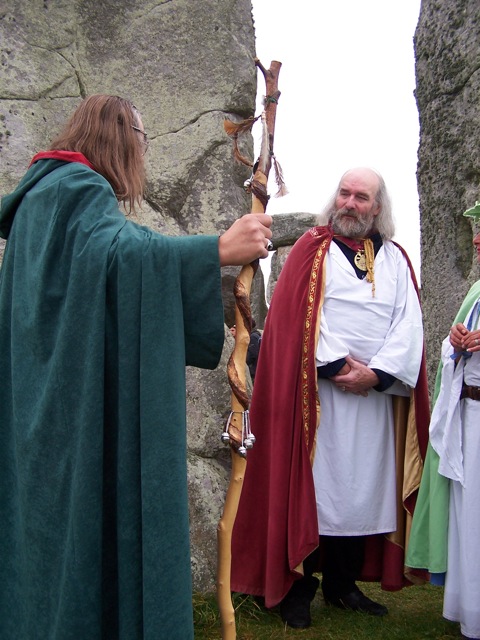
Associated Press Druids performing pagan rituals as part of the Summer Solstice ceremonies at Stonehenge, Wiltshire, England, before dawn, Monday June 21, 2004. The stone circle at Stonehenge is believed to be at least 4,500 years old. Druidry has been officially recognized as a religion in Britain under charity law. The Charity Commission has granted the Druid Network charitable status, giving it tax breaks and equal status to mainstream religions like Christianity. The commission said Saturday Oct. 2, 2010, that druidry has a coherent and serious set of beliefs and that it offers a beneficial ethical framework.

1_Britain_Druids_Recognized.sff.jpg

 Associated Press This Tuesday Aug. 10, 1999 photo from files shows Arch Druid Ed Prynn as he calls down the sun during his sun dance around a ring of stones, in St. Merryn, England. The druid dance is to celebrate the total eclipse of the sun, which is due in this part of southwest England on August 11. Druidry has been officially recognized as a religion in Britain under charity law. The Charity Commission has granted the Druid Network charitable status, giving it tax breaks and equal status to mainstream religions like Christianity. The commission said Saturday that druidry has a coherent and serious set of beliefs and that it offers a beneficial ethical framework.

More information try these links:

British Druid Order

The British Druid Order (BDO) teaches and practices a shamanic, mystical, celebratory form of Druidry, inspired by the past but deeply relevant to the
www.druidry.co.uk/

The Official Website Of The Council Of British Druid Orders – (CoBDO)™

The Council of British Druid Orders, CoBDO, would like to recommend one of our initial co-founders, who at present is not a member, the Order of Bards,
http://www.cobdo.org.uk/

Merlin @ Stonehenge
The Stonehenge Stone Circle Website


Autumn Equinox 2010 – Stonehenge Celebrations

23 09 2010

Stonehenge Autumn Equinox 2010

 The Autumn Equinox (also known as Mabon) is celebrated when day and night are of equal duration before the descent into increasing darkness and is the final festival of the season of harvest.  For many pagans, this is the time to reflect on the past season, and to recognize the balance of the year has changed.

Although the Summer Solstice at Stonehenge attrackts a large crowd, you may expect the Autumn Equinox celebrations to be less attended, with fewer than 1,000 people showing up.

The 2010 Autumnal Equinox takes place on September 23th, at 4.03am UK time (3.03 UTC), but when ‘open access’ to Stonehenge starts is decided by English Heritage and depends on visibility. The sunrise is at 6.48am, and it is expected access to the stones will be allowed from approximately 6.30 to 8.30am.

Public access to Stonehenge is denied after dark, so if you want to see the sunset on September 22th (18.59pm), you’ll have to stand on either the Avenue or on the side of the A344

The Autumnal Equinox

In September is the Fall Equinox, which has come to be called Mabon by many contemporary Neo-Pagans. Occuring approximately on September 21st, this is the day when the hours of daylight and nighttime are once again balanced. Calender days from now until the Winter Solstice will slowly get shorter and shorter in their daylight hours.

Agriculturally, this time of year the harvest is now in full swing, with late summer and fall fruits, vegetables and grains being gathered up before winter. This is the time of year a lot of canning or preserving of garden foods takes place. Hunting season also starts around this time, and this was when farmers would slaughter animals and preserve meat for the coming months as well.

This holiday is the last of the harvest holidays which began with the summer solstice and continued with Lammas.


21st/23rd September Harvest time!
The Autumn Equinox or Harvest Home is also called Mabon, pronounced ‘MAY-bon’, after the Welsh god Mabon ap Modron, which means literally ‘son of mother’. Mabon appears in ‘The Mabinogion’ tale. The Druids call this celebration, Mea’n Fo’mhair, and honour The Green Man, the God of the Forest, by offering libations to the trees. The Welsh know this time as ‘Alban Elfed’, meaning ‘light of autumn’. This is the point of the year when once again day and night are equal – 12 hours, as at Ostara, the Spring Equinox. The Latin word for Equinox means ‘time of equal days and nights’. After this celebration the descent into winter brings hours of increasing darkness and chiller temperatures. It is the time of the year when night conquers day. After the Autumn Equinox the days shorten and nights lengthen. To astrologers this is the date on which the sun enters the sign of Libra, the scales, reflecting appropriately the balanced day and night of the equinox. This was also the time when the farmers brought in their harvested goods to be weighed and sold.
Harvest festival This is the second festival of the season of harvest – at the beginning of the harvest, at Lammas, winter retreated to his underworld, now at the Autumn equinox he comes back to earth. For our Celtic ancestors this was time to reflect on the past season and celebrate nature’s bounty and accept that summer is now over. Harvest Home marks a time of rest after hard work, and a ritual of thanksgiving for the fruits of nature. This is the time to look back on the past year and what you have achieved and learnt, and to plan for the future. The full moon nearest to the Autumn Equinox is called the Harvest Moon and farmers would harvest their crops by then, as part of the second harvest celebration. Mabon was when livestock would be slaughtered and preserved (salted and smoked) to provide enough food for the winter. At the South Pole they will be celebrating the first appearance of the sun in six months. However, at the North Pole they will be preparing for six months of darkness. During Medieval times, the Christian Church replaced Pagan solstices and equinox celebrations with Christianized occasions. The Autumn equinox celebration was Michaelmas, the feast of the Archangel Michael.

The triple Goddess – worshipped by the Ancient Britons, is now in her aspect of the ageing Goddess and now passes from Mother to Crone, until she is reborn as a youthful virgin as the wheel of nature turns. At the Autumn equinox the goddess offers wisdom, healing and rest. Mabon Traditions The Wicker man There was a Celtic ritual of dressing the last sheaf of corn to be harvested in fine clothes, or weaving it into a wicker-like man or woman. It was believed the sun or the corn spirit was trapped in the corn and needed to be set free. This effigy was usually burned in celebration of the harvest and the ashes would be spread on the fields. This annual sacrifice of a large wicker man (representing the corn spirit) is thought by many to have been the origin of the misconception that Druids made human sacrifices. ‘The reaping is over and the harvest is in, Summer is finished, another cycle begins’ In some areas of the country the last sheaf was kept inside until the following spring, when it would be ploughed back into the land. In Scotland, the last sheaf of harvest is called ‘the Maiden’, and must be cut by the youngest female in attendance.
To Autumn O Autumn, laden with fruit, and stained With the blood of the grape, pass not, but sit Beneath my shady roof, there thou may’st rest, And tune thy jolly voice to my fresh pipe; And all the daughters of the year shall dance, Sing now the lusty song of fruits and flowers. William Blake Mabon is a time to reflect, as we reap the harvest of experience from the past year – the completion of another turn of the Great Wheel. Corn Dollies Corn dollies were also made from the last sheaf and kept in the house to protect the inhabitants from bad spirits during the long winter. Apples To honour the dead, it was also traditional at Mabon to place apples on burial cairns, as symbolism of rebirth and thanks. This also symbolizes the wish for the living to one day be reunited with their loved ones. Mabon is also known as the Feast of Avalon, deriving from the meaning of Avalon being, ‘the land of the apples’.

Merlin @ Stonehenge – A good time by all…….
The Stonehenge Stone Circle Website


Stonehenge Winter Solstice – 22nd December 2010

22 09 2010

Last year saw a large number of people (including Druids) turn up at Stonehenge on the wrong day in 2009?  I thought I would clarify the correct ‘Winter Solstice’ day for 2010 to save any embaresment.  The summer solstice is always on the 21st, however the winter solstice can fall on the 21st or the 22nd.  The celebration does not always fall on the same date as the solstice because the modern year does not correspond precisely to the solar one.

The exact time for the Winter Solstice is December 21st, 11.39pm (UK time). The sunset on the 21st is at 3.53pm and the sunrise on the 22nd of December at 8.04am. Exceptionally, you can also expect a full moon on December 21th.

English Heritage did not confirm the date for Open Access for Stonehenge for the Winter Solstice yet, but most likely this will be dawn on the 22nd of December. (The sunrise on the 22nd is closer to the actual solstice than that on the 21th of December.) Expect a short period of access, from approximately 7.30 to 9.00am

Stonehenge is carefully aligned on a sight-line that points to the winter solstice sunset (opposed to New Grange, which points to the winter solstice sunrise, and the Goseck circle, which is aligned to both the sunset and sunrise). It is thought that the Winter Solstice was actually more important to the people who constructed Stonehenge than the Summer Solstice. The Winter Solstice was a time when most cattle were slaughtered (so they would not have to be fed during the winter) and the majority of wine and beer was finally fermented.

Gerald Hawkins’ work

Gerald Hawkins’ work on Stonehenge was first published in Nature in 1963 following analyses he had carried out using the Harvard-Smithsonian IBM computer. Hawkins found not one or two alignments but dozens. He had studied 165 significant features at the monument and used the computer to check every alignment between them against every rising and setting point for the sun, moon, planets, and bright stars in the positions they would have been in 1500 BC. Thirteen solar and eleven lunar correlations were very precise against the early features at the site with precision falling during the megalithic stages. Hawkins also proposed a method for using the Aubrey holes to predict lunar eclipses by moving markers from hole to hole. In 1965 Hawkins wrote (with J. B. White) Stonehenge Decoded, which detailed his findings and proposed that the monument was a ‘Neolithic computer’.

Stonehenge – An Asronimical Calandar

Stonehenge features an opening in the henge earthwork facing northeast, and suggestions that particular significance was placed by its builders on the solstice and equinox points have followed. For example, the summer solstice sun rose close to the Heel Stone, and the sun’s first rays shone into the centre of the monument between the horseshoe arrangement. While it is possible that such an alignment can be coincidental, this astronomical orientation had been acknowledged since William Stukeley drew the site and first identified its axis along the midsummer sunrise in 1720.

Stukeley noticed that the Heel Stone was not precisely aligned on the sunrise. Year to year, the movement of the sun across the sky appears regular. However, due to temporal changes in obliquity of the ecliptic, illumination declinations change with time. The purported Heel Stone alignment with summer solstice sunrise would have been less accurate four to five thousand years ago. The Heel Stone, in fact, is located at 1/7th of circumference from due North, as noted by archaeologist James Q. Jacobs.[3] Stukeley and the renowned astronomer Edmund Halley were to attempt what amounted to the first scientific attempt to date a prehistoric monument. Stukeley concluded the Stonehenge had been set up “by the use of a magnetic compass to lay out the works, the needle varying so much, at that time, from true north.” He attempted to calculate the change in magnetic variation between the observed and theoretical (ideal) Stonehenge sunrise, which he imagined would relate to the date of construction. Their calculations returned three dates, the earliest of which, 460 BC, was accepted by Stukeley. That was incorrect, but this early exercise in dating is a landmark in field archaeology [4]. .

Early efforts to date Stonehenge exploited tiny changes in astronomical alignments and led to efforts such as H Broome’s 1864 theory that the monument was built in 977 BC, when the star Sirius would have risen over Stonehenge’s Avenue. Sir Norman Lockyer proposed a date of 1680 BC based entirely on an incorrect sunrise azimuth for the Avenue, aligning it on a nearby Ordnance Survey trig point, a modern feature. Petrie preferred a later date of AD 730. The necessary stones were leaning considerably during his survey, and it was not considered accurate.

Neolithic Computer

An archaeoastronomy debate was triggered by the 1963 publication of Stonehenge Decoded, by British-born astronomer Gerald Hawkins. Hawkins claimed to observe numerous alignments, both lunar and solar. He argued that Stonehenge could have been used to predict eclipses. Hawkins’ book received wide publicity, in part because he used a computer in his calculations, then a rarity. Archaeologists were suspicious in the face of further contributions to the debate coming from British astronomer C. A. ‘Peter’ Newham and Sir Fred Hoyle, the famous Cambridge cosmologist, as well as by Alexander Thom, a retired professor of engineering, who had been studying stone circles for more than 20 years. Their theories have faced criticism in recent decades from Richard J. C. Atkinson and others who have suggested impracticalities in the ‘Stone Age calculator’ interpretive approach.

There are a few tour companies offering Stonehenge Tours during the Solstice period.  Try the Stonehenge Tour Company, Best Value Tours, Salisbury Guided Tours and Premium Tours 

See you all at the Winter Sostice

Merlin @ Stonehenge
The Stonehenge Stone Circle Web site


Tonight at Stonehenge will be best night in five years to view spectacular Perseids meteor shower

12 08 2010

Stonehenge Landscape in Wiltshire – Step back in time and discover the ancient skies of Salisbury Plain’s chalk downlands, home to the impressive prehistoric stone monument
It is also one of the most awe-inspiring sights in the heavens that you can view from your own back garden.

And now scientists say that star-gazers are in for a treat this week with clear skies expected to give fantastic views of the spectacular Perseids meteor shower.

Experts say that with the moon in its ‘new’ phase and clear skies this week could mean that it’s the best year since 2007 to catch the spectacular show.

The annual Perseids meteor shower ) at Friars Crag, Derwentwater, Keswick, Cumbria in 2008. Astronomers predict this year will be the best display yetThe annual Perseids meteor shower ) at Friars Crag, Derwentwater, Keswick, Cumbria in 2008. Astronomers predict this year will be the best display yet

The phenomenon, which happens each summer as the Earth’s orbit takes it through debris scattered by the tail of Comet Swift-Tuttle is expected to peak on Thursday night.

Amateur astronomers were left disappointed last year after clouds ruined the expected view.

The Taurids are named after the constellation Taurus, because their paths can be traced from that area of sky.

On the night of the 12 August the new moon’s thin crescent will have set in the early evening, leaving a dark sky for the meteor shower, promising a stunning show of shooting stars.

For the best views, star gazers are advised to escape the city lights and head out to the big open and dark skies of the countryside where the stars and meteors will be at their brightest.

SEVEN BEST PLACES IN UK FOR SEEING THE PERSEIDS

Black Down in Sussex – Get closer to the stars on the highest point in the South Downs, just over a mile from the town of Haslemere

Teign Valley in Devon – Discover the stars at this Trust property within Dartmoor National Park and close to Castle Drogo

Penbryn Beach in Wales – Beautiful, unspoilt mile-long beach on the Ceredigion coast in west Wales, great for a bit of star gazing and a late night paddle

Stonehenge Landscape in Wiltshire – Step back in time and discover the ancient skies of Salisbury Plain’s chalk downlands, home to the impressive prehistoric stone monument

Wicken Fen National Nature Reserve in Cambridgeshire – Close to historic Ely, the wild landscape of the National Trust’s oldest nature reserve offers dark skies and a wealth of nocturnal wildlife to listen out for

Mam Tor in Derbyshire – Escape the bright city lights of Sheffield and experience the peace and tranquillity of Mam Tor’s dark skies in the Peak District

Friar’s Crag in Cumbria – Surrounded by the breathtakingly beautiful scenery of the Lake District, Friar’s Crag in Keswick juts out into the spectacular lake of Derwentwater

The Met Office is predicting that the clearest skies on Thursday night are likely to be in southern and western parts of England and Wales.

Nasa scientists also claim that this ‘promises to be one of the best displays of the year.’

‘If forecasters are correct, the shower should produce a peak display of at least 80 meteors per hour,’ they say.

Jo Burgon, Head of Access and Recreation at the National Trust, said: ‘Seeing the stars in  their full splendour, shining bright in the sky above you, is one of the unofficial wonders of the natural world. 

‘The intrusive glow of street lighting or a bright moon can be detrimental to a good meteor experience.

‘But with a good weather forecast, this year’s Perseids display could be a cracker, and not one to be missed.’

Some of the locations highlighted in the National Trust guide include the dramatic landscape around the world famous Stonehenge in Wiltshire and Mam Tor in the Peak District, high above Sheffield and only a short distance from the city of steel.

Jo Burgon, added: ‘Its worth spending the time to find the perfect spot to gaze up at the stars; as once you’re there looking into the night sky it will take your breath away.

‘And the best thing is that it won’t cost you a penny and this star time will always stay with you as one of those experiences that money can’t buy.

Emily Winterburn, author of The Stargazer’s Guide, said: ‘The Perseids are a great meteor shower to watch. 

‘The nights aren’t too cold and for once, thanks to the moon, the summer nights are dark enough to make even the dimmer meteors visible to the naked eye.’ 
As usualy Histouries UK Tours will be operating guided tours of Stonehenge and Avebury tonight, I joined them last year and it was awesome!

Merlin @ Stonehenge
The Stonehenge Stone Circle Website


Astro-Archaeology at Stonehenge

15 07 2010

Its more than a pile of old stones…………….
The Revd. Edward Duke was the first person to associate astronomy with Stonehenge, describing it as a planetarium full of significant astronomical alignments – although he named none. Unfortunately most of his ideas on the subject were rather fanciful and over-imaginative, and not very scientific.

Sir Norman Lockyer (1836 – 1920) was the first person to identify the reason for the orientation of Stonehenge. He realised that on the summer solstice the sun rose at the end of the main axis (as it would have done in the second and third millenniums BC). He published these findings in a book in 1906. However, Lockyer made many errors and incorrect assumptions, which made archaeologists suspicious of the possibility of astronomical alignments.

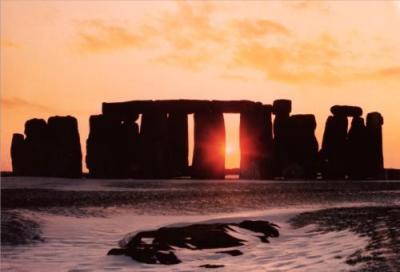
Stonehenge, looking West (7 KB) - links to a larger 38 KB version

Therefore, it was not until the second half of the 20th Century that astro-archaeology became a major science in its own right. Gerald Hawkins, an American astronomer, published the results of an intense study of Stonehenge’s astronomical alignments in Nature in 1963. In the article he described how he had used a computer to prove that alignments between Stonehenge and 12 major solar and lunar events was extremely unlikely to have been a coincidence (Castleden, 1993). His book, Stonehenge Decoded, containing the fully developed theory, appeared in Britain in 1966. He described how he had found astronomical alignments among 165 points of Stonehenge associated purely with the Sun and the Moon, and not with any stars or the five naked-eye planets (Mercury, Venus, Mars, Jupiter and Saturn). He discovered that lunar eclipses could be predicted through a system of moving stones around the circle of Aubrey Holes.

Controversially, he went on to suggest that Stonehenge was an ancient computer. The 1960’s were still early in the computer revolution, and the Harvard-Smithsonian IBM had produced some fantastic results for him. This was merely Hawkins’ way of paying a high compliment to the architects and builders of Stonehenge (Castleden, 1993).

There are indeed a large number of astronomical alignments, prediction and measuring devices, and representative features to be found among the megalithic stones and holes of Stonehenge. Gerald Hawkins discovered many of them, and most of his discoveries are commonly accepted.

Stonehenge III

M. W. Postins wrote a booklet entitled Stonehenge: Sun, Moon, Wandering Stars in 1982. Postins built two scale models, which he called the ‘Temple model’ (Stonehenge III) and the ‘Enclosure model’ (which shows outlying features such as the Aubrey Holes and Station Stones of Stonehenge I and II). ‘Table 1’ below outlines the astronomical alignments from Stonehenge III. (Also see Figure 1.)

TABLE 1: Stonehenge III (Temple) Astronomical Alignments

Astronomical Event Alignment Stones From… …to between sarsens Summer solstice sunrise Altar Stone 30 + 1 Summer solstice sunset Northern Low Trilithon gap 23 + 24 Winter solstice sunrise Eastern Low Trilithon gap 6 + 7 Winter solstice sunset Great Trilithon gap 15 + 16 Summer solstice moonrise, major standstill Southern Intermediate Trilithon gap 9 + 10 Summer solstice moonrise, minor standstill Southern Intermediate Trilithon gap 8 + 9 Winter solstice moonrise, major standstill Altar Stone 29 + 30 Winter solstice moonrise, minor standstill Altar Stone 1 + 2 Winter solstice moonset, major standstill Western Intermediate Trilithon gap 21 + 22 Winter solstice moonset, minor standstill Western Intermediate Trilithon gap 20 + 21

Trilithons

In his booklet, Postins states that the five trilithons represented the planets visible with the naked eye.

Mercury and Venus are the two planets in the sky that keep in closest association with the Sun. The eastern and northern lowest trilithons have alignments through the sarsen circle relating directly to the Sun (see Figure 1). Therefore, Postins suggested that these two lowest trilithons represented Mercury and Venus.

The two intermediate trilithons represented Mars and Jupiter because they are associated with lunar alignments. Mars and Jupiter are associated with the Moon due to their paths through the Zodiac. Because of this they are not linked to sunrise and sunset events like Mercury and Venus, but may be observed close to the Moon as they all follow similar paths along the ecliptic. The two intermediate trilithons align with major and minor positions of the Moon, which the Altar Stone (stone 80) also does through gaps in the sarsen circle (see Figure 1).

The Great trilithon represented Saturn because Saturn moves very slowly across the sky compared to the other four planets. This stately pace may have indicated to the people who built Stonehenge that Saturn held some sort of ‘senior’ position in the heavens.

FIGURE 1: Stonehenge III (Temple) Astronomical Alignments

Stonehenge III alignments (30 KB) - links to a larger 50 KB version

The Sun-aligned low trilithons cannot be differentiated in order to determine which planet (Mercury or Venus) each represents. The same problem exists with the Moon-aligned intermediate trilithons representing Mars and Jupiter. Postins speculates that there could have been carvings on the trilithons, now long eroded from existence, which indicated which trilithon represented which planet.

All of the astronomical alignments within the sarsen circle are present in older parts of the monument, including the Station Stones, Heel Stone and the numerous holes and posts. See Figure 2, which illustrates all of the astronomical alignments among the features of Stonehenge.

The alignments are extremely precise, which illustrates the high level of knowledge possessed by the builders of Stonehenge. Such knowledge must have been gathered over decades or centuries of observations of the sky (during which the behaviour and interaction of the heavenly bodies was noted), before the idea of Stonehenge was even conceived.

Station Stones

The four Station Stones (SS), 91, 92, 93 and 94 formed a perfect rectangle, which is remarkable considering that the long axis of the rectangle is around 300 ft in length. The sarsen ring formed a circle 97 ½ ft across in which every upright was, on average, less than 3 inches out of position!

This geometric precision was investigated in around three hundred megalithic monuments all over Britain by Alexander Thom. He deliberately investigated large numbers of megalithic monuments prior to visiting Stonehenge (in 1973) in order to prevent obtaining a biased view. It would have been easy to see Stonehenge as the perfect example of a Megalithic monument and then proceed to examine other monuments with this assumption in mind.

During his study of these monuments he came across two standard units of measurement, which he called the ‘Megalithic Fathom’ (equivalent to 1.6 m or 5.44 ft) and the ‘Megalithic Yard’ (equivalent to 0.83 m or 2.72 ft – 8 ½ inches short of a standard English yard). Thom found that the Megalithic Yard had been used at Stonehenge, in the spacing and positioning on the sarsen circle uprights. With these commonly recognised units, it is understandable how the Neolithic peoples that built Stonehenge achieved such a level of precision – and hence produce a very accurate astronomical observatory. Figure 2, below, illustrates the many alignments among the stones of Stonehenge I and Stonehenge III.

FIGURE 2: Stonehenge I and III Astronomical Alignments

Stonehenge I and III alignments (40 KB) - links to a larger 64 KB version

Figure 2 shows that an observer looking from SS92 (Station Stone 92) over SS91 would see the summer solstice sunrise, as he would if standing behind the Altar Stone (stone 80) and looking over stones C and B in the Avenue, just to the left of the remaining Heel Stone. Many of the alignments are at exact right angles. This is due to latitude at which Stonehenge was built. The exact rectangle of alignments through the Station Stones can only be achieved on (or very close to) 51° North. Once again, this demonstrates the astronomical knowledge the Neolithic populations possessed.

TABLE 2: Stonehenge I Astronomical Alignments

Astronomical Event Alignment Stones From… …to… Summer solstice sunrise SS 93 SS 94 SS 92 SS 91 Summer solstice sunset Stone G SS 94 Winter solstice sunrise SS 94 Stone G Winter solstice sunset SS 91 SS 92 SS 94 SS 93 Summer solstice moonrise, major standstill SS 93 SS 92 Summer solstice moonrise, minor standstill SS 93 SS 91 Winter solstice moonset, major standstill SS 91 SS 94 Winter solstice moonset, minor standstill SS 91 SS 93 Most southerly moonrise SS 94 SS 91 Most northerly moonset SS 92 SS 93 Equinox sunrise SS 94 Stone C Equinox moonrise SS 94 Stone B [ SS = Station Stone ]

Bluestone Horseshoe

Consisting of 19 stones, the bluestone horseshoe (just inside the 5 sarsen trilithons) had a couple of possible uses.

They could be used for counting the period from a full moon on a particular day of the year to the next full moon that falls on that day of the year, which would be 19 years later. Known as the Metonic cycle (after Meton, a 5th Century BC Greek astronomer), this is correct to around 2 hours. (Postins, 1982)

It could also be used to follow the nodal cycle of the Moon, which has a period of 18.61 years. The extremes of the Moon’s position on the horizon are marked on Figure 1, with the two intermediate trilithons and stones 8, 9, 10, and 20, 21, 22 of the sarsen circle.

The Bluestone Horseshoe (inside the five trilithons) can also be used to predict eclipses. There are 19 of these stones, which again relate to the 18.61-year cycle of the Moon’s wandering rising and setting points on the horizon, and therefore also eclipses. “Due to the way in which the lunar nodes move around the Zodiac, it takes somewhat less than a year for the Sun to return to the same position in relation to the nodes. This period is 346.62 days, and is connected with the repetition of eclipses. It is known as an ‘eclipse year’. 19 eclipse years and 223 lunar months [each of 29.53 days] have the following relationship: –

19 x 346.62 = 6585.78 days,
and
223 x 29.53 = 6585.32 days.”

(Postins, 1982)

This means that to predict an eclipse, 223 full Moons must be counted before the Earth, Moon and Sun are again in the same positions as at the beginning of that time. This period of time is called the Saros, and it is possible that Stonehenge III people discovered it. However, not all eclipses would be predicted by this method of counting the bluestones in the horseshoe because eclipses occur quite frequently, except with slightly different positions of the Earth, Moon and Sun.

Aubrey Holes

Gerald Hawkins’ theory on the use of the 56 Aubrey Holes to predict lunar events was workable but imprecise. At intervals of 9, 9, 10, 9, 9, 10, you could place 6 alternately black and white marker stones around the Aubrey Hole (AH) circle, and move them clockwise or anti-clockwise around the ring one hole per year. (Castleden, 1993.) Aubrey Holes 51, 56 and 5 were fixed markers. See Figure 3 below, which illustrates the concept.

If a white marker arrived at AH56 the full Moon would rise over the Heel Stone that year. The next astronomical event would occur when a white marker arrived at AH51. At its extreme declination, in that year the winter solstice Moon rose over the alignment to hole D from the centre of the monument, along the alignment from SS94 to SS91, and was framed in the southern intermediate trilithon. The summer solstice Moon rose along the alignment from SS93 to SS92, and was framed in the western intermediate trilithon. (Castelden, 1993)

Hawkins successfully demonstrated that several important lunar alignments occurred in 1549 BC. He suggested that the astronomers at Stonehenge knew these alignments would take place when a white marker arrived at AH51 that year.

FIGURE 3: Gerald Hawkins’ Eclipse Predictor

Hawkins' Eclipse Predictor using the 56 Aubrey Holes (13 KB)

Eclipses of the Moon occur every 18.61 years. The reason why there are 56 Aubrey Holes is because 18.61 x 3 = 55.83 (or 56 to the nearest integer). Eclipses of the Moon in summer or winter took place when any marker stone arrived at AH56 or AH28, the two holes that lie on the main axis of Stonehenge. When a white marker reached AH5 or AH51, equinox eclipses would occur.

There are 30 uprights in the sarsen circle. A full Moon occurs every 29.53 days. A seventh marker stone (a Moon marker, shown in Figure 3) would be moved once a day around the sarsen circle to keep track of the phases of the Moon.

In the 1960’s many British Stonehenge archaeologists were frustrated that an American astronomer had determined the reasoning behind the monument’s structure, having barely laid a foot in Stonehenge! As Hawkins’ highly plausible ideas went down badly in the British archaeological circles, Glyn Daniel (the editor of Antiquity) sought assistance from Fred Hoyle, the current Professor of Astronomy at Cambridge University. Hoyle studied Hawkins’ work, and produced his own theories on lunar predictions using Stonehenge. In his scenario, Stonehenge became a Solar System model with Earth at the centre. Rather than seven stones, Hoyle chose 3 stones representing the Sun, Moon, and one node of the Moon’s orbit. The 3 stones were moved around the Aubrey Hole ring at their real rates relative to each other. When the 3 markers lay close together or almost opposite each other, eclipse seasons took place. Actual eclipses occurred in these seasons only when the Moon stone moved close to the Sun stone, or was diametrically opposed to it (i.e. precisely on the opposite side of the Aubrey Hole ring).

Stonehenge, looking East (7 KB) - links to a larger 36 KB version

Hoyle’s method is much more accurate than Hawkins’ because the actual day of the eclipse was predicted, as well as the eclipse season. It is also much simpler to operate on the ground.

Hoyle also studied other astronomical alignments, and came to the conclusion that, surprisingly, Stonehenge I was much more sophisticated than Stonehenge III, although the later monument was undoubtedly more architecturally impressive. (Castleden, 1993)

Even after Hoyle’s more rational efforts, many archaeologists remained unconvinced. Today it is regarded as remarkable that Hawkins’ eclipse prediction method was seen as such an impressive step towards understanding parts of Stonehenge. It is believed that his use of the Harvard-Smithsonian IBM computer made his theory ‘infallible’ at the time. After all, it is highly unlikely that even the people of Stonehenge I would have been satisfied knowing only the year in which an eclipse would occur!

Merlin @ Stonehenge
The Stonehenge Stone Circle Website

Tours of Stonehenge
The Stonehenge Tour Company
HisTOURies UK
Salisbury Guided Tours


Celebrations at Stonehenge Summer Solstice 2010

22 06 2010


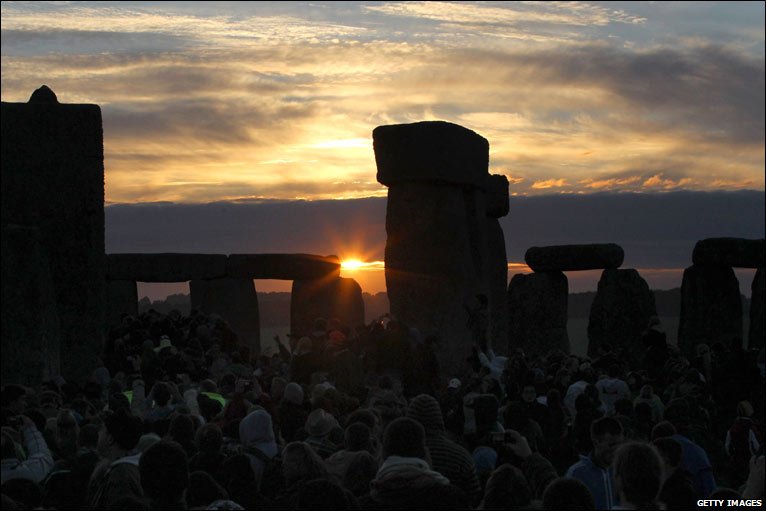
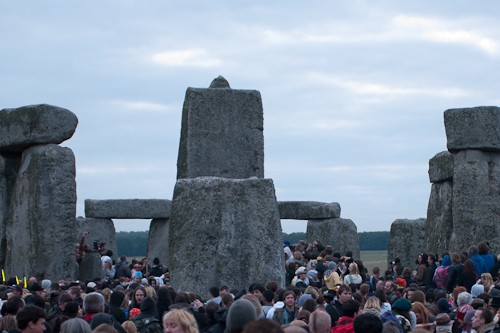
About 20,000 revellers were at Stonehenge to mark the Summer Solstice, each hoping to see the sun as it rose above the ancient stone circle at dawn.

Police described the event on Salisbury Plain in Wiltshire as one of the safest in years, although 34 people were arrested for minor drug offences.

Sunrise, marking the longest day of the year north of the equator, occurred over the circle at 0452 BST.

The Heel Stone, just outside the main circle, aligns with the rising sun.

Peter Carson from English Heritage said: “It has been quieter this year but it’s been a great solstice.

‘Monday morning’

“It’s an improvement on the last few years – the last time I remember seeing the sun rise was in 2003 – so it’s great to see the sun has put in an appearance.

“This year there are about 20,000 people and last year it was about 35,000 – so that is quite a bit down which has meant the operation is a lot easier. ”

He said two years ago the solstice happened early on a Saturday and about 30,000 people attended.

He added: “I think the days of the week do make a considerable difference to the number of people who come along – this year it’s a Monday morning.

Pagan roots

“The people who are streaming out now – a lot of them are going to work.”

Victoria Campbell, 29, was among those marking the solstice.

She said: “It means a lot to us…being British and following our pagan roots.”

The Londoner, who works in the finance industry, added “getting away from the city” was a major draw.

On Sunday police chiefs said they had planned for “all eventualities” ahead of the event.

Last year a record 36,500 revellers attended, causing traffic chaos and road closures.

Merlin @ Stonehenge

The Stonehenge Stone Circle Website


Building a 20ft man for summer solstice at Stonehenge

22 06 2010


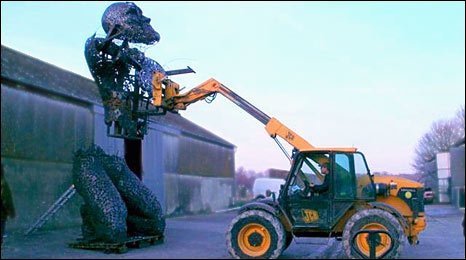
The massive steel Ancestor is over 20 feet tall and weighs in at an impressive six tonnes

For the last six months, like Dr Frankenstein, a married couple have been building a man – a 20-feet man in a barn a stone’s throw from Stonehenge. In Pictures: Solstice Giant at Stonehenge Reaching to the rafters, of a massive hangar, and weighing in just shy of an African bull elephant – he’s a monument in the making and the creation of Andy and Michelle Rawlings. “He’s very big,” admits Andy. “He’s as big as a double-decker bus and at least 20 feet on his knees. Shaped by eye the giant not only has a four-pack but a pot belly as well “And he’s going to weigh about six tonnes, when he’s finished. So, yeah he’s quite a chunk of metal.” ‘Quite a chunk of metal’, needless to say, is a bit of an understatement. Not only will this giant steel man dwarf a double-decker bus, by at least six feet, but his glittering mosaic of steel plates is a far cry from a hunk of a metal. Wielding plasma cutters and welders – Andy and Michelle, who found herself metal working after a ‘spectacular mid-life crises’, have not only cut their way through miles of steel plate. More miles then either say they’d liked to have actually walked. But painstakingly welded thousands of randomly cut steel pieces on to a super-sized steel frame in a colossus of a jigsaw. ‘Thierry Henry goal celebration’ “I’ve had to remove his crotch to give me access through there,” admits Andy, “it will be a removable panel. “It’s not the best entry point in the world but it’s got to be done.” Working with their heads, where even the solstice sun doesn’t shine, both Michelle and Andy have spent nine months creating their giant. An ancient-looking man who, both hope, will represent everyone’s ancestor on his knees in praise of the sun. “What we tried to do with his position,” says Michelle, “is to actually capture the very moment the sun comes up and he’s dropped to his knees in thanks. Andy is hoping that they’ll be able to fly him in by helicopter “One lad saw him and immediately said: ‘Thierry Henri goal celebration’ – it’s that moment that we’ve tried to create with him and hopefully we’ve pulled it off.” Created and shaped by eye, ‘in the old fashioned way’, without a computer or a CAD programme in sight – the Ancestor has, according to Michelle, had to evolve. And he’s evolved with slightly less then a six-pack. “Well he’s got a four pack and a little bit of a pot belly,” laughs Michelle, “in honour of the Great British pot belly. “We think the way he’s been built and where he’s been built really is a salute to the Great British shed heads – that do these mad projects in their sheds and pull it of. We salute them.” For Sale And like the Great British shed heads, Michelle and Andy have had to dig deep into their own pockets to create him. But with just weeks to go, before sun-up on the longest day, and just two gargantuan arms and hands to finish, the couple are hoping that they’ve found a buyer in Amesbury. “Hopefully the owner of the Holiday Inn will like him,” says Andy. “He’s been good enough to allow us to put him in front of his hotel for sale – with an option for him to buy. For Sale: the Ancestor is up for sale for an undisclosed amount “And he’s going to be in a very prominent position so that most people will be able to view him down the A303. So hopefully he’ll become our Angel of the South.” But with transportation arrangements having to include chopping him in half, a giant crane and a gang – Andy is hoping his ‘Angel of the South’ might actually take to the wing. “I would like to think we could fly him in by helicopter” says Andy. “but we’ve got to speak nicely to the Army for that. “But it would be nice and I would be very happy for him to be 100 foot up in the air.” But before the giant ancestor heads to Solstice park, or is spotted in the skies over Amesbury, he’s making a stop-off at Stonehenge just in time for sun-up on the longest day. But how will Stonehenge’s largest sarsen stone measure up to the 20ft steel man? And, despite the traditional lack of actual sun at solstice, will the massive sculpture overshadow the ancient monument? “No,” says Michelle. “We’re hoping to enhance. We’re not trying to compete. “We want to enhance the Stonehenge experience and just give people the opportunity to think about where we’ve actually come from and what a proud race we are.”

Merlin & Stonehenge
The Stonehenge Stone Circle Website


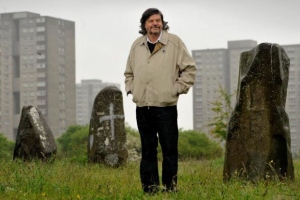
Glasgow Megalith – astronomer bids to rejuvenate stone circle

7 06 2010

It was created in the late 1970s to mirror the rise and fall of the moon and sun across Glasgow on a site of ancient astronomical interest.

Now efforts are being made to rejuvenate the Sighthill Stone Circle, created by amateur astronomer and science writer Duncan Lunan, who brought Britain’s first authentically alligned stone circle in more than 3000 years to Glasgow’s inner city.

More than 30 years later, Lunan hopes to revive interest in the stone circle, which was built by the Glasgow Parks Astronomy Department using funds from the former Jobs Creation Scheme.

When money for the project was abruptly scrapped by the then prime minister Margaret Thatcher, four pieces of stone never made it to the circle and are now stashed under a nearby bush in Sighthill Park. It is hoped the circle can now be completed as Lunan intended.

At the stones yesterday, Lunan said: “There is still nothing up here to say who built the circle, who it was built for or how it works. I have been told that nowadays children are afraid of it, that they think it is linked to black magic, that sort of thing. That is something I want to change.”

The site of the stones may not at first seem a likely spot of spiritual significance given that they are surrounded by 1960s tower blocks, acres of plain parkland and a belching incinerator.

Built on a hilltop with dramatic views across the city, they incorporate the line of the midsummer sunset across the city, which is historically mapped by Dobie’s Loan from the neolithic site, where Glasgow Cathedral now sits, to Summerhill.

It was here where midsummer parties were held to celebrate the sun at its highest and most powerful, where bonfires were lit to hail the light and ward off evil spirits believed to roam freely as the sun turned southwards again. The Pagan-style parties continued until the 17th century, when they were halted by the church.

Lunan would like to revive the celebrations of the midsummer sunset at Sighthill, with a gathering planned for the night of June 21.

Whereas in Neolithic times stone circle creators would take 100 years to observe the movement of the moon, the earth and the light of the sun, Lunan had a matter of months to work out the necessary co-ordinates on his New Stone Age calendar.

“Getting the precision right was the really hard part. And the winters of 1978 and 1979 were really terrible too, you could hardly see a thing,” he said.

Photographs and astronomical graphs gave Lunan and his colleagues the necessary guide with the last of the 17 stones lowered into place by an RAF helicopter from HMS Gannet.

“The moon stones were too big to be brought by helicopter so it was the sun stones and the star stones that came by air. That was a hell of a day,” he said.

At first the project was to build a replica Stonehenge and Callanish Stones using modern materials, but given the significant astronomical setting it became a true stone circle of which Lunan remains proud.

He built it in tribute to four academics at Glasgow University who are responsible for the promotion and understanding of ancient astronomy; Professor Archie Roy, Dr Ewan McKay, Professor Alexander Thom and his son, Dr Archie Thom. “It started with Alexander Thom who, between the two world wars, was inspired by the falling moon over the Callanish Stones,” Lunan said.

“He became convinced that they used astronomy and mathematics on an advanced scale.”

The work was continued by his son and explored further by McKay and Roy.

“This was at a time when most archaeologists wouldn’t go near this stuff, claiming that primitive society was not capable of such understanding. It is very fitting that this stone circle is in Glasgow, as a tribute to them.”

Lunan would ultimately like the stone circle to be a key feature of a city-wide astronomy map, with the entire solar system represented on the correct scale within the city limits. If the stone circle represented the sun, Pluto would be at Cathkin Braes, Lunan said.

An illustrated talk on the Sighthill Stone Circle will be held at the Ogilve Centre, St Aloysius Church, Rose Street, Glasgow, on Monday June 21, followed by a visit to the circle for midsummer sunset from 9.30pm to 10pm.

The stone festivals

Stonehenge: The axis of Stonehenge in Wiltshire is aligned with sunrise at the summer solstice. Druids and other Pagans have gathered here at different points in history to celebrate the longest day of the year. Because of clashes with police in the 1980s, ceremonies were banned until 2001.

Callanish: The prehistoric site on Lewis has become a focus of summer solstice celebrations. According to local legend, the “shining one” walks up to the stone on the midsummer dawn. A path has been laid around the perimeter by Historic Scotland to lessen the damage caused by visitors.

Cornwall: The Golowan Festival is held on June 23, the eve of St John’s Day. Bonfires, feasting and merrymaking define the celebration. The streets of Penzance were traditionally lined with burning tar barrels and fires blazed on nearby hills but these were scaled back for safety reasons.

Merlin @ Stonehenge
The Stonehenge Stone Circle Website


Stonehenge Summer Solstice 2010

28 05 2010

Open Access at Stonehenge

 
Date:  Monday 21st June 10
Location:  Stonehenge, Wiltshire – MAP
Cost:  FREE (including FREE car park)
| |

There are 3 weeks and 3 days until Stonehenge 2010

English Heritage are again expected to provide “Managed Open Access” to Stonehenge for the Summer Solstice. Please help to create a peaceful occasion by taking personal responsibility and following the conditions (see below).

The car park (enter off the A303 from the roundabout – it’s signposted) will open at around 7pm on Sunday 20th June, and close at around noon on Monday 21st June. Note that last admission to the car park for vehicles is at around 6am.

Access to the stones themselves is expected to be from around 8.30pm on Sunday 20th June until 8am on Monday 21st June.

There’s likely to be casual entertainment from samba bands & drummers but no amplified music is allowed.

Van loads of police have been present in the area in case of any trouble, but generally a jovial mood prevails. Few arrests have been made in previous years, mostly in relation to minor drug offences.

Toilets and drinking water are available and welfare is provided by festival welfare services. There are normally one or two food and drink vans with reasonable prices but huge queues, all well away from the stones themselves.

Sunrise is at around 4:45am.

Rules include no camping, no dogs, no fires or fireworks, no glass bottles, no large bags or rucksacks, and no climbing onto the stones. Please respect the rules so that we’re all able to enjoy the solstice morning at Stonehenge for years to come.

More information will be here when available.

English Heritage Message

English Heritage is pleased to be providing Managed Open Access to Stonehenge for the Summer Solstice.  Please help us to create a peaceful occasion by taking personal responsibility and following the Conditions of Entry.

Please note that a high volume of traffic is anticipated in the Stonehenge area on the evening of Sunday 20th June.

Getting To Stonehenge

Where possible, please travel to Stonehenge using public transport.  The local bus company, Wilts & Dorset, will be running a service from Salisbury railway and bus stations to Stonehenge over the Solstice period.  This bus service will commence at 1830 hours (6.30pm) on Sunday 20th June and run regularly until 0115 hours (1.15am) on Monday 21st June. A service taking people back to Salisbury will start again at 0400 hours (4am) and run frequently until 0945 hours (9.45am). Access to Stonehenge from the bus drop off point is through the National Trust farmland.

The buses will stop at any recognised bus stop along the line of the route, which is via Amesbury.

Bus Service Information

Wilts and Dorset Bus Company
www.wdbus.co.uk
Tel: 01983 827005 begin_of_the_skype_highlighting              01983 827005      end_of_the_skype_highlighting

Train Information

South West Trains
www.southwesttrains.co.uk
Tel: 0845 6000 650 begin_of_the_skype_highlighting              0845 6000 650      end_of_the_skype_highlighting

Merlin @ Stonehenge
The Stonehenge Web Site


Beltane – May 1st 2020 – The beginning of Summer!

19 04 2010

On the cusp between spring and summer, Beltane is a fire festival that celebrates the fertility of the coming year.
The beginning of Summer – Summer is a comin in !

Beltane is a Celtic word which means ‘fires of Bel’ (Bel was a Celtic deity). It is a fire festival that celebrates of the coming of summer and the fertility of the coming year.

Celtic festivals often tied in with the needs of the community. In spring time, at the beginning of the farming calendar, everybody would be hoping for a fruitful year for their families and fields.

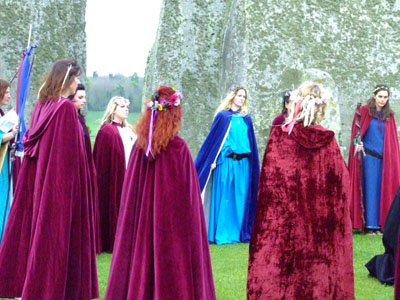
Maidens at Stonehenge

Beltane rituals would often include courting: for example, young men and women collecting blossoms in the woods and lighting fires in the evening. These rituals would often lead to matches and marriages, either immediately in the coming summer or autumn.

Other festivities involved fire which was thought to cleanse, purify and increase fertility. Cattle were often passed between two fires and the properties of the flame and the smoke were seen to ensure the fertility of the herd.

Today Pagans believe that at Beltane the God (to whom the Goddess gave birth at the Winter Solstice) achieves the strength and maturity to court and become lover to the Goddess. So although what happens in the fields has lost its significance for most Pagans today, the creation of fertility is still an important issue.

Emma Restall Orr, a modern day Druid, speaks of the ‘fertility of our personal creativity’. (Spirits of the Sacred Grove, pub. Thorsons, 1998, pg.110). She is referring to the need for active and creative lives. We need fertile minds for our work, our families and our interests.

Fire is still the most important element of most Beltane celebrations and there are many traditions associated with it. It is seen to have purifying qualities which cleanse and revitalise. People leap over the Beltane fire to bring good fortune, fertility (of mind, body and spirit) and happiness through the coming year.

Although Beltane is the most overtly sexual festival, Pagans rarely use sex in their rituals although rituals often imply sex and fertility. The tradition of dancing round the maypole contains sexual imagary and is still very popular with modern Pagans.

The largest Beltane celebrations in the UK are held in Edinburgh. Fires are lit at night and festivities carry on until dawn. All around the UK fires are lit and private celebrations are held amongst covens and groves (groups of Pagans) to mark the start of the summer.

Merlin @ Stonehenge
Stonehenge Stone Circle Website