Stonehenge a monumental attraction since prehistory

1 10 2010

Stonehenge may have been a top international tourist attraction in prehistoric times – just as it is today.

 Ongoing scientific research suggests that around 30 per cent of the wealthiest individuals buried around the neolithic and Bronze Age temple came from hundreds and, in some cases, thousands of miles away.

 Recent isotopic tests carried out by the British Geological Survey and announced yesterday reveal that one very high-status individual – a teenage boy – found buried near Stonehenge, had in fact come from somewhere along the north coast of the Mediterranean, potentially Spain, southern France or Italy.

 Another individual, whose origins were revealed a few years ago, came from the Alps – and others came from Brittany (or possibly Wales).

 The Alpine individual suffered from a painful leg condition and the Mediterranean teenager died aged 14 or 15 and is likely therefore to have also suffered from serious illness.

 Some archaeologists have therefore begun to speculate that Stonehenge attracted health tourists who went there to be cured – and ended up being buried there instead.

 Interestingly, a healing function for Stonehenge is hinted at by Arthurian legend, which holds that the monument was indeed an ancient healing centre. Even as late as the 18th century, the stones of Stonehenge were regarded as having magical healing powers – and visitors to the site often chipped bits off to take away as talismans.

 Certainly the monument was internationally known in ancient times – and appears to have been described by a fourth-century BC Greek geographer, centuries after it had actually gone out of use.

 Stonehenge’s international visitors were extremely wealthy. The Alpine man was buried with gold and copper objects – including three copper daggers and a pair of gold hair clasps.

 The Mediterranean teenager was buried wearing a necklace of around 90 amber beads.

 “Isotopic analyses of tooth enamel from both these people shows that the two individuals provide a contrast in origin, which highlights the diversity of people who came to Stonehenge from across Europe,” said Professor Jane Evans, head of archaeological science at the British Geological Survey.

 Merlin @ Stonehenge
The Stonehenge Stone Circle Website


Autumn Equinox 2010 – Stonehenge Celebrations

23 09 2010

Stonehenge Autumn Equinox 2010

 The Autumn Equinox (also known as Mabon) is celebrated when day and night are of equal duration before the descent into increasing darkness and is the final festival of the season of harvest.  For many pagans, this is the time to reflect on the past season, and to recognize the balance of the year has changed.

Although the Summer Solstice at Stonehenge attrackts a large crowd, you may expect the Autumn Equinox celebrations to be less attended, with fewer than 1,000 people showing up.

The 2010 Autumnal Equinox takes place on September 23th, at 4.03am UK time (3.03 UTC), but when ‘open access’ to Stonehenge starts is decided by English Heritage and depends on visibility. The sunrise is at 6.48am, and it is expected access to the stones will be allowed from approximately 6.30 to 8.30am.

Public access to Stonehenge is denied after dark, so if you want to see the sunset on September 22th (18.59pm), you’ll have to stand on either the Avenue or on the side of the A344

The Autumnal Equinox

In September is the Fall Equinox, which has come to be called Mabon by many contemporary Neo-Pagans. Occuring approximately on September 21st, this is the day when the hours of daylight and nighttime are once again balanced. Calender days from now until the Winter Solstice will slowly get shorter and shorter in their daylight hours.

Agriculturally, this time of year the harvest is now in full swing, with late summer and fall fruits, vegetables and grains being gathered up before winter. This is the time of year a lot of canning or preserving of garden foods takes place. Hunting season also starts around this time, and this was when farmers would slaughter animals and preserve meat for the coming months as well.

This holiday is the last of the harvest holidays which began with the summer solstice and continued with Lammas.


21st/23rd September Harvest time!
The Autumn Equinox or Harvest Home is also called Mabon, pronounced ‘MAY-bon’, after the Welsh god Mabon ap Modron, which means literally ‘son of mother’. Mabon appears in ‘The Mabinogion’ tale. The Druids call this celebration, Mea’n Fo’mhair, and honour The Green Man, the God of the Forest, by offering libations to the trees. The Welsh know this time as ‘Alban Elfed’, meaning ‘light of autumn’. This is the point of the year when once again day and night are equal – 12 hours, as at Ostara, the Spring Equinox. The Latin word for Equinox means ‘time of equal days and nights’. After this celebration the descent into winter brings hours of increasing darkness and chiller temperatures. It is the time of the year when night conquers day. After the Autumn Equinox the days shorten and nights lengthen. To astrologers this is the date on which the sun enters the sign of Libra, the scales, reflecting appropriately the balanced day and night of the equinox. This was also the time when the farmers brought in their harvested goods to be weighed and sold.
Harvest festival This is the second festival of the season of harvest – at the beginning of the harvest, at Lammas, winter retreated to his underworld, now at the Autumn equinox he comes back to earth. For our Celtic ancestors this was time to reflect on the past season and celebrate nature’s bounty and accept that summer is now over. Harvest Home marks a time of rest after hard work, and a ritual of thanksgiving for the fruits of nature. This is the time to look back on the past year and what you have achieved and learnt, and to plan for the future. The full moon nearest to the Autumn Equinox is called the Harvest Moon and farmers would harvest their crops by then, as part of the second harvest celebration. Mabon was when livestock would be slaughtered and preserved (salted and smoked) to provide enough food for the winter. At the South Pole they will be celebrating the first appearance of the sun in six months. However, at the North Pole they will be preparing for six months of darkness. During Medieval times, the Christian Church replaced Pagan solstices and equinox celebrations with Christianized occasions. The Autumn equinox celebration was Michaelmas, the feast of the Archangel Michael.

The triple Goddess – worshipped by the Ancient Britons, is now in her aspect of the ageing Goddess and now passes from Mother to Crone, until she is reborn as a youthful virgin as the wheel of nature turns. At the Autumn equinox the goddess offers wisdom, healing and rest. Mabon Traditions The Wicker man There was a Celtic ritual of dressing the last sheaf of corn to be harvested in fine clothes, or weaving it into a wicker-like man or woman. It was believed the sun or the corn spirit was trapped in the corn and needed to be set free. This effigy was usually burned in celebration of the harvest and the ashes would be spread on the fields. This annual sacrifice of a large wicker man (representing the corn spirit) is thought by many to have been the origin of the misconception that Druids made human sacrifices. ‘The reaping is over and the harvest is in, Summer is finished, another cycle begins’ In some areas of the country the last sheaf was kept inside until the following spring, when it would be ploughed back into the land. In Scotland, the last sheaf of harvest is called ‘the Maiden’, and must be cut by the youngest female in attendance.
To Autumn O Autumn, laden with fruit, and stained With the blood of the grape, pass not, but sit Beneath my shady roof, there thou may’st rest, And tune thy jolly voice to my fresh pipe; And all the daughters of the year shall dance, Sing now the lusty song of fruits and flowers. William Blake Mabon is a time to reflect, as we reap the harvest of experience from the past year – the completion of another turn of the Great Wheel. Corn Dollies Corn dollies were also made from the last sheaf and kept in the house to protect the inhabitants from bad spirits during the long winter. Apples To honour the dead, it was also traditional at Mabon to place apples on burial cairns, as symbolism of rebirth and thanks. This also symbolizes the wish for the living to one day be reunited with their loved ones. Mabon is also known as the Feast of Avalon, deriving from the meaning of Avalon being, ‘the land of the apples’.

Merlin @ Stonehenge – A good time by all…….
The Stonehenge Stone Circle Website


Stonehenge Winter Solstice – 22nd December 2010

22 09 2010

Last year saw a large number of people (including Druids) turn up at Stonehenge on the wrong day in 2009?  I thought I would clarify the correct ‘Winter Solstice’ day for 2010 to save any embaresment.  The summer solstice is always on the 21st, however the winter solstice can fall on the 21st or the 22nd.  The celebration does not always fall on the same date as the solstice because the modern year does not correspond precisely to the solar one.

The exact time for the Winter Solstice is December 21st, 11.39pm (UK time). The sunset on the 21st is at 3.53pm and the sunrise on the 22nd of December at 8.04am. Exceptionally, you can also expect a full moon on December 21th.
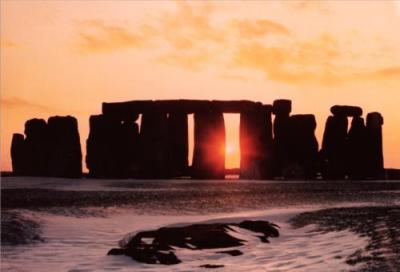
English Heritage did not confirm the date for Open Access for Stonehenge for the Winter Solstice yet, but most likely this will be dawn on the 22nd of December. (The sunrise on the 22nd is closer to the actual solstice than that on the 21th of December.) Expect a short period of access, from approximately 7.30 to 9.00am

Stonehenge is carefully aligned on a sight-line that points to the winter solstice sunset (opposed to New Grange, which points to the winter solstice sunrise, and the Goseck circle, which is aligned to both the sunset and sunrise). It is thought that the Winter Solstice was actually more important to the people who constructed Stonehenge than the Summer Solstice. The Winter Solstice was a time when most cattle were slaughtered (so they would not have to be fed during the winter) and the majority of wine and beer was finally fermented.

Gerald Hawkins’ work

Gerald Hawkins’ work on Stonehenge was first published in Nature in 1963 following analyses he had carried out using the Harvard-Smithsonian IBM computer. Hawkins found not one or two alignments but dozens. He had studied 165 significant features at the monument and used the computer to check every alignment between them against every rising and setting point for the sun, moon, planets, and bright stars in the positions they would have been in 1500 BC. Thirteen solar and eleven lunar correlations were very precise against the early features at the site with precision falling during the megalithic stages. Hawkins also proposed a method for using the Aubrey holes to predict lunar eclipses by moving markers from hole to hole. In 1965 Hawkins wrote (with J. B. White) Stonehenge Decoded, which detailed his findings and proposed that the monument was a ‘Neolithic computer’.

Stonehenge – An Asronimical Calandar

Stonehenge features an opening in the henge earthwork facing northeast, and suggestions that particular significance was placed by its builders on the solstice and equinox points have followed. For example, the summer solstice sun rose close to the Heel Stone, and the sun’s first rays shone into the centre of the monument between the horseshoe arrangement. While it is possible that such an alignment can be coincidental, this astronomical orientation had been acknowledged since William Stukeley drew the site and first identified its axis along the midsummer sunrise in 1720.

Stukeley noticed that the Heel Stone was not precisely aligned on the sunrise. Year to year, the movement of the sun across the sky appears regular. However, due to temporal changes in obliquity of the ecliptic, illumination declinations change with time. The purported Heel Stone alignment with summer solstice sunrise would have been less accurate four to five thousand years ago. The Heel Stone, in fact, is located at 1/7th of circumference from due North, as noted by archaeologist James Q. Jacobs.[3] Stukeley and the renowned astronomer Edmund Halley were to attempt what amounted to the first scientific attempt to date a prehistoric monument. Stukeley concluded the Stonehenge had been set up “by the use of a magnetic compass to lay out the works, the needle varying so much, at that time, from true north.” He attempted to calculate the change in magnetic variation between the observed and theoretical (ideal) Stonehenge sunrise, which he imagined would relate to the date of construction. Their calculations returned three dates, the earliest of which, 460 BC, was accepted by Stukeley. That was incorrect, but this early exercise in dating is a landmark in field archaeology [4]. .

Early efforts to date Stonehenge exploited tiny changes in astronomical alignments and led to efforts such as H Broome’s 1864 theory that the monument was built in 977 BC, when the star Sirius would have risen over Stonehenge’s Avenue. Sir Norman Lockyer proposed a date of 1680 BC based entirely on an incorrect sunrise azimuth for the Avenue, aligning it on a nearby Ordnance Survey trig point, a modern feature. Petrie preferred a later date of AD 730. The necessary stones were leaning considerably during his survey, and it was not considered accurate.

Neolithic Computer

An archaeoastronomy debate was triggered by the 1963 publication of Stonehenge Decoded, by British-born astronomer Gerald Hawkins. Hawkins claimed to observe numerous alignments, both lunar and solar. He argued that Stonehenge could have been used to predict eclipses. Hawkins’ book received wide publicity, in part because he used a computer in his calculations, then a rarity. Archaeologists were suspicious in the face of further contributions to the debate coming from British astronomer C. A. ‘Peter’ Newham and Sir Fred Hoyle, the famous Cambridge cosmologist, as well as by Alexander Thom, a retired professor of engineering, who had been studying stone circles for more than 20 years. Their theories have faced criticism in recent decades from Richard J. C. Atkinson and others who have suggested impracticalities in the ‘Stone Age calculator’ interpretive approach.

There are a few tour companies offering Stonehenge Tours during the Solstice period.  Try the Stonehenge Tour Company, Best Value Tours, Salisbury Guided Tours and Premium Tours 

See you all at the Winter Sostice

Merlin @ Stonehenge
The Stonehenge Stone Circle Web site


Secret Sounds of Stonehenge

30 08 2010

Trevor Cox reveals how the acoustic footprint of the world’s most famous prehistoric monument was measured 

 Echoes of the past: The sites and sounds of prehistory Just after sunrise on a misty spring morning last year, my fellow acoustician at the University of Salford, Bruno Fazenda, and Rupert Till of the University of Huddersfield, UK, could be found wandering around Stonehenge popping balloons. This was not some bizarre pagan ritual. It was a serious attempt to capture the “impulse response” of the ancient southern English stone circle, and with it perhaps start to determine how Stonehenge might have sounded to our ancestors. An impulse response characterises all the paths taken by the sound between its source – in this case a popping balloon – and a microphone positioned a few metres away. It is simply a plot of the sound pressure at the microphone in the seconds after the pop. The first, strongest peak on the plot represents the sound that travelled directly from the source to the microphone. Later, smaller peaks indicate the arrival of reflections off the stones. The recording and plot shows the impulse response Bruno and Rupert measured with a microphone positioned at the centre of Stonehenge and a popping balloon at the edge of the circle. This impulse response represents an acoustic fingerprint of the stones. Back in the lab, it can be used to create a virtual rendition of any piece of music or speech as it would sound within the stone circle. All that is needed is an “anechoic” recording of the raw music or speech – a recording made in a reflection-free environment such as the open air or, better, a specialist anechoic chamber such as we have at Salford. The anechoic recording and the impulse response can then be combined using a mathematical operation called convolution. We’ve done with with a recording of drumming: here is the anechoic original, and here it is convolved with the measured impulse response of Stonehenge. The difference is easily appreciable: there is more reverberation or ringing to the drumming sound thanks to the reflections off the stones. What’s more, the tonal balance of the sound is entirely different: it has become much deeper, as if the treble has been turned down.

Replica henge The popping of a balloon is not the standard or best way to measure an impulse response, but more sophisticated equipment was not allowed at Stonehenge. At a full-size replica of the monument at Maryhill, Washington state, however, Bruno and Rupert were able to use powerful loudspeakers and special test signals to get more accurate results. Maryhill also has the advantage that it is complete, whereas some of the stones of Stonehenge have fallen or disappeared over the years. That makes a noticeable difference to the drum sounds convolved with Maryhill’s impulse response: the more complete stone circle makes the sound echo for longer, with the extended reverberation being most noticeable after the last drum. Over many decades, a sophisticated understanding of how to interpret impulse responses has been built up. For example, we now know how features within the impulse response, such as the time it takes for reverberations to die away, relate to peoples’ perceptions of the nature of the sound. The hope is that by applying that expertise to ancient monuments such as Stonehenge, we can better appreciate their acoustical effects on our ancestors –and perhaps begin to answer the question whether these effects were the product of accident or design.

Sounding stones

We also know that our ancestors appreciated their ability to exploit their environment to make sound early on. The discovery of three flutes in 2009 in a cave in south-west Germany, the best preserved of them made from a vulture’s wing bone and containing five finger holes, pushes the origins of music back to the middle Palaeolithic era, 40,000 years ago.

Lithophones or rock gongs- stones that create a tone when hit- are found around the world. A cave at Fieux à Miers in the Midi-Pyrénées region of the south of France contains a 2-metre-tall feature which resonates like a gong when struck. Recalcified fractures on the lithophone indicating where it was struck can be dated back to the upper Palaeolithic, around 20,000 years ago (Oxford Journal of Archaeology, vol 4, p 31). Outdoor examples include Kupgal Hill in Karnataka state, southern India, where an outcrop of dolerite boulders emits loud ringing tones when hit with granite stones. Nicole Boivin of the University of Oxford suggests that shamans might have used the rock gongs during formal rituals. Dating the wear marks in boulders is impossible, but the presence of Neolithic rock art indicates that the site was used for many thousands of years (Antiquity, vol 78, p 38).

Imagery such as cave paintings, markings or etchings also provides tantalising clues to how prehistoric humans might have exploited their surroundings to make sound. Iegor Reznikoff of Nanterre University, Paris, has examined the caves of Rouffignac in the south of France and showed that paintings are located where the most interesting sound effects are heard. Devereux, in his book Stone Age Soundtracks, cites numerous other examples around the globe of seemingly premeditated placing of petroglyphs or pictographs, including sites where art is painted on concave rock walls that give distinct echoes.

Merlin @ Stonehenge
The Stonehenge Stone Circle Website


Stonehenge Comedy

27 07 2010

I did promise a few laughs along the way…..
Hope you like this classic Eddie Izzard comedy sketch of Stonehenge (18+)

Merlin @ Stonehenge
The Stonehenge Stone Circle Website