Stonehenge Built With Balls?

12 12 2010

New experiment suggests monumental stones could have rolled on rails.

It’s one of Stonehenge‘s greatest mysteries: How did Stone Age Britons move 45-ton slabs across dozens of miles to create the 4,500-year-old stone circle?
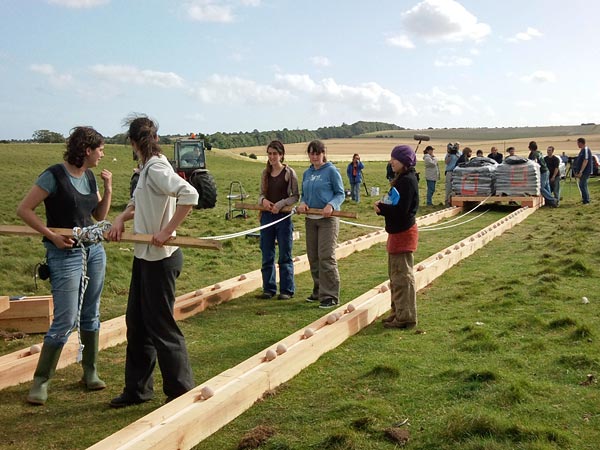
U.K. archaeology students attempt to prove a rail-and-ball system could have moved Stonehenge stones

U.K. archaeology students attempt to prove a rail-and-ball system could have moved Stonehenge stones

Now a new theory says that, while the ancient builders didn’t have wheels, they may well have had balls. (See Stonehenge pictures.)

A previous theory suggested that the builders used wooden rollers—carved tree trunks laid side by side on a constructed hard surface. Another imagined huge wooden sleds atop greased wooden rails.

But critics say the rollers’ hard pathway would have left telltale gouges in the landscape, which have never been found. And the sled system, while plausible, would have required huge amounts of manpower—hundreds of men at a time to move one of the largest Stonehenge stones, according to a 1997 study.

Andrew Young, though, says Stonehenge’s slabs, may have been rolled over a series of balls lined up in grooved rails, according to a November 30 statement from Exeter University in the U.K., where Young is a doctoral student in biosciences.

Young first came up with the ball bearings idea when he noticed that carved stone balls were often found near Neolithic stone circles in Aberdeenshire, Scotland (map).

“I measured and weighed a number of these stone balls and realized that they are all precisely the same size—around 70 millimeters [3 inches] in diameter—which made me think they must have been made to be used in unison, rather than alone,” he told National Geographic News.

The balls, Young admitted, have been found near stone circles only in Aberdeenshire and the Orkney Islands (map)—not on Stonehenge’s Salisbury Plain.

But, he speculated, at southern sites, including Stonehenge (map), builders may have preferred wooden balls, which would have rotted away long ago. For one thing, wooden balls are much faster to carve. For another, they’re much lighter to transport.

Proof of Concept

To test his theory, Young first made a small-scale model of the ball-and-rail setup.

“I discovered I could push over a hundred kilograms [220 pounds] of concrete using just one finger,” he said.

With the help of his supervisor, Bruce Bradley, and partial funding from the PBS series Nova, Young recently scaled up his experiment to see if the ball-and-track system could be used to move a Stonehenge-weight stone.

Sure enough, they found that, with just seven people pushing, they could easily move a four-ton load—about as heavy as Stonehenge’s smaller stones.

Using the ball system, Young said, “I estimate it would be possible to cover 20 miles [32 kilometers] in a day” by leapfrogging track segments.

But the inner circle’s “sarsen” stones weigh not 4 tons but up to about 45 tons. Young suspects a Stone Age system could have handled much heavier loads than his experimental one.

For one thing, he thinks oxen, not people, provided the pulling power—an idea supported by the remains of burned ox bones found in ditches around many stone circles.

For another, Britain’s old-growth forests hadn’t yet been razed 4,500 years ago, so the builders would have had easy access to cured oak. This tough wood—which was beyond the modern project’s budget—would have resulted in a stronger, more resilient system than the soft, “greenwood” system the researchers built.
Stonehenge Experiment Needs Scaling Up

Civil engineer Mark Whitby, who’s been involved with other Stonehenge-construction experiments, thinks the ball method could work for smaller stones but isn’t convinced it could shift a sarsen.

“The problem will be when the tip of the ball bears on the timber trough, it will bite” into the trough, possibly splitting the rail, said Whitby, who runs London-based +Whitby Structural Engineers. “When transporting lighter stones, this won’t be a problem. But when they get to 30 and 40 tons, it will be.”

Instead, Whitby prefers the sled theory—and even helped prove a sled could move a 40-ton replica sarsen for a 1997 BBC documentary.

Archaeologist David Batchelor, meanwhile, thinks the ball idea is plausible but isn’t completely convinced.

The ball technique “seems to be a development of the sledge method,” said Batchelor, of the government agency English Heritage. “But the added complexity needed to channel the track runners and then make the ball bearings all of one size seems to me a lot of work, which is probably unnecessary when animal-fat grease does the job.”

Research leader Young counters that the sled system, even with its animal-fat lubrication, still results in a lot of friction.

“Using wooden balls almost removes friction from the system and makes for a really efficient method of moving heavy weights around,” he said.

Even so, Young realizes he needs to prove the new system can be scaled up to handle heavier loads. To that end, Young’s team is seeking funding to repeat the experiment—this time with harder wood, stone balls, and oxen

What a load of old balls……………………………..
Merlin @ Stonehenge
The Stonehenge Stone Circle Website


Could This Be How Stonehenge Was Actually Built? New theory

2 12 2010

One of the most puzzling mysteries is how Stonehenge, the prehistoric circle of stones in England, came to be. We know it was built around 4500 years ago, and the stones came from Wales, some 250km away… but how?

Of course, back then, it wasn’t so easy to transport stuff around the country – especially not 60 bluestones which are said to weigh between two and four tons each. Several theories have been bandied about over the years of how the stones were transported, including sledges; rafts along the rivers; and that Merlin himself used his magic to gather the stones there.

This week, an engineer and former BBC TV presenter, Garry Lavin, tested his theory that wicker baskets made from willows were used to roll the stones all 250kms from the quarry in Preseli Hills, Wales, to Salisbury, in Wiltshire, England. He built one himself, using willow and alder saplings, and enlisted several friends to help roll a one-ton boulder along the ground.

He thinks oxen might’ve helped roll the baskets in some parts, and that rivers could have floated them downstream. But it’s the baskets which Lavin is sure had a huge part in the formation of Stonehenge – and as he’s currently building a maxi-basket to move a five ton stone, we may soon find out the answer. Unless aliens decide to show up and show us otherwise, of course.

Well, your comments ?

Merlin @ Stonehenge
The Stonehenge Stone Circle Website


Ancient UK standing stone guided people through sacred landscape

29 11 2010

Archeologists say Trefael, a standing stone near Newport south-west Wales, was used as a ritual marker to guide communities through a scared landscape.

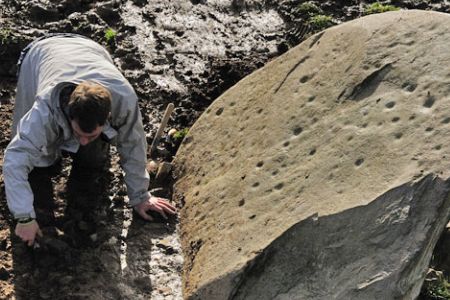
Studies showed that the cupmarks gouged onto the solitary stone represent a section of the night sky that includes the star constellations of Cassiopeia, Orion, Sirius and the North Star.

There are more than 75 cupmarks on the stone, which were revealed through complete exposure of the stone during recent excavations, Archeo News reported.

Until 40 years ago archaeologists assumed that the stone was part of a capstone covering a small burial chamber.

Later geophysical surveys unveiled the remains of a kidney-shaped anomaly, looking like remnants of the cairn that once surrounded the chamber, with an entrance to the east.

Excavations confirmed the site to be a portal dolmen, also exposing a cairn deposit within the eastern and northern sections of the trench.

A clear vertical cut was also found in section, which was parallel with the dip of the former capstone. This showed that the cairn had been excavated into and the capstone set and packed within the existing cairn, probably used as a standing stone during the Early Bronze Age when new burial-ritual monuments were introduced in Western Britain.

Archeologists found medieval and post-medieval pottery shards and two Mesolithic shale beads. They are planning to conduct further excavations in the area to assess the later prehistoric landscape setting and a contour survey of the monument.

Merlin @ Stonehenge
The Stonehenge Stone Circle Website


University student sparks new Stonehenge theory

29 11 2010

Stonehenge

A REVOLUTIONARY new idea on the movement of big monument stones like those at Stonehenge has been put forward by an archaeology student at the University of Exeter.

While an undergraduate, Andrew Young saw a correlation between standing stone circles in Aberdeenshire, Scotland and a concentration of carved stone balls, which may have been used to help transport the big stones by functioning like ball bearings.

Young discovered that many of the late Neolithic stone balls had a diameter within a millimetre of each other, which he felt indicated they would have been used together in some way rather than individually.

By plotting on a map where the carved balls were found, he realised they were all within the vicinity of Neolithic monuments known as recumbent stone circles.

These stone circle monuments in Aberdeenshire share an equivalent form to Stonehenge, yet with some much larger stones.

To test his theory Young built a model using small wooden balls which were placed in a grooved pieces of wood moulding, similar to a railway track but with a groove rather than a rail.

The balls were spread apart and a mirror image of the track was placed on top supporting a wood platform.

He then placed concrete slabs on the tracks, to replicate a heavy weight.

Young said: “I then sat on top of the slabs to add extra weight. The true test was when a colleague used his index finger to move me forward, a mere push and the slabs and I shot forward with great ease.

“This proved the balls could move large heavy objects and could be a viable explanation of how giant stones were moved, especially in relation to where the stone balls were originally found.”

A further experiment on a much larger scale was arranged with the financial assistance of Gemini Productions and WGBH, Boston for NOVA, an American documentary TV programme.

They were focusing on Stonehenge and wanted to see if a team of archaeology students directed by Professor Bruce Bradley, a lead archaeologist at the University of Exeter could build and test a life size model using wood that might reflect how massive stones could have been moved across the landscape.

Previous experiments, which others have carried out to move large stones had not been particularly effective.

The building of a hardened surface to roll logs on and the trench experiments only moved the stone with great effort and if they had been moved in this way the hardened surface or trench would show up in the archaeological record, however these have not been found.

In the large scale experiment, green wood was used for cost purposes. Neolithic people would have had access to much better materials, such as cured oak, which is extremely tough and was in abundance due to the great forests at the time.

They also had the technical ability to cut long timber planks, known through archaeological evidence of planks used as a way of creating tracks for people to walk on through bogs.

The experiment used hand shaped granite spheres as well as wooden spheres.

Professor Bradley said: “Our experiment had to go for the much cheaper option of green wood, which is relatively soft, however, we successfully moved extremely heavy weights at a pace.

“The demonstration indicated that big stones could have been moved using this ball bearing system with roughly ten oxen and may have been able to transport stones up to ten miles per day.

“This method also has no lasting impact on the landscape, as the tracks with the ball bearings are moved along leap-frogging each other as the tracks get moved up the line.”

He added: “It demonstrates that the concept works. It does not prove that Neolithic people used this method, but it was and is possible.

“This is a radical new departure, because previous ideas were not particularly effective in transporting large stones and left unanswered questions about the archaeological record they would have left behind.”

The next stage in the project is to collaborate with the engineering experts at the University who can calculate the loads which could be transported using various combinations of variables such as hard wood and U-shaped grooves.

This will provide the mathematical evidence to see how much force would be needed to get the stone moving and to keep it moving.

This will enable the project team to gain an even greater understanding of how stones may have been transported across huge distances and even up hills.

The ultimate goal is for a full-scale experiment in Aberdeenshire using more authentic materials, stone balls and a team of oxen.

Merlin @ Stonehenge
The Stonehenge Stone Circle Website


New Stone Circle Discovered ? 1000’s years older than Stonehenge.

10 11 2010

A stone circle located high in the highlands of Southern Armenia may in fact be the oldest stone observatory in the world, predating England’s Stonehenge. According to newly started excavations, the Armenian Stonehenge (Karahunj) has a history of 7500 years. It’s discovery has sparked a scientific debate in astronomical and astrological circles. Yerkir Media’s Gayane Avetisyan reports on the story for CNN World View.

7,500-YEAR-OLD STONE CIRCLE IN ARMENIA ALIGNED TO CYGNUS’S BRIGHTEST STAR
A Report by Andrew Collins

A new study into Armenia’s Carahunge stone circle complex, has shown that it is arguably one of the oldest known megalithic sites outside of Turkey, dating to around 5500 BC. Moreover, investigations by Russian prehistorian Professor Paris Herouni indicate that Carahunge (car means “stone” in Armenian, and hunge means “voice” or “sound”), located some 200km from the Armenian capital Yerevan, not far from the town of Sisian, was created as an astronomical observatory marking the movement not only of the sun and moon, but also the stars.

Indeed, Herouni’s work at Carahunge was impressive enough to draw in the expertise of the late Professor Gerald Hawkins, who was impressed by the thoroughness of the survey undertaken by his Russian colleague.

Key hole to Cygnus
More significant is that Carahunge’s principal stellar alignment is towards Deneb, the bright star in the constellation of Cygnus the swan.

One of the holed stones at Carahunge aligned to celestial events and key starsA number of the standing stones bear smooth angled spy holes that are 4 to 5cm in diameter, each one being angled towards different points on the horizon or ancient targets in the heavens.

A key stone had a hole that was focused due north towards the meridian. This suggested that it targeted a bright star at its culmination – i.e. the highest or lowest point it reaches as it revolves around the north celestial pole.

One of the holed stones at Carahunge aligned to celestial events and key stars.
Herouni ran the angle of the stone through various astronomical programmes and found that it was aligned to Deneb at a date of around 5,500 BC, suggesting that this was the time frame in which Carahunge was in use by an advanced society of astronomer priests. It was this alignment that provided the key to finally dating the site, which was expected to have been constructed during this distant epoch.

It is even now being claimed by Professor Herouni that Carahunge is the oldest stone obervatory in the world, although surely the stone setting at Nabta Playa in Egypt’s Libyan desert is at least as old as Carahunge, and arguably older. Plus there are my own findings with respect to the orientations of various Pre-Pottery Neolithic (PPN) sites in southeast Turkey, including the 12,000 year old Gobekli Tepe. In The Cygnus Mystery (2006) I demonstrated that, like Carahunge, they seemed to be orientated towards Cygnus’s brightest star, Deneb.

The importance of Professor Herouni’s findings regarding Carahunge is that in a time frame little different to the Neolithic city of Catal Huyuk in neighbouring Turkey, there was an astronomical observatory in Armenia not just aligned to the sun and moon, but also to the stars, and Cygnus in particular. I suspect that the interest in this star group goes back beyond the PPN sites of southeast Turkey to the Palaeolithic age, and the peoples who created the amazing cave art in Western Europe. Representations of Cygnus certainly exist in the Lascaux cave in the Dordogne region of southern France, and I suspect it is present in various other painted caves as well.

So why was Cygnus important?
Primarily it is because of its use as a time marker, its stars being so close to the north celestial pole they move very little across hundreds of years. Then there is its position on the Milky Way, exactly where this starry stream bifurcates to form what is known as the Cygnus Rift or Dark Rift. Universally, this area of the sky has been seen as the point of access into the sky-world, as well as a place of cosmic birth and death. It was also the place where the souls of the dead travelled in the afterlife, very often accompanied by, or in the form of, a bird, seen as a psychopomp, a soul carrier. Very often the identity of these birds corresponded with how the stars of Cygnus were represented in regional mythologies – a falcon in Egypt, a vulture on the Euphrates and a swan in Hellenic Greece and Turkey.

I am not surprised that Carahunge is aligned to Cygnus, although it is always pleasing when one’s theories are shown to be real. I think that in years to come we shall find a lot more about the cult of the swan, and its relationship to the earliest sky-religions of the ancient world. I also think there is much more to learn about the prehistoric beliefs of the proto Armenians, and how they held true age old beliefs that went back all the way to Palaeolithic times.

Professor Herouni has published a book of his findings with respect to Carahunge. Entitled ARMENIANS AND OLD ARMENIA “, it provides compelling evidence that this impressive megalithic site of over 200 standing stones spread out across 7 hectacres, was constructed and used by an advanced civilization. The book provides a detailed explanation of how the stone monument works as an astronomical observatory, and explains its context as the foundation point of Armenia and Armenian history.

Merlin @ Stonehenge
The Stonehenge Stone Circle Website