World Heritage Site Landscape Project: Stonehenge, Amesbury, Wiltshire

10 06 2011

Summary of an English Heritage Report on Stonehenge by David Field and Trevor Pearson:

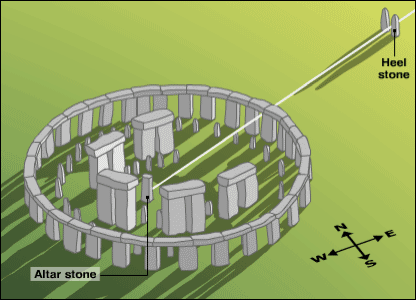
Analytical survey of the ground surface at Stonehenge revealed the presence of a number of interesting earthworks that have a bearing on interpretation and the development of the monument. Chief among these is a low mound that was revealed within the stone settings. Its location focuses attention on that part of the arrangement which is ruinous and supplements former reservations as to whether the monument was ever complete. Survey also revealed that the Y and Z holes are visible asStonehenge plan earthworks and that each circuit has a shallow bank within it. The feature known as the North ‘Barrow’ may have preceded the enclosure and therefore be one of the earliest elements at the site. The South ‘Barrow’ by contrast is, at least in one of its phases, a later feature. These are clearly not barrows and the more neutral term ‘circles’ is therefore preferred. An outer bank to the enclosure has been largely truncated by cultivation, while a mis-match of the Avenue at the enclosure entrance indicates that the two may have been mutually exclusive entities. The eastern ditch and bank of the Avenue is revealed to have changed course, perhaps in an attempt to avoid the pre-existing ditch around the Heel Stone.

http://services.english-heritage.org.uk/ResearchReportsPdfs/109_2010WEB.pdf
http://heritageaction.wordpress.com

Sponsored by ‘The Stonehenge Tour Company’ www.StonehengeTours.com

Merlin @ Stonehenge
The Stonehenge Stone Circle Website


A Stonehenge found in America. Is it bigger and better ? Probably…..

28 05 2011

A Stonehenge under Lake Michigan
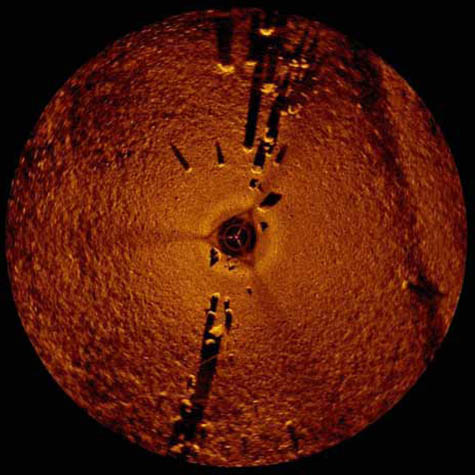
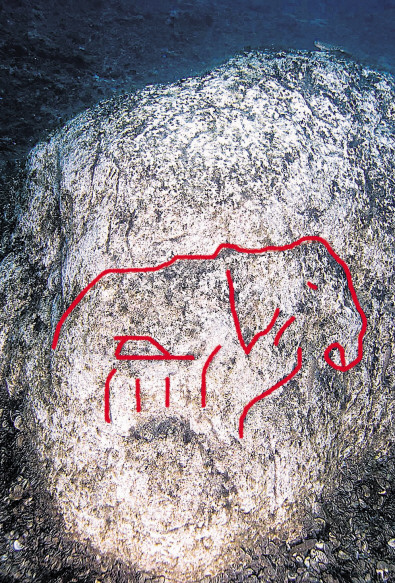
While scanning underneath the waters of Lake Michigan for shipwrecks, archeologists found something a lot more interesting than they bargained for, as they discovered a boulder with a prehistoric carving of a mastodon, as well as a series of stones arranged in a Stonehenge-like manner.

Stonehenge found under Lake Michigan

Stonehenge found under Lake Michigan

At a depth of about 40 feet into Lake Michigan’s Grand Traverse Bay, using sonar techniques to look for shipwrecks, archeologists discovered sunken boats and cars and even a Civil War-era pier, but among all these they found this prehistoric surprise, which a trained eye can guess by looking at the sonar scans photos in this article.

“When you see it in the water, you’re tempted to say this is absolutely real,” said Mark Holley, a professor of underwater archaeology at Northwestern Michigan University College who made the discovery, during a news conference with photos of the boulder on display in 2007. “But that’s what we need the experts to come in and verify.

The boulder with the markings is 3.5 to 4 feet high and about 5 feet long. Photos show a surface with numerous fissures. Some may be natural while others appear of human origin, but those forming what could be the petroglyph stood out, Holley said.

Viewed together, they suggest the outlines of a mastodon-like back, hump, head, trunk, tusk, triangular shaped ear and parts of legs, he said.

“We couldn’t believe what we were looking at,” said Greg MacMaster, president of the underwater preserve council.

Specialists shown pictures of the boulder holding the mastodon markings have asked for more evidence before confirming the markings are an ancient petroglyph, said Holley.

“They want to actually see it,” he said. Unfortunately, he added, “Experts in petroglyphs generally don’t dive, so we’re running into a little bit of a stumbling block there.”

If found to be true, the wannabe petroglyph could be as much as 10,000 years old – coincident with the post-Ice Age presence of both humans and mastodons in the upper midwest. The formation, if authenticated, wouldn’t be completely out of place. Stone circles and other petroglyph sites are located in the area.

The discovery was made back a few years ago, and surprisingly enough the find hasn’t been popularized at all, with little to no information available online, but I’ll be sure to update this post as soon as I can get ahold of more info. So, who’s from Michigan?

Sponsored by the ‘Stonehenge Tour Company’ – www.StonehengeTours.com

Come and visit Stonehenge in England – you went get wet at this one!

Merlin @ Stonehenge
The Stonehenge Stone Circle website

Follow me on twitter for all the latest Stonehenge (U.K) news:
http://www.twitter.com/ST0NEHENGE


Mystery origins of Stonehenge unravelling

9 05 2011

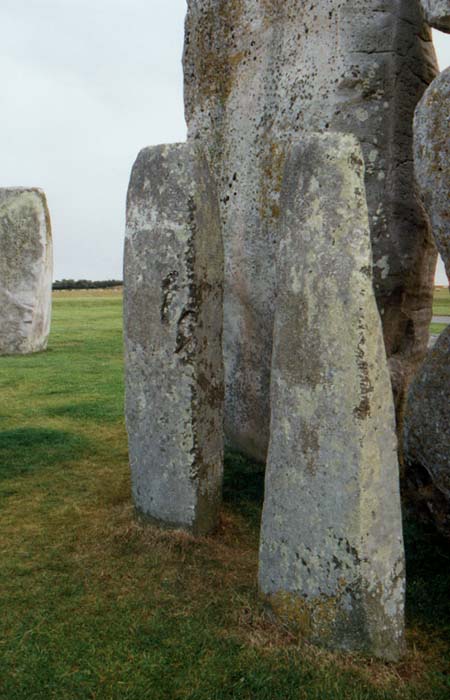
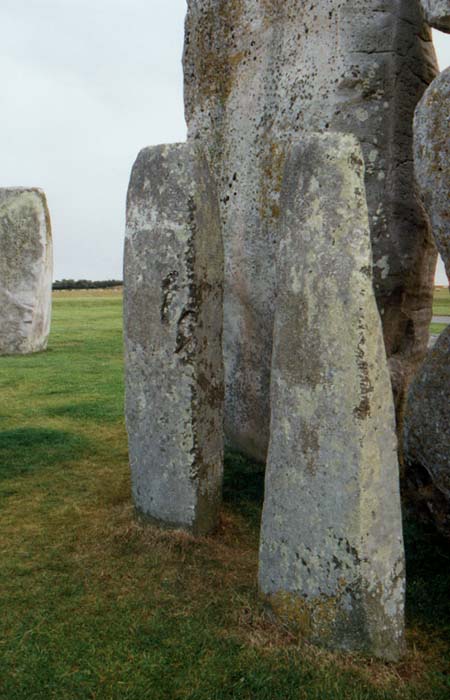
Stonehenge is an ancient site which dominates Salisbury Plain in the south Stonehenge Blue Stoneswest of England. Much of where the stones came from and how they were moved is still an enigma.

Built around 3100 BC, the origins and purpose remains the subject of much debate around the world.

At the National Museum of Wales in Cardiff some detective work is taking place that could help solve this historical conundrum.

With precision and patience Dr. Richard Bevins is examining a minute piece of stone that is part of a 5000-year-old mystery.
Under his microscope is a sample taken from Stonehenge.

Bevins says the whereabouts of some of the stones is already known.

“Stonehenge comprises an outer circle, an inner circle and an inner horseshoe. The outer circle, which are the very big stones are actually local to the Stonehenge area, to Salisbury Plain.”

In the 1920s scientists traced the origins of the remaining stones, known as Bluestones, to an unspecified part of the Preseli Hills in Pembrokeshire, West Wales.

This is 240km from Stonehenge. It remains unclear how an ancient civilisation would have transported such heavy stones such a huge distance.

Bevins says: “These stones that form the inner circle and the inner horseshoe, the Bluestones, they still weigh two to three tons so they’re substantial pieces of rock to be moving around the countryside, if it was humans.”

A unique discovery is now fuelling further debate about how the architects of Stonehenge moved their building materials from Wales to the south west of England.

Dr. Bevins and a team of scientists have matched stone samples from Stonehenge with ones taken from the Preseli Hills and uncovered their precise origin.

They have done it by using new technologies by analysing and comparing their mineral content.

“We got a good match in terms of what they looked like in hand specimen and down the microscope,” says Bevins. “But we wanted to go one stage further, we wanted to have a diagnostic technique, we wanted some data.”

Still in Wales, at the University of Aberystwyth, geochemist Dr Nick Pearce was tasked with analysing the zircon crystals that are embedded in the stone samples.

He pioneered a technique that uses a laser to vaporise the crystals so that their chemical make up can be scrutinised.

Pearce explains how the technique works.

“We get hold of the samples as thin sections. We’ve identified in those where the grains of zircon are that we want to analyse and then we put those samples into the glazer abrasion ISO PMS system, fire a very powerful laser on top of the samples, on the individual grains within the sample. The vapour gets transported then into a mass spectrometer and we analyse the components of that mineral grain.”

By matching the chemical finger prints of their stone samples they have proven the origin of stones used to build parts of Stonehenge.

In a picturesque and quiet corner of West Wales called Pont Saesnon is a rocky outcrop that looks like any other in this mountainous country.

But thousands of years ago it provided the building blocks for the ancient structure of Stonehenge that still captivates people today.

Pearce says their research has located the exact spot the stones came from.

“It pins them down to place where nobody has really considered they came from before; on the north side of the Preseli Hills in North Pembrokeshire and not localities on the top of the Presellis.”

The unearthing of the stone’s origins also challenges the theories on how the builders of Stonehenge transported their materials to Salisbury Plain.

“It was always thought they were transported by humans south down towards the Bristol Channel and put onto rafts at Milford Haven. Well this location changes that perspective,” Bevins says.

It’s now thought the stones took an alternative route and travelled 16km west to the natural harbours that dot the Welsh coastline then shipped to their final resting place on Salisbury Plain, in England.

This theory now needs to be tested by archaeologists.

These new discoveries bring people who are fascinated with Stonehenge one step closer to unlocking its mysteries.

More information: http://www.3news.co.nz/
Sponsored by ‘The Stonehenge Tour Company’ www.StonehengeTours.com

Merlin @ Stonehenge
The Stonehenge Stone Circle Website


Scientists ‘step closer’ to solving Stonehenge mystery

23 02 2011

IT is a mystery that has baffled geologists and historians for centuries… how were the Stonehenge rocks transported from Wales’ Preseli mountains to their resting place 120 miles away.

Scientists are today one step closer to solving the 4,000-year- old mystery after making their most significant discovery in 15 years.

Of the six to eight different bluestone types found in the inner circle of rocks on Salisbury Plain, only one, the so- called “spotted dolerite”, was convincingly traced to the Mynydd Preseli area in north Pembrokeshire in the early 1920s.

But modern technology has now assisted geologists at Amgueddfa Cymru – National Museum Wales – in creating a “fingerprint” for one of the other rock types found in Wiltshire.

And that “fingerprint” has been identically matched to stones found in an area north of the Mynydd Preseli range, in the vicinity of Pont Saeson.

The discovery means archaeologists are now a step closer to retracing the footsteps of Neolithic engineers who moved the stones in the first place.

Dr Richard Bevins, Keeper of Geology at Amgueddfa Cymru, said: “The outer circle of Stonehenge is made up from stones sourced locally in Salisbury Plain but it is the mismatch of rocks found in the inner circle that have caused so much mystery.

“We have known for some time that spotted dolerite came from Preseli but of those remaining stones we think that six to eight more may have come from Pembrokeshire, until now though we haven’t been able to be sure because the stones are very fragile and we didn’t previously have the technology to extract their DNA.”

Dr Bevins added: “Theoretically if we could trace the source of the other rhyolites (rock types) we could create a map with six or more locations pinpointing where each stone was sourced.

“Archeologists could then essentially see the route that was taken by these people, they could re-trace those steps, set up archaeological digs and make who knows how many new discoveries.

“In terms of looking at where the stones came from this is the most important discovery we’ve made regarding Stonehenge in 10 or 15 years.”

Dr Bevins, in partnership with Dr Rob Ixer at the University of Leicester and Dr Nick Pearce of Aberystwyth University, made the discovery by analysing microscopic crystals found in the rock, vaporising them and analysing the gases found as a result.

The composite of gases makes up the rock’s DNA which can then be matched to other rock forms.

Sourcing the rhyolites also provides the opportunity for new thoughts on how the stones might have been transported to the Stonehenge area.

Much of the archaeology in recent years has been based on the assumption that Neolithic Age man had a reason to transport bluestones all the way from West Wales to Stonehenge and the technical capacity to do it.

Dr Bevins said: “It has been argued that humans transported the spotted dolerites from the high ground of Mynydd Preseli down to the coast at Milford Haven and then rafted them up the Bristol Channel and River Avon to the Stonehenge area.

“However, the outcome of our research questions that route, as it is unlikely that they would have transported the Pont Saeson stones up slopes and over Mynydd Preseli to Milford Haven, we would assume that they would not carry the rocks up and over a steep mountain range.

“If humans were responsible then an alternative route might need to be considered.”

Some believe that the stones were transported by the actions of glacier sheets during the last glaciation and so the Pont Season discovery will need appraising in the context of this hypothesis.

Mike Parker Pearson, Professor of Archaeology at Sheffield University, added: “This is a hugely significant discovery which will fascinate everyone interested in Stonehenge.

“It forces us to re-think the route taken by the bluestones to Stonehenge and opens up the possibility of finding many of the quarries from which they came.

“It’s a further step towards revealing why these mysterious stones were so special to the people of the Neolithic.”

Read More http://www.walesonline.co.uk/news/wales-news/2011/02/23/scientists-step-closer-to-solving-stonehenge-mystery-91466-28216698/#ixzz1ElvHUPjT

Merlin @ Stonehenge


Stonehenge rocks definitely came from Wales, but how?

23 02 2011

New research has cast fresh doubt on the journey which the Stonehenge Bluestones took from Pembrokeshire to the site of the pagan monument.

Since the 1920s, geologists have strongly suspected that the ‘spotted dolerite’ Bluestones, which form Stonehenge’s inner ring, originated from Mynydd Preseli in the north of the county.

However, whilst the new findings have also linked a second type of stone – rhyolites – to the area, they call into question how the stones arrived in Wiltshire.

Matching up the rock from Stonehenge with a rock outcrop in Pembrokeshire has been a bit like looking for a needle in a haystack”
Dr Richard Bevins National Museum Wales

Perceived wisdom had it that Stone Age man transported the giant slabs via raft, up the Bristol Channel and River Avon.

But as Pont Saeson, the location of the new match, is to the north of the Preselis, some believe its unlikely that they would have been able to navigate the terrain in order to get the enormous rocks to the coast.

An alternative theory was that nature drove the stone to Stonehenge, in the path of an Ice Age glacier, although the absence of any other Welsh rock in the region seemed to have ruled out the possibility.

Yet Dr Richard Bevins, a geology expert from the museum which collaborated in the research by Aberystwyth and Sheffield Universities, believes it may now be time to revisit the idea.

“If humans were responsible then an alternative route might need to be considered. However, if, as some believe, the stones were transported by the actions of glacier sheets during the last glaciation, the Pont Season discovery will need appraising in the context of this hypothesis.”

“It’s a further step towards revealing why these mysterious stones were so special to the people of the Neolithic”
 Prof Mike Parker Pearson Sheffield University

“Matching up the rock from Stonehenge with a rock outcrop in Pembrokeshire has been a bit like looking for a needle in a haystack, but I’ve looked at many if not most outcrops in the Mynydd Preseli area.

“We are however, confident that we have found the source of one of the rhyolites from Stonehenge because we’ve been able to make the match on a range of features not just a single characteristic. Now we are looking for the sources of the other Stonehenge volcanic and sandstone rocks”.

Dr Bevins’ team are able to say so categorically that they’ve discovered the source of the rhyolites, thanks to a range of laser mass spectrometry techniques, which analyse both the chemical composition of the rock and the micro-biology present when it was formed.

The combination of the two provides an almost unique signature for rocks only found in the Pont Saeson area.

But the new match does explain the absence of any other Welsh Bluestone in the Stonehenge area, if indeed glaciation was responsible for carrying them there.

Prof Mike Parker Pearson, from Sheffield University, called it a “a hugely significant discovery which will fascinate everyone interested in Stonehenge”.

“It forces us to re-think the route taken by the Bluestones to Stonehenge and opens up the possibility of finding many of the quarries from which they came.

“It’s a further step towards revealing why these mysterious stones were so special to the people of the Neolithic.”

Merlin @ Stonehenge
THe Stonehenge Stone Circle Website


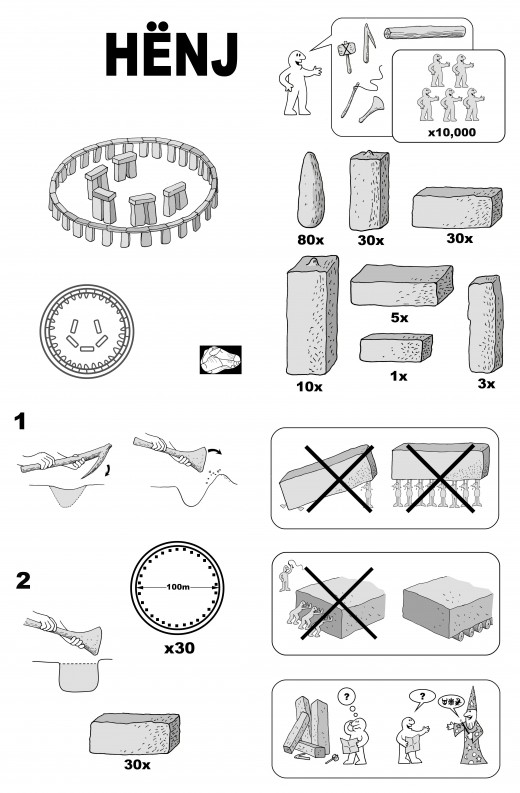
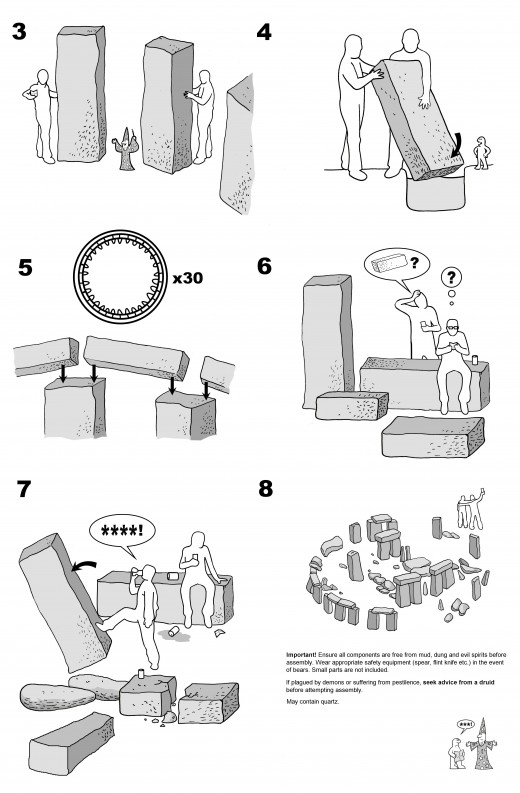
Ikea Stonehenge (HENJ) DIY flat-pack henge.

18 02 2011

Ikea Henge

Ikea Henge

Ikea Henge (Henj)

Ikea Henge (Henj)


Don’t forget “When all else fails, read the instructions”

Have a great weekend…………..
Merlin @ Stonehenge
The Stonehenge Website


STONEHENGE MODEL IS TOURING THE UK!

7 02 2011

To celebrate the new BBC Two series on the Ancient Britons, a Stonehenge model is touring the UK. 

English Heritage policy researchers, archaeological investigators, surveyors and historians have all been keen to join forces and investigate a variety of archived information, including 3D data from a previous survey of the monument in 1993, old plans and photos of the 1958 re-erection, in order to supply correct dimensions.

Others have also helped to supply images, information and check details for a series of popular, jointly branded learning resources as part of an ongoing partnership between BBC Learning and English Heritage Education.

Resources on the Normans went down well at English Heritage properties last year and prehistory timelines and group activity guides are currently being handed out free of charge to families and learning groups visiting Stonehenge.

All these can also be downloaded from the BBC Hands on History website where teachers, parents and students can also find events, a map of sites to visit, animations featuring the Hands on History mini-time traveller, Eric and more.

The Stonehenge road show will challenge families to help solve the mystery of how the stones were moved and also feature interpretation boards and an interactive mini drama led by historical interpreters. It is scheduled to visit shopping centres in five locations from 11.00am – 15.30pm:

  • Monday 21 February: Queen’s Arcade, Cardiff
  • Tuesday 22 February: thecentre:mk, Middleton Hall, Milton Keynes 
  • Wednesday 23 February: Swindon Designer Outlet
  • Thursday 24 February: Westfield Derby
  • Friday 25h February: MetroCentre, Gateshead

Stonehenge model is touring the UK. 

English Heritage experts are helping BBC Hands on History make the most of a new BBC Two TV series, ‘A History of Ancient Britain’, scheduled to start on 9 February. They are pulling out all the stops to get an inflatable scale model of one Stonehenge trilithon (two uprights and a lintel) as accurate as possible before it goes on a whistle-stop tour of five city centre shopping centres from 21-25 February

English Heritage policy researchers, archaeological investigators, surveyors and historians have all been keen to join forces and investigate a variety of archived information, including 3D data from a previous survey of the monument in 1993, old plans and photos of the 1958 re-erection, in order to supply correct dimensions.

Others have also helped to supply images, information and check details for a series of popular, jointly branded learning resources as part of an ongoing partnership between BBC Learning and English Heritage Education.

Resources on the Normans went down well at English Heritage properties last year and prehistory timelines and group activity guides are currently being handed out free of charge to families and learning groups visiting Stonehenge.

All these can also be downloaded from the BBC Hands on History website where teachers, parents and students can also find events, a map of sites to visit, animations featuring the Hands on History mini-time traveller, Eric and more.

The Stonehenge road show will challenge families to help solve the mystery of how the stones were moved and also feature interpretation boards and an interactive mini drama led by historical interpreters. It is scheduled to visit shopping centres in five locations from 11.00am – 15.30pm:

  • Monday 21 February: Queen’s Arcade, Cardiff
  • Tuesday 22 February: thecentre:mk, Middleton Hall, Milton Keynes 
  • Wednesday 23 February: Swindon Designer Outlet
  • Thursday 24 February: Westfield Derby
  • Friday 25h February: MetroCentre, Gateshead

English Heritage – http://www.english-heritage.org.uk/

Has anyone got a photo of the model they can send me ?
Merlin @ Stonehenge
The Stonehenge Stone Circle Website


Sarsen stones – Shaped like wood 42 centuries ago

5 02 2011

Sarsen stones are the very large stones that forms the outer circle at Stonehenge.

These stones are a very hard type of sandstone. Now to give one a clear idea as to how hard this particular stone is we will take a look at the Mohs scale.

The Mohs scale is simply a measurement used to measure the surface resistance to abrasion of any hard substance.

That just means that if we take a hammer and bash the stone how much will it resist before we can knock a chunk off it.

Sarsen stone measures a seven (7) on the Mohs scale.

Now, if we compare the surface resistance of sarsen stone to that of steel we find that steel measures 6,7 on the same scale.

So, we now know that sarsen stone is a very hard stone and we can appreciate how difficult it must have been to shape the stone with ancient tools.

Sarsen stones were worked and dressed with other sarsen stone which were round balls of stone known as mauls. The mauls were of various sizes and can today be viewed at the Salisbury museum.

From exploration at Stonehenge it would appear that there were 30 stones that were used as “uprights”.

Of these “uprights” 29 of them were shaped to the same basic size.

When the sarsen “uprights” were placed into position they were then capped with a line of sarsen stone lintels.

The lintels weighs up to seven tons ( 7,000kg.) each.

To fix the lintels securely in position thirteen feet or 4m. above the ground these lintels were locked together like pieces in a jigsaw.

The lintels were held in place on the upright sarsen stones by mortice-and-tenon joints which was carved out of the solid stone.

The lintels in the circle were then locked end-to-end by a method known as vertical tongue and groove joints.

The vertical tongue and groove jointing techniqueThe jointing techniques used on the sarsen stones are all from the wood joiners craft.

Another amazing feature is that the lintel circle of sarsen stones were shaped to follow the curve of the circle which is both a design and engineering feature.

Merlin @ Stonehenge
The Stonehenge Stone Circle Website


Book Extract: Stonehenge by Rosemary Hill

8 01 2011

Hill’s Stonehenge surveys the endless speculations around this mysterious monument

Antiquaries were a relatively new intellectual species, largely a
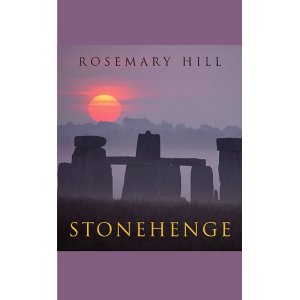
Rosemary Hill - Stonehenge

Rosemary Hill - Stonehenge

product of the Reformation, and they were interested in what could be discovered of the past by looking beyond the written records. They studied anything that was old – stones, metal, pottery, coins – attracting in the process much derision from contemporaries who thought it an “unnaturall disease” to be so “enamour’d of old age and wrinkles”. Yet the antiquaries were the first archaeologists. They were also the first oral historians, costume historians, art historians and folklorists. They opened up vast intellectual horizons and if, as later archaeologists have sometimes been quick to point out, they made mistakes, they were not alone in that and, working in an age before academic specialisation, before science and the arts had parted company, they were also able to make daring and useful connections.

It was James I, who prided himself on being up to date with intellectual fashion, who initiated the archaeological investigation of Stonehenge, although as befits the man known as “the wisest fool in Christendom” his efforts had mixed results. Staying nearby at Wilton House in 1620, he expressed an interest in the stones. Since the Reformation the land on which Stonehenge stood had passed into private hands and it was to remain private property until the 20th century. James’s intimate friend the Duke of Buckingham, eager to please, immediately tried to buy it for the King. The owner, however, refused to sell, so Buckingham had to be content with digging an enormous hole in the middle of it, from which he removed various objects now lost and, as John Aubrey later thought, caused one of the stones (stone 56) to tilt over “by being underdigged”. After this unpromising start the King approached the Royal Surveyor, Inigo Jones, and asked him to produce a report. Jones’s Stone-Heng Restored appeared posthumously in 1655. It was the first book entirely devoted to the subject and it argued that Stonehenge was Roman. The reaction that this theory provoked kick-started the antiquarian investigation of Stonehenge. If there was anything the typical antiquary liked more than proving himself right, it was proving somebody else wrong, and Jones’s book prompted two people, Walter Charleton and his friend John Aubrey, to throw their energies into discrediting it.

The archaeologist Jacquetta Hawkes famously remarked that every age “has the Stonehenge it deserves – or desires” and the Stonehenge of the Stuart antiquaries was born of the age that saw the foundation of the Royal Society, the wider exploration of the Americas and a new Baconian spirit of critical enquiry, in which nature and mathematics were the ultimate authorities. This critical, analytical cast of mind brought about a change in attitudes to the past and to the study of it. Until then history had been narrated, chiefly, as the story of a Golden Age, with everything since a long-protracted fall. “Till about the yeare 1649,” as Aubrey noted, “’twas held a strange presumption for a man to attempt an innovation in learning; and not to be good manners to be more knowing than his neighbours and forefathers.” Enquiry now was all the rage, but it was tinged also with melancholy and foreboding. The generation of antiquaries that had lived through the Civil Wars had seen towns and families divided. They had watched Puritans smash stained glass and knock the heads off the statues in churches; they feared for the past and for the future. Charleton, who was the first to respond to Inigo Jones, had been particularly close to these events as physician to Charles I and later to his son in exile. His book, Chorea Gigantum Or, The Most Famous Antiquity of Great Britain, Vulgarly called Stone-heng, was published in 1663. When Charleton looked at the monument he saw the stones “sleeping in deep forgetfulness, and well-nigh disanimated by the Lethargy of Time”. But he also saw the spot where Charles II, now restored as king, had paused on his flight after the Battle of Worcester at one of the most desperate moments of his life. Both images haunt Charleton’s treatise and inform its surprising conclusion that the circle was the work of the Danes.

The argument was based on some, admittedly rather loose, comparisons with the stone circles of Denmark documented by his Danish friend and fellow antiquary Ole Worm, but the method was new and not naïve. In trying to understand Stonehenge in its own terms, without magic and in relation to the other similar monuments, Charleton was a pioneer. The dedicatory poem that prefaces Chorea Gigantum was written by John Dryden and it associates Charleton firmly with the new spirit of “free-born Reason”. From now on the attempt to “make Stones to live” was to be on a par with medicine and exploration as a proper study for the best minds. In the end Charleton’s thesis found by analogy with Denmark that Stonehenge was not a temple, or the tomb of Boadicea as Edmund Bolton had suggested in 1624, but a meeting place for the election and coronation of kings. This was an especially happy conclusion given that Charleton’s book was dedicated to his employer, Charles II. As Dryden put it:

These Ruins sheltred once His Sacred Head,
Then when from Wor’ster’s fatal Field He fled…
His Refuge then was for a Temple shown:
But, He Restor’d, ’tis now become a Throne.

Charleton is usually written off as a sycophant as well as a poor scholar. Yet in so far as his book is a political statement, and there are few antiquarian texts of the 17th century which are not, he is no simple-minded royalist. Chorea Gigantum is not an endorsement of the Divine Right of Kings but of popular leaders, governing “by the general suffrage of the assembly”. It dwells, to the point of tactlessness in the circumstances, on the fact that the Danes were republicans. Charleton’s Stonehenge is an emblematic reminder to the restored monarch that he reigns only with the people’s consent.

The treatise concludes somewhat smugly that “this Opinion of mine, if it be erroneous, is yet highly plausible; having this advantage over the others… that it is not so easily to be refuted”. Charleton was wrong about that as well and he was not to rest on his laurels for long.

© Rosemary Hill 2008
Stonehenge’ by Rosemary Hill is published by Profile, £15.99
Buy the book here: Stonehenge (Wonders of the World)

About the author Rosemary Hill is a Fellow of the Society of Antiquaries, a trustee of the Victorian Society and a Brother of the Artworkers’ Guild. Her biography of AWN Pugin, ‘God’s Architect’, was published in 2007. She was born in London, where she lives with her husband, the poet Christopher Logue.

Well worth a read………………….
Merlin @ Stonehenege
The Stonehenge Stone Circle website


Stonehenge Winter Solstice 21stDecember 2010

21 12 2010

I went to Stonehenge this morning hoping to witness the Lunar eclipse between 7.30am and 8am.  Sadly there was freezing fog and a snowy sky?  It was a pleasant surprise to find that English Heritage decided to grant access into Stonehenge today as well as tomorrow (22nd)  There were a few hundred ‘happy’ people, a pagan wedding and a small Druid ceremony.  It was extremely cold but well worth it. 
I have uploaded these photos for your perusal – hot off the press!  They anticipate 2-3000 people for tomorrows Solstice celebrations – See you there!

This slideshow requires JavaScript.


Happy Solstice
Merlin @ Stonehenge
The Stonehenge Stone Circle Website