Druids Recognized As Religion For First Time In UK

3 10 2010
 

 Druids have been worshipping the sun and earth for thousands of years in Europe, but now they can say they’re practicing an officially recognized religion.

The ancient pagan tradition best known for gatherings at Stonehenge every summer solstice has been formally classed as a religion under charity law for the first time in Britain, the national charity regulator said Saturday. That means Druids can receive exemptions from taxes on donations — and now have the same status as such mainstream religions as the Church of England.

The move gives an old practice new validity, said Phil Ryder, the chairman of the 350-member Druid Network.

“It will go a long way to make Druidry a lot more accessible,” he said.

Druids have practiced for thousands of years in Britain and in Celtic societies elsewhere in Europe. They worship natural forces such as thunder and the sun, and spirits they believe arise from places such as mountains and rivers. They do not worship a single god or creator, but seek to cultivate a sacred relationship with the natural world.

Although many see them as robed, mysterious people who gather every summer solstice at Stonehenge — which predates the Druids — believers say modern Druidry is chiefly concerned with helping practitioners connect with nature and themselves through rituals, dancing and singing at stone circles and other sites throughout the country believed to be “sacred.”

Ancient Druids were known to be religious leaders, judges and sages among the Celts during pre-Christian times, although little evidence about their lives survived. There are now various Druid orders and about 10,000 practitioners in Britain — and believers said the numbers are growing because more people are becoming aware of the importance to preserve the environment.

The Druid Network fought for nearly five years to be recognized under the semi-governmental Charity Commission, which requires proof of cohesive and serious belief in a supreme entity and a moral framework.

After initially rejecting the Druid Network’s application, the Charity Commission decided this week that Druidry fit the bill.

“There is sufficient belief in a supreme being or entity to constitute a religion for the purposes of charity law,” the commission said.

Adrian Rooke, a Druid who works as a counselor, said Druidry appeals to people who are turning away from monotheistic religions but still long for an aspect of spirituality in their lives.

“It uplifts the spirit,” he said. “The world is running out of resources, and in that context it’s more important to people now to formulate a relationship with nature.”

2_Britain_Druids_Recognized.sff.jpg

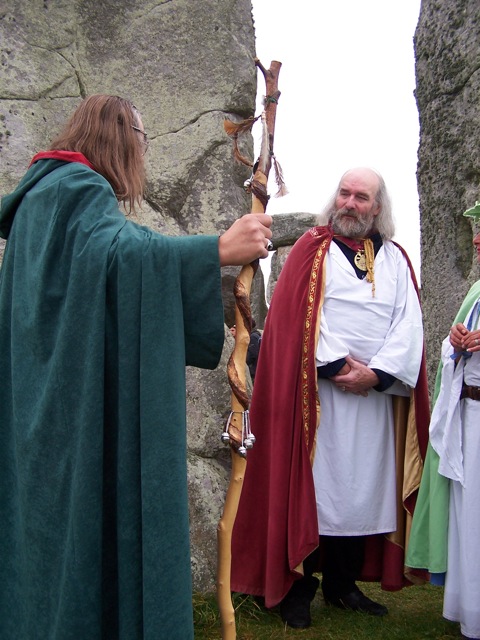
Associated Press Druids performing pagan rituals as part of the Summer Solstice ceremonies at Stonehenge, Wiltshire, England, before dawn, Monday June 21, 2004. The stone circle at Stonehenge is believed to be at least 4,500 years old. Druidry has been officially recognized as a religion in Britain under charity law. The Charity Commission has granted the Druid Network charitable status, giving it tax breaks and equal status to mainstream religions like Christianity. The commission said Saturday Oct. 2, 2010, that druidry has a coherent and serious set of beliefs and that it offers a beneficial ethical framework.

1_Britain_Druids_Recognized.sff.jpg

 Associated Press This Tuesday Aug. 10, 1999 photo from files shows Arch Druid Ed Prynn as he calls down the sun during his sun dance around a ring of stones, in St. Merryn, England. The druid dance is to celebrate the total eclipse of the sun, which is due in this part of southwest England on August 11. Druidry has been officially recognized as a religion in Britain under charity law. The Charity Commission has granted the Druid Network charitable status, giving it tax breaks and equal status to mainstream religions like Christianity. The commission said Saturday that druidry has a coherent and serious set of beliefs and that it offers a beneficial ethical framework.

More information try these links:

British Druid Order

The British Druid Order (BDO) teaches and practices a shamanic, mystical, celebratory form of Druidry, inspired by the past but deeply relevant to the
www.druidry.co.uk/

The Official Website Of The Council Of British Druid Orders – (CoBDO)™

The Council of British Druid Orders, CoBDO, would like to recommend one of our initial co-founders, who at present is not a member, the Order of Bards,
http://www.cobdo.org.uk/

Merlin @ Stonehenge
The Stonehenge Stone Circle Website


Solving Stonehenge – The experts gather……….

23 09 2010

LEADING experts on Stonehenge will be gathering in Salisbury to debate the monument’s purpose next weekend.

The event, called Solving Stonehenge, is part of Salisbury & South Wiltshire Museum’s 150th anniversary conference on October 2 and 3, 2010

The main speakers will be Professor Tim Darvill, Professor Mike Parker Pearson, Mike Pitts and Julian Richards.

The debate will be chaired by Andrew Lawson.

Museum director Adrian Green said: “This is the first time that all the leading Stonehenge archaeologists have been gathered together for a public debate in recent times.

“With all their conflicting opinions about the role of the monument, and the opportunity for the public to quiz the archaeologists, this promises to be a thought-provoking event.”

There will also be a paper about recent survey work at Stonehenge by English Heritage archaeologist David Field on Saturday afternoon and a tour of the Stonehenge landscape on Sunday afternoon.

Stonehenge has been a vital part of the history of Salisbury Museum. The first official guidebook to the stones was written by former curator and director Frank Stevens in 1916.

The museum’s collections contain finds from every major excavation at the site, and since Victorian times it has had permanent displays about the monument.

Tickets for the whole conference, including a buffet, are £60 for members and £75 for non-members. Separate tickets for the Stonehenge debate are £15.
Tickets on 01722 332151          museum@salisburymuseum.org.uk // <![CDATA[
document.write( '‘ );
// ]]>This e-mail address is being protected from spambots. // <![CDATA[
document.write( '’ );
// ]]>
For media enquiries speak to Administration and Marketing Officer Sara Willis.

See you there………

 Merlin @ Stonehenge
The Stonehenge Stone Circle Website


Autumn Equinox 2010 – Stonehenge Celebrations

23 09 2010

Stonehenge Autumn Equinox 2010

 The Autumn Equinox (also known as Mabon) is celebrated when day and night are of equal duration before the descent into increasing darkness and is the final festival of the season of harvest.  For many pagans, this is the time to reflect on the past season, and to recognize the balance of the year has changed.

Although the Summer Solstice at Stonehenge attrackts a large crowd, you may expect the Autumn Equinox celebrations to be less attended, with fewer than 1,000 people showing up.

The 2010 Autumnal Equinox takes place on September 23th, at 4.03am UK time (3.03 UTC), but when ‘open access’ to Stonehenge starts is decided by English Heritage and depends on visibility. The sunrise is at 6.48am, and it is expected access to the stones will be allowed from approximately 6.30 to 8.30am.

Public access to Stonehenge is denied after dark, so if you want to see the sunset on September 22th (18.59pm), you’ll have to stand on either the Avenue or on the side of the A344

The Autumnal Equinox

In September is the Fall Equinox, which has come to be called Mabon by many contemporary Neo-Pagans. Occuring approximately on September 21st, this is the day when the hours of daylight and nighttime are once again balanced. Calender days from now until the Winter Solstice will slowly get shorter and shorter in their daylight hours.

Agriculturally, this time of year the harvest is now in full swing, with late summer and fall fruits, vegetables and grains being gathered up before winter. This is the time of year a lot of canning or preserving of garden foods takes place. Hunting season also starts around this time, and this was when farmers would slaughter animals and preserve meat for the coming months as well.

This holiday is the last of the harvest holidays which began with the summer solstice and continued with Lammas.


21st/23rd September Harvest time!
The Autumn Equinox or Harvest Home is also called Mabon, pronounced ‘MAY-bon’, after the Welsh god Mabon ap Modron, which means literally ‘son of mother’. Mabon appears in ‘The Mabinogion’ tale. The Druids call this celebration, Mea’n Fo’mhair, and honour The Green Man, the God of the Forest, by offering libations to the trees. The Welsh know this time as ‘Alban Elfed’, meaning ‘light of autumn’. This is the point of the year when once again day and night are equal – 12 hours, as at Ostara, the Spring Equinox. The Latin word for Equinox means ‘time of equal days and nights’. After this celebration the descent into winter brings hours of increasing darkness and chiller temperatures. It is the time of the year when night conquers day. After the Autumn Equinox the days shorten and nights lengthen. To astrologers this is the date on which the sun enters the sign of Libra, the scales, reflecting appropriately the balanced day and night of the equinox. This was also the time when the farmers brought in their harvested goods to be weighed and sold.
Harvest festival This is the second festival of the season of harvest – at the beginning of the harvest, at Lammas, winter retreated to his underworld, now at the Autumn equinox he comes back to earth. For our Celtic ancestors this was time to reflect on the past season and celebrate nature’s bounty and accept that summer is now over. Harvest Home marks a time of rest after hard work, and a ritual of thanksgiving for the fruits of nature. This is the time to look back on the past year and what you have achieved and learnt, and to plan for the future. The full moon nearest to the Autumn Equinox is called the Harvest Moon and farmers would harvest their crops by then, as part of the second harvest celebration. Mabon was when livestock would be slaughtered and preserved (salted and smoked) to provide enough food for the winter. At the South Pole they will be celebrating the first appearance of the sun in six months. However, at the North Pole they will be preparing for six months of darkness. During Medieval times, the Christian Church replaced Pagan solstices and equinox celebrations with Christianized occasions. The Autumn equinox celebration was Michaelmas, the feast of the Archangel Michael.

The triple Goddess – worshipped by the Ancient Britons, is now in her aspect of the ageing Goddess and now passes from Mother to Crone, until she is reborn as a youthful virgin as the wheel of nature turns. At the Autumn equinox the goddess offers wisdom, healing and rest. Mabon Traditions The Wicker man There was a Celtic ritual of dressing the last sheaf of corn to be harvested in fine clothes, or weaving it into a wicker-like man or woman. It was believed the sun or the corn spirit was trapped in the corn and needed to be set free. This effigy was usually burned in celebration of the harvest and the ashes would be spread on the fields. This annual sacrifice of a large wicker man (representing the corn spirit) is thought by many to have been the origin of the misconception that Druids made human sacrifices. ‘The reaping is over and the harvest is in, Summer is finished, another cycle begins’ In some areas of the country the last sheaf was kept inside until the following spring, when it would be ploughed back into the land. In Scotland, the last sheaf of harvest is called ‘the Maiden’, and must be cut by the youngest female in attendance.
To Autumn O Autumn, laden with fruit, and stained With the blood of the grape, pass not, but sit Beneath my shady roof, there thou may’st rest, And tune thy jolly voice to my fresh pipe; And all the daughters of the year shall dance, Sing now the lusty song of fruits and flowers. William Blake Mabon is a time to reflect, as we reap the harvest of experience from the past year – the completion of another turn of the Great Wheel. Corn Dollies Corn dollies were also made from the last sheaf and kept in the house to protect the inhabitants from bad spirits during the long winter. Apples To honour the dead, it was also traditional at Mabon to place apples on burial cairns, as symbolism of rebirth and thanks. This also symbolizes the wish for the living to one day be reunited with their loved ones. Mabon is also known as the Feast of Avalon, deriving from the meaning of Avalon being, ‘the land of the apples’.

Merlin @ Stonehenge – A good time by all…….
The Stonehenge Stone Circle Website


Stonehenge Winter Solstice – 22nd December 2010

22 09 2010

Last year saw a large number of people (including Druids) turn up at Stonehenge on the wrong day in 2009?  I thought I would clarify the correct ‘Winter Solstice’ day for 2010 to save any embaresment.  The summer solstice is always on the 21st, however the winter solstice can fall on the 21st or the 22nd.  The celebration does not always fall on the same date as the solstice because the modern year does not correspond precisely to the solar one.

The exact time for the Winter Solstice is December 21st, 11.39pm (UK time). The sunset on the 21st is at 3.53pm and the sunrise on the 22nd of December at 8.04am. Exceptionally, you can also expect a full moon on December 21th.
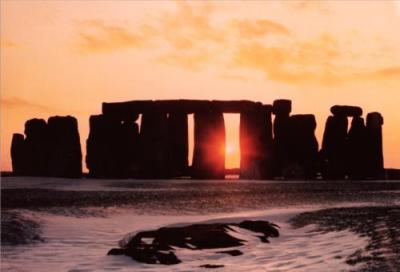
English Heritage did not confirm the date for Open Access for Stonehenge for the Winter Solstice yet, but most likely this will be dawn on the 22nd of December. (The sunrise on the 22nd is closer to the actual solstice than that on the 21th of December.) Expect a short period of access, from approximately 7.30 to 9.00am

Stonehenge is carefully aligned on a sight-line that points to the winter solstice sunset (opposed to New Grange, which points to the winter solstice sunrise, and the Goseck circle, which is aligned to both the sunset and sunrise). It is thought that the Winter Solstice was actually more important to the people who constructed Stonehenge than the Summer Solstice. The Winter Solstice was a time when most cattle were slaughtered (so they would not have to be fed during the winter) and the majority of wine and beer was finally fermented.

Gerald Hawkins’ work

Gerald Hawkins’ work on Stonehenge was first published in Nature in 1963 following analyses he had carried out using the Harvard-Smithsonian IBM computer. Hawkins found not one or two alignments but dozens. He had studied 165 significant features at the monument and used the computer to check every alignment between them against every rising and setting point for the sun, moon, planets, and bright stars in the positions they would have been in 1500 BC. Thirteen solar and eleven lunar correlations were very precise against the early features at the site with precision falling during the megalithic stages. Hawkins also proposed a method for using the Aubrey holes to predict lunar eclipses by moving markers from hole to hole. In 1965 Hawkins wrote (with J. B. White) Stonehenge Decoded, which detailed his findings and proposed that the monument was a ‘Neolithic computer’.

Stonehenge – An Asronimical Calandar

Stonehenge features an opening in the henge earthwork facing northeast, and suggestions that particular significance was placed by its builders on the solstice and equinox points have followed. For example, the summer solstice sun rose close to the Heel Stone, and the sun’s first rays shone into the centre of the monument between the horseshoe arrangement. While it is possible that such an alignment can be coincidental, this astronomical orientation had been acknowledged since William Stukeley drew the site and first identified its axis along the midsummer sunrise in 1720.

Stukeley noticed that the Heel Stone was not precisely aligned on the sunrise. Year to year, the movement of the sun across the sky appears regular. However, due to temporal changes in obliquity of the ecliptic, illumination declinations change with time. The purported Heel Stone alignment with summer solstice sunrise would have been less accurate four to five thousand years ago. The Heel Stone, in fact, is located at 1/7th of circumference from due North, as noted by archaeologist James Q. Jacobs.[3] Stukeley and the renowned astronomer Edmund Halley were to attempt what amounted to the first scientific attempt to date a prehistoric monument. Stukeley concluded the Stonehenge had been set up “by the use of a magnetic compass to lay out the works, the needle varying so much, at that time, from true north.” He attempted to calculate the change in magnetic variation between the observed and theoretical (ideal) Stonehenge sunrise, which he imagined would relate to the date of construction. Their calculations returned three dates, the earliest of which, 460 BC, was accepted by Stukeley. That was incorrect, but this early exercise in dating is a landmark in field archaeology [4]. .

Early efforts to date Stonehenge exploited tiny changes in astronomical alignments and led to efforts such as H Broome’s 1864 theory that the monument was built in 977 BC, when the star Sirius would have risen over Stonehenge’s Avenue. Sir Norman Lockyer proposed a date of 1680 BC based entirely on an incorrect sunrise azimuth for the Avenue, aligning it on a nearby Ordnance Survey trig point, a modern feature. Petrie preferred a later date of AD 730. The necessary stones were leaning considerably during his survey, and it was not considered accurate.

Neolithic Computer

An archaeoastronomy debate was triggered by the 1963 publication of Stonehenge Decoded, by British-born astronomer Gerald Hawkins. Hawkins claimed to observe numerous alignments, both lunar and solar. He argued that Stonehenge could have been used to predict eclipses. Hawkins’ book received wide publicity, in part because he used a computer in his calculations, then a rarity. Archaeologists were suspicious in the face of further contributions to the debate coming from British astronomer C. A. ‘Peter’ Newham and Sir Fred Hoyle, the famous Cambridge cosmologist, as well as by Alexander Thom, a retired professor of engineering, who had been studying stone circles for more than 20 years. Their theories have faced criticism in recent decades from Richard J. C. Atkinson and others who have suggested impracticalities in the ‘Stone Age calculator’ interpretive approach.

There are a few tour companies offering Stonehenge Tours during the Solstice period.  Try the Stonehenge Tour Company, Best Value Tours, Salisbury Guided Tours and Premium Tours 

See you all at the Winter Sostice

Merlin @ Stonehenge
The Stonehenge Stone Circle Web site


Clonehenge – Bonsai style.

5 09 2010

Bonsai Stonehenge–Yes, It’s Salisbury But It Isn’t Plain!

Photo courtesy of Salisbury Newspapers www.journalphotos.co.uk

No one does a Stonehenge like the locals! Above we see bonsai hengers (wouldn’t Bonsai Hengers be a great name for a rock band?!) and gardener/artists Tony Oswin & Wilf Colston with their prize-winning creation at the Salisbury Community Show recently–a charming Stonehenge model landscaped with bonsai trees and a bit of whimsy.

We have to say this is one of the finest and prettiest Stonehenge models we have seen! True, the landscape around it is not true-to-life, but we see no reason English Heritage shouldn’t run out and make it so. It would cost a great deal less than not putting in the tunnel and not putting in the new visitor centre has cost them so far!

The photo above, used courtesy of the Salisbury Bonsai Society, to which the gentlemen belong, shows the thought that must have been put into the Stonehenge section of the display. The stones themselves were cast in molds to make blocks all the same size and then hand carved with a knife and painted. No buying a little Stonehenge kit and quickly standing the plastic pieces in a circle for these fellows!* Care has been taken to make the assemblage resemble the original. We’re impressed!

Score: 8 druids! (New readers–no we do not believe druids built Stonehenge. Our scoring is a bit of a joke.) That’s very good for a small model. Mr. Oswin and Mr. Colson now have Clonehenge score bragging rights. That and £3 will get you a cup of coffee at Starbucks. Unless prices have gone up!

We want to thank Matt Penny, aka @salisbury_matt , friend of the blog, Salisbury and Stonehenge enthusiast, and perpetrator of the Salisbury and Stonehenge website for spotting this Stonehenge replica and sending us a link. We count on you, alert readers! Here’s a deal: you keep sending us Stonehenge replicas and we’ll keep wasting your time with our drivel! We promise.

Merlin @ Stonehenge
Stonehenge Stone Circle News Website and Blog


Stonehenge Comedy

27 07 2010

I did promise a few laughs along the way…..
Hope you like this classic Eddie Izzard comedy sketch of Stonehenge (18+)

Merlin @ Stonehenge
The Stonehenge Stone Circle Website