Could This Be How Stonehenge Was Actually Built? New theory

2 12 2010

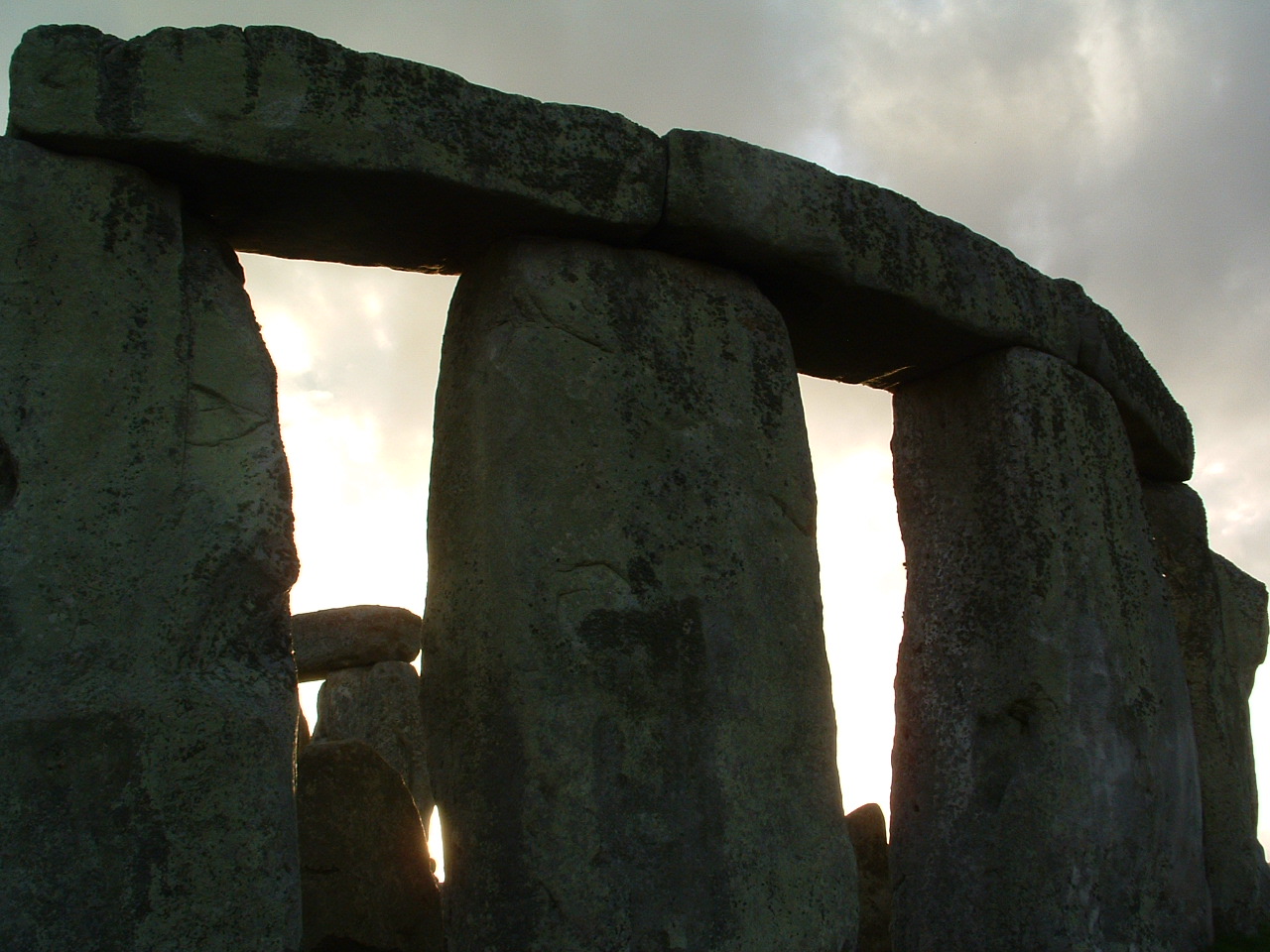
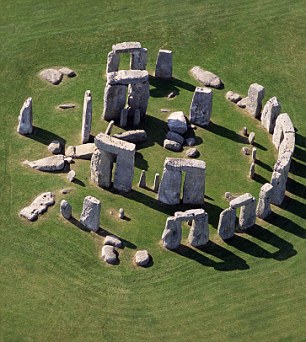
One of the most puzzling mysteries is how Stonehenge, the prehistoric circle of stones in England, came to be. We know it was built around 4500 years ago, and the stones came from Wales, some 250km away… but how?

Of course, back then, it wasn’t so easy to transport stuff around the country – especially not 60 bluestones which are said to weigh between two and four tons each. Several theories have been bandied about over the years of how the stones were transported, including sledges; rafts along the rivers; and that Merlin himself used his magic to gather the stones there.

This week, an engineer and former BBC TV presenter, Garry Lavin, tested his theory that wicker baskets made from willows were used to roll the stones all 250kms from the quarry in Preseli Hills, Wales, to Salisbury, in Wiltshire, England. He built one himself, using willow and alder saplings, and enlisted several friends to help roll a one-ton boulder along the ground.

He thinks oxen might’ve helped roll the baskets in some parts, and that rivers could have floated them downstream. But it’s the baskets which Lavin is sure had a huge part in the formation of Stonehenge – and as he’s currently building a maxi-basket to move a five ton stone, we may soon find out the answer. Unless aliens decide to show up and show us otherwise, of course.

Well, your comments ?

Merlin @ Stonehenge
The Stonehenge Stone Circle Website


Ancient UK standing stone guided people through sacred landscape

29 11 2010

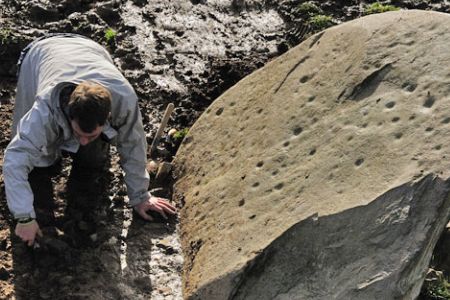
Archeologists say Trefael, a standing stone near Newport south-west Wales, was used as a ritual marker to guide communities through a scared landscape.

Studies showed that the cupmarks gouged onto the solitary stone represent a section of the night sky that includes the star constellations of Cassiopeia, Orion, Sirius and the North Star.

There are more than 75 cupmarks on the stone, which were revealed through complete exposure of the stone during recent excavations, Archeo News reported.

Until 40 years ago archaeologists assumed that the stone was part of a capstone covering a small burial chamber.

Later geophysical surveys unveiled the remains of a kidney-shaped anomaly, looking like remnants of the cairn that once surrounded the chamber, with an entrance to the east.

Excavations confirmed the site to be a portal dolmen, also exposing a cairn deposit within the eastern and northern sections of the trench.

A clear vertical cut was also found in section, which was parallel with the dip of the former capstone. This showed that the cairn had been excavated into and the capstone set and packed within the existing cairn, probably used as a standing stone during the Early Bronze Age when new burial-ritual monuments were introduced in Western Britain.

Archeologists found medieval and post-medieval pottery shards and two Mesolithic shale beads. They are planning to conduct further excavations in the area to assess the later prehistoric landscape setting and a contour survey of the monument.

Merlin @ Stonehenge
The Stonehenge Stone Circle Website


University student sparks new Stonehenge theory

29 11 2010

Stonehenge

A REVOLUTIONARY new idea on the movement of big monument stones like those at Stonehenge has been put forward by an archaeology student at the University of Exeter.

While an undergraduate, Andrew Young saw a correlation between standing stone circles in Aberdeenshire, Scotland and a concentration of carved stone balls, which may have been used to help transport the big stones by functioning like ball bearings.

Young discovered that many of the late Neolithic stone balls had a diameter within a millimetre of each other, which he felt indicated they would have been used together in some way rather than individually.

By plotting on a map where the carved balls were found, he realised they were all within the vicinity of Neolithic monuments known as recumbent stone circles.

These stone circle monuments in Aberdeenshire share an equivalent form to Stonehenge, yet with some much larger stones.

To test his theory Young built a model using small wooden balls which were placed in a grooved pieces of wood moulding, similar to a railway track but with a groove rather than a rail.

The balls were spread apart and a mirror image of the track was placed on top supporting a wood platform.

He then placed concrete slabs on the tracks, to replicate a heavy weight.

Young said: “I then sat on top of the slabs to add extra weight. The true test was when a colleague used his index finger to move me forward, a mere push and the slabs and I shot forward with great ease.

“This proved the balls could move large heavy objects and could be a viable explanation of how giant stones were moved, especially in relation to where the stone balls were originally found.”

A further experiment on a much larger scale was arranged with the financial assistance of Gemini Productions and WGBH, Boston for NOVA, an American documentary TV programme.

They were focusing on Stonehenge and wanted to see if a team of archaeology students directed by Professor Bruce Bradley, a lead archaeologist at the University of Exeter could build and test a life size model using wood that might reflect how massive stones could have been moved across the landscape.

Previous experiments, which others have carried out to move large stones had not been particularly effective.

The building of a hardened surface to roll logs on and the trench experiments only moved the stone with great effort and if they had been moved in this way the hardened surface or trench would show up in the archaeological record, however these have not been found.

In the large scale experiment, green wood was used for cost purposes. Neolithic people would have had access to much better materials, such as cured oak, which is extremely tough and was in abundance due to the great forests at the time.

They also had the technical ability to cut long timber planks, known through archaeological evidence of planks used as a way of creating tracks for people to walk on through bogs.

The experiment used hand shaped granite spheres as well as wooden spheres.

Professor Bradley said: “Our experiment had to go for the much cheaper option of green wood, which is relatively soft, however, we successfully moved extremely heavy weights at a pace.

“The demonstration indicated that big stones could have been moved using this ball bearing system with roughly ten oxen and may have been able to transport stones up to ten miles per day.

“This method also has no lasting impact on the landscape, as the tracks with the ball bearings are moved along leap-frogging each other as the tracks get moved up the line.”

He added: “It demonstrates that the concept works. It does not prove that Neolithic people used this method, but it was and is possible.

“This is a radical new departure, because previous ideas were not particularly effective in transporting large stones and left unanswered questions about the archaeological record they would have left behind.”

The next stage in the project is to collaborate with the engineering experts at the University who can calculate the loads which could be transported using various combinations of variables such as hard wood and U-shaped grooves.

This will provide the mathematical evidence to see how much force would be needed to get the stone moving and to keep it moving.

This will enable the project team to gain an even greater understanding of how stones may have been transported across huge distances and even up hills.

The ultimate goal is for a full-scale experiment in Aberdeenshire using more authentic materials, stone balls and a team of oxen.

Merlin @ Stonehenge
The Stonehenge Stone Circle Website


Canadian Archeologists given access to Bluehenge

12 11 2010

 Eerie, foreboding, mysterious and yet utterly familiar, the stone monuments at Stonehenge are part of the popular consciousness, and yet not much is known about them except that they predate recorded history.

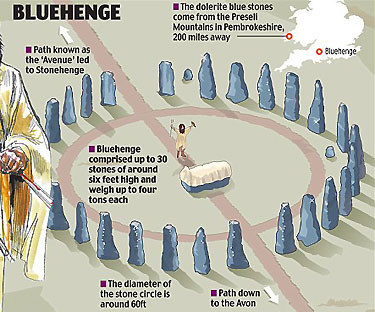
Bluehenge

Bluehenge

Until now, that is.

An archeological research team from PBS’s science program Nova was recently granted unique access to a stone-circle monument little more than a mile from the famous site in Wiltshire, England.

This new site, discovered just over two years ago and dubbed Bluestonehenge – or just plain Bluehenge – has prompted a renewed wave of speculation and investigation, using the latest in high-tech gadgetry and breakthroughs in carbon-dating techniques.

Armchair archeologists will get a kick out of Nova’s findings, which are even more compelling, because they’re presented as dry, scientific history, with none of the hype, loud music or tacky dramatized recreations of most docureality TV shows.

The big questions – who built Stonehenge, why, and how on earth did they manage without engineering blueprints, heavy machinery and construction unions – remain elusive, but it’s hard not to share the researchers’ excitement and enthusiasm as they seem to draw ever closer to the answers. The discovery of traces of charcoal, for example, suggests that some kind of ritual fire or ceremonial burnings happened there – shades of The Wicker Man – and it’s fun to let one’s imagination wander, in the best tradition of folk tales.

Archeologists have since hypothesized that stones may have been removed from Bluehenge around 2500 BC and used to shore up Stonehenge itself, which is known to have undergone major restoration around that time. One theory holds that Bluehenge was a place of life, where the living gathered, and Stonehenge was the “domain of the dead,” and ancient Britain’s first known cemetery.

Whether Stonehenge was created by the ancient Celts or by the magician Merlin, or by space aliens of the Erich von Daniken variety, the ruins’ origin and purpose remain one of the most enduring mysteries facing humankind today.

More than a million people make a pilgrimage to Salisbury Plain every year, and hardly any of them know why. Perhaps it was the site of the original Burning Man.  (what ?)

External links:
http://www.megalithic.co.uk/article.php?sid=23928
http://news.bbc.co.uk/1/hi/england/wiltshire/8288567.stm
http://blog.histouries.co.uk/2010/02/28/bluehenge-unearthed-prehistoric-site-that-could-be-famous-stone-circles-little-sister/
blog: http://www.canada.com/tv guy

Merlin @ Stonehenge
The Stonehenge Stone Circle Website


Stonehenge expert awarded OBE

29 10 2010

ONE of the world’s leading experts on Stonehenge discovered his passion for archaeology as a child in his Cheltenham back garden.
Professor Timothy Darvill has been awarded an OBE, in this year’s Queen’s Birthday Honours List, for services to archaeology. He is a leading expert on prehistoric Britain.

He said it was a “great privilege” to receive the honour from the Queen earlier this month at Windsor Castle and thanked his colleagues, friends and family.

“I have always been passionate about archaeology and feel fortunate to have contributed to so many amazing projects that have revealed such a great deal about our nation’s history and heritage,” he said.

Born and bred in Cheltenham, Prof Darvill has been passionate about archaeology since he was a child, according to his mother Win Darvill.

“He has always been interested from when he was a small boy. He used to dig holes in the garden all the time,” she said.

“His father, who was a civil engineer, was interested in fossils and passed it all on to Timothy and it went from there.”

The family lived in the Battledown area and Mrs Darvill now lives in Pittville.

Timothy Darvill is now a professor at Bournemouth University.

Mrs Darvill said: “When he was in his teens he was always either involved in archaeology in Cirencester or on field walks. It has always been his passion. I could not believe it when he was awarded the OBE but I am so proud.”

She said her son grew up in the right area to find all kinds of interesting landscapes.

But he developed an interest in Stonehenge from a young age too.

“He has done a lot of work on it and written many books about it. I read them but I wouldn’t like to write an essay on them,” she said.

The author of more than 20 books and 200 papers and articles, Mr Darvill famously co-directed the first excavations within the stone circle at Stonehenge for more than 40 years in April 2008.

His work featured in a BBC Timewatch programme, which examined the theory that Stonehenge was a prehistoric centre of healing.

After completing a PhD at Southampton University on the Neolithic of Wales and the west of England, he worked with the Western Archaeological Trust and the Council for British Archaeology before establishing a private practice offering consultancy services in the field of archaeological resource management.

In October 1991, he was appointed to the chair of archaeology in the newly-established archaeology group at Bournemouth University and led the Monuments at Risk survey commissioned by English Heritage in the mid 1990s and has worked in Russia, Malta, Greece, and Germany. He is chairman of the board of directors of Cotswold Archaeology, one of the top archaeological companies in the UK, and vice-president of the Society of Antiquaries of London.

Merlin @ Stonehenge
The Stonehenge Stone Circle Website


Stonehenge was not made from Preseli bluestones

6 10 2010

In the third of a series of Western Mail articles by speakers at this year’s Do Lectures, geologist and author Brian John debunks the ‘bluestone myth’ – the idea that prehistoric people travelled hundreds of miles in order to drag gigantic stones toSalisbury Plain 

THIS story is about the heroic neolithic tribesmen carrying scores of giant stones from the Preseli Hills to Stonehenge has now entered into British mythology. It has become gradually clearer, over the last decade or two, that there is no evidence to support this story. I want to inspire people to think very carefully about some of the myths that we as a community sign up for. 

A whole story has been developed over the years about this heroic human venture of tribesmen coming all the way to the Preselis to pick up the bluestones from a quarry – and then to carry those 80 stones all the way back to Stonehenge where they were going to be used as part of this amazing new monument. That has become a part of British mythology but is widely accepted as fact. It has become an immensely valuable story commercially for British tourism – a million people visit Stonehenge each year and nearly all of them are familiar with this heroic tale. That tale is used quite cynically, quite deliberately, by English Heritage and almost every other organisation that has anything to do with tourism in the promotion of Stonehenge, as a means of attracting even more visitors there 

The Questions? 

What I am trying to do is stand back from all that and question: what exactly is the evidence in support of this wonderful story?  When you start to dig a little bit you find that actually there is no evidence at all.  It is entirely a myth which was invented in 1922, immediately after the First World War. The myth received instant acceptance on the part of the British public because there was a desperate need for a feel-good factor after the war – national pride had been dented, the economy was in tatters and everybody needed a good news story. 

The story was invented by a Welsh geologist, Herbert Thomas. He gave a lecture which had purported to demonstrate that a lot of the bluestones had come from the Preselis. His geology was reasonably accurate. He was intent on telling this story of human transport.
His theory, once he had propounded it, was instantly grabbed hold of by everybody. It was a wonderful tale that showed us just how clever our neolithic ancestors were and they were a damn’ sight more clever than those ancestors on the Continent – especially in Germany. There was almost a strong, almost xenophobic element about this propaganda. 

No-one questioned this theory or seriously investigated it. 

It was just blown up from that point on. It has become one of the key beliefs of Britain, in the same way we believe about King Arthur and Glastonbury and Robin Hood in Sherwood Forest. It is now a part of British mythology. 

There is no evidence that the stones were taken from this so-called neolithic quarry at Carn Meini. In fact, there is no evidence of the quarry at all.  The stones which are supposed to have come from that one source actually came from many other places.  As the geology has advanced, with a lot of work from the Open University and many other geologists, we now know that the stones came from at least 20 other places. They haven’t come from the eastern end of the Preselis at all.  We know that at least two of the stones have come from the Newport area, quite possibly on the North Pembrokeshire coast. Another stone has come from the Brecon Beacons and some stones seem to have come from the Fishguard area. 

What the geologists say 

It was already known by some geologists in 1922 that during the Ice Age there had been an enormous glacier which had flowed across Pembrokeshire and had actually flowed up the Bristol Channel and into the coastlands of Somerset, Devon and Cornwall – we still don’t know how far east that glacier went, but it certainly did cross the Bristol Channel pressed up across the English coasts. A number of these old geologists had demonstrated this pretty clearly, but for reasons that I still don’t fully understand, Thomas in 1922 totally dismissed this theory in favour of his human transport theory. And still nobody has ever found any evidence as to how exactly the stones were moved, although of course there is endless speculation about it. There are literally thousands and thousands of pages on the internet devoted to precisely this question.  We should give more credence to scientific evidence and keep myths in the places they belong, namely mythology, and don’t let’s pretend that myths are telling us anything concrete about what happened in the past. 

The problem for archaeolo- gy is it has become involved in pedalling myths and seems to have lost its respect for evidence on the ground. People are so obsessed with making blockbuster TV programmes, for example, with support from National Geographic magazine and the Smithsonian Institute, that actually the archaeologists seem to be trying to out do each other on how spectacular their stories are. It has all become a little bit absurd. 

When we look at the hard science behind the bluestones story, there is quite a lot of evidence to support the idea that the bluestones at Stonehenge are no more than glacial erratics that were transported by the ice, maybe 450,000 years ago and then picked up somewhere in the Salisbury Plain in the East Somerset area – probably within easy striking distance of Stonehenge and that is where they were picked up from. 

The whole of the Stone- henge story is a complete fabrication. 

I have just put up a YouTube video called StoneHenge Unhinged in which I show that Stonehenge was probably never even finished. We have these wonderful reconstructions of Stonehenge, showing this incredible geometric arrangement of stones, and all the archaeologists and astronomers say this was a highly sophisticated astronomical observatory etc, but actually there is no evidence that it was ever finished. 

I think it was just an experiment. They tried to build something that was really rather ambitious but they really didn’t have enough stones to finish it. On the ground about half of the monument has never been excavated and 67 of the stones are totally missing, but people have just imagined that they were there without having any evidence to support that idea. 

Stonehenge has become a national icon and a key part of mythology with immense commercial value attached to it. Over and over again, people talk about the magical serenity of Stonehenge and the great feeling of power it gives you – which is wonderful, but I think people have been brought up to have this reverence for Stonehenge because it is such an iconic structure and that in itself creates a feeling of religious esteem or spirituality. 

I’m not saying Stonehenge is not wonderful. It is quite inspirational in the sense that it was a brave enterprise. The stones that are there are not very accurately placed and a lot of them are pretty rough and I think were just placed there as part of an ambitious building project

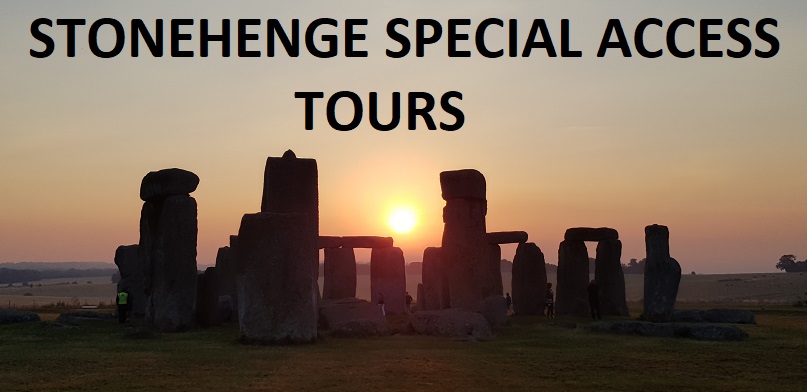
If you want to here all the theories why not organise a ‘Stonehenge special access’ tour with the English Heritage.  This enables you to go beyiond the fences before or after its open to the public.  The Stonehenge Tour Company and Histouries UK, based in Salisbury and Bath offer a ‘Rent a guide’ service. Salisbury guided Tours also offer specail access tours from Salisbury

Merlin @ Stonehenge
The Stonehenge Stone Circle Website