Stonehenge Architect Linked With Welsh Burial Cairn?

8 09 2011

An impressive tomb discovered in Wales is believed to belong to an important figure involved with the construction of Stonehenge.

The burial chamber is located in the Preseli Hills in Pembrokeshire, Wales, and sits on top of a ceremonial monument.

Nearby, a pair of standing stones embedded in a bank bear a strong resemblance to the pair-arrangement of the stones at Stonehenge, the famous prehistoric monument in Wiltshire, southern England.

Stonehenge features earthworks encompassing a circular arrangement of large standing stones. These are mainly two types of rock—the large sarsen stones (a type of sandstone), and a variety of smaller igneous rocks called bluestones (natural columns of while-spotted dolerite).

The excavation of the tomb in the Carn Menyn region of west Wales was led by Tim Darvill from Bournemouth University, and Geoffrey Wainwright from the Society of Antiquaries.

The archeologists believe the 80 bluestones at Stonehenge originated from the same area as the tomb and were transported around 160 miles (nearly 260 kilometers) to the Wiltshire plains about 4,500 years ago (around 2,300BC).

Uncovering the reason for this epic journey will unlock the mystery behind Stonehenge’s existence

Darvill and Wainwright first suggested in 2008 that Stonehenge may have been built as a major healing center, rather like a prehistoric version of Lourdes or Santiago de Compostela. They think the bluestones, not the sarsen, were believed to convey healing powers.

The Preseli area has many springs linked with ritual healing in prehistory, and this could explain why the bluestones were quarried for Stonehenge, despite being so far away.

“We went back to the Preselis and started doing excavations up there,” says Wainright, according to The Guardian. “The first site we explored was a big burial cairn in the shadow of Carn Menyn, where the Stonehenge bluestones come from.”

The excavation team discovered a stone circle underneath the cairn, built of bluestone, and organic material is being carbon dated.

“Then this stone circle was covered with the huge burial cairn with a chamber in the middle,” Wainright added. “The space turned from a public ceremonial space defined by the stone circle into the burial spot of a very important person.”

“We have obviously got a very important person who may have been responsible for the impetus for these stones to be transported,” Wainwright BBC News.

“It can be compared directly with the first Stonehenge, so for the first time we have a direct link between Carn Menyn—where the bluestones came from—and Stonehenge, in the form of this ceremonial monument.”

Sponsored by the Stonehenge Tour Company – www.StonehengeTours.com

Merlin @ Stonehenge
The Stonehenge Stone Circle Website


Tomb found at Stonehenge quarry site

1 09 2011

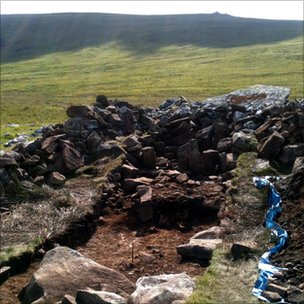
The tomb for the original builders of Stonehenge could have been unearthed by an excavation at a site in Wales.

The Carn Menyn site in the Preseli Hills is where the bluestones used to

The central site had already been disturbed so archaeologists chose to excavate around the edges

The central site had already been disturbed so archaeologists chose to excavate around the edges

construct the first stone phase of the henge were quarried in 2300BC.

Organic material from the site will be radiocarbon dated, but it is thought any remains have already been taken.

Archaeologists believe this could prove a conclusive link between the site and Stonehenge.

The remains of a ceremonial monument were found with a bank that appears to have a pair of standing stones embedded in it.

The bluestones at the earliest phase of Stonehenge – also set in pairs – give a direct architectural link from the iconic site to this newly discovered henge-like monument in Wales.

The tomb, which is a passage cairn – a style typical of Neolithic burial monument – was placed over this henge.

The link between the Welsh site and Stonehenge was first suggested by the geologist Herbert Thomas in 1923.

This was confirmed in 2008 when permission was granted to excavate inside the stone circle for the first time in about 50 years.

The bluestones had been transported from the hills over 150 miles to the plain in Wiltshire to create Stonehenge, the best known of all Britain’s prehistoric monuments.

Two of the leading experts on Stonehenge, Prof Geoff Wainwright and Prof Timothy Darvill, have been leading the project.

They are now excavating at the site of a robbed out Neolithic tomb, built right next to the original quarry.

They knew that the tomb had been disturbed previously, so rather than excavate inside, they placed their small trench along its outer edge.

Prof Darvill said: “It’s a little piece of keyhole surgery into an important monument, but it has actually lived up to our expectations perfectly.”

There are many springs in the area, which may be have been associated with ritual healing in prehistoric times, and also the reason why these particular stones were quarried for another monument so far away.

Prof Wainwright said: “The important thing is that we have a ceremonial monument here that is earlier than the passage grave.

“We have obviously got a very important person who may have been responsible for the impetus for these stones to be transported.

“It can be compared directly with the first Stonehenge, so for the first time we have a direct link between Carn Menyn – where the bluestones came from – and Stonehenge, in the form of this ceremonial monument.”

Sponsored by ‘The Stonehenge Tour Company’ www.StonehengeTours.com

Merlin @ Stonehenge
The Stonehenge Stone Circle Website


Mystery origins of Stonehenge unravelling

9 05 2011

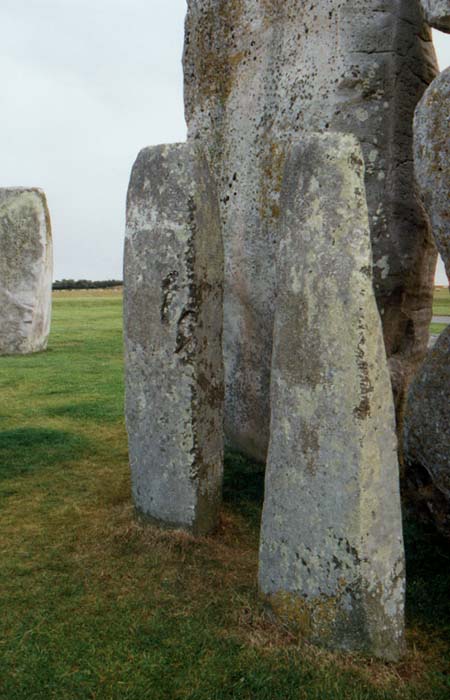
Stonehenge is an ancient site which dominates Salisbury Plain in the south Stonehenge Blue Stoneswest of England. Much of where the stones came from and how they were moved is still an enigma.

Built around 3100 BC, the origins and purpose remains the subject of much debate around the world.

At the National Museum of Wales in Cardiff some detective work is taking place that could help solve this historical conundrum.

With precision and patience Dr. Richard Bevins is examining a minute piece of stone that is part of a 5000-year-old mystery.
Under his microscope is a sample taken from Stonehenge.

Bevins says the whereabouts of some of the stones is already known.

“Stonehenge comprises an outer circle, an inner circle and an inner horseshoe. The outer circle, which are the very big stones are actually local to the Stonehenge area, to Salisbury Plain.”

In the 1920s scientists traced the origins of the remaining stones, known as Bluestones, to an unspecified part of the Preseli Hills in Pembrokeshire, West Wales.

This is 240km from Stonehenge. It remains unclear how an ancient civilisation would have transported such heavy stones such a huge distance.

Bevins says: “These stones that form the inner circle and the inner horseshoe, the Bluestones, they still weigh two to three tons so they’re substantial pieces of rock to be moving around the countryside, if it was humans.”

A unique discovery is now fuelling further debate about how the architects of Stonehenge moved their building materials from Wales to the south west of England.

Dr. Bevins and a team of scientists have matched stone samples from Stonehenge with ones taken from the Preseli Hills and uncovered their precise origin.

They have done it by using new technologies by analysing and comparing their mineral content.

“We got a good match in terms of what they looked like in hand specimen and down the microscope,” says Bevins. “But we wanted to go one stage further, we wanted to have a diagnostic technique, we wanted some data.”

Still in Wales, at the University of Aberystwyth, geochemist Dr Nick Pearce was tasked with analysing the zircon crystals that are embedded in the stone samples.

He pioneered a technique that uses a laser to vaporise the crystals so that their chemical make up can be scrutinised.

Pearce explains how the technique works.

“We get hold of the samples as thin sections. We’ve identified in those where the grains of zircon are that we want to analyse and then we put those samples into the glazer abrasion ISO PMS system, fire a very powerful laser on top of the samples, on the individual grains within the sample. The vapour gets transported then into a mass spectrometer and we analyse the components of that mineral grain.”

By matching the chemical finger prints of their stone samples they have proven the origin of stones used to build parts of Stonehenge.

In a picturesque and quiet corner of West Wales called Pont Saesnon is a rocky outcrop that looks like any other in this mountainous country.

But thousands of years ago it provided the building blocks for the ancient structure of Stonehenge that still captivates people today.

Pearce says their research has located the exact spot the stones came from.

“It pins them down to place where nobody has really considered they came from before; on the north side of the Preseli Hills in North Pembrokeshire and not localities on the top of the Presellis.”

The unearthing of the stone’s origins also challenges the theories on how the builders of Stonehenge transported their materials to Salisbury Plain.

“It was always thought they were transported by humans south down towards the Bristol Channel and put onto rafts at Milford Haven. Well this location changes that perspective,” Bevins says.

It’s now thought the stones took an alternative route and travelled 16km west to the natural harbours that dot the Welsh coastline then shipped to their final resting place on Salisbury Plain, in England.

This theory now needs to be tested by archaeologists.

These new discoveries bring people who are fascinated with Stonehenge one step closer to unlocking its mysteries.

More information: http://www.3news.co.nz/
Sponsored by ‘The Stonehenge Tour Company’ www.StonehengeTours.com

Merlin @ Stonehenge
The Stonehenge Stone Circle Website
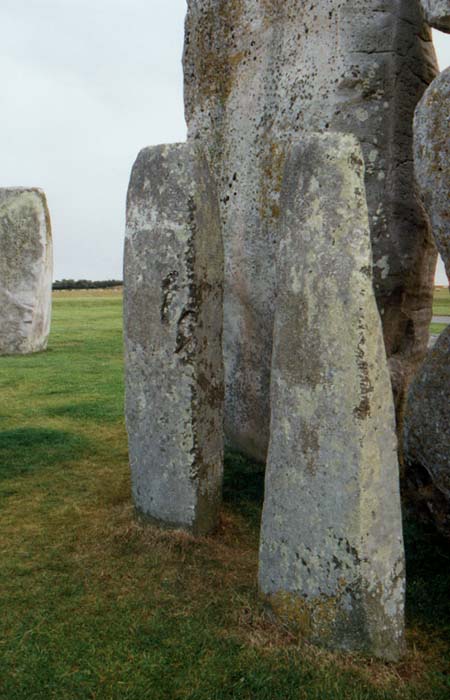


Scientists ‘step closer’ to solving Stonehenge mystery

23 02 2011

IT is a mystery that has baffled geologists and historians for centuries… how were the Stonehenge rocks transported from Wales’ Preseli mountains to their resting place 120 miles away.

Scientists are today one step closer to solving the 4,000-year- old mystery after making their most significant discovery in 15 years.

Of the six to eight different bluestone types found in the inner circle of rocks on Salisbury Plain, only one, the so- called “spotted dolerite”, was convincingly traced to the Mynydd Preseli area in north Pembrokeshire in the early 1920s.

But modern technology has now assisted geologists at Amgueddfa Cymru – National Museum Wales – in creating a “fingerprint” for one of the other rock types found in Wiltshire.

And that “fingerprint” has been identically matched to stones found in an area north of the Mynydd Preseli range, in the vicinity of Pont Saeson.

The discovery means archaeologists are now a step closer to retracing the footsteps of Neolithic engineers who moved the stones in the first place.

Dr Richard Bevins, Keeper of Geology at Amgueddfa Cymru, said: “The outer circle of Stonehenge is made up from stones sourced locally in Salisbury Plain but it is the mismatch of rocks found in the inner circle that have caused so much mystery.

“We have known for some time that spotted dolerite came from Preseli but of those remaining stones we think that six to eight more may have come from Pembrokeshire, until now though we haven’t been able to be sure because the stones are very fragile and we didn’t previously have the technology to extract their DNA.”

Dr Bevins added: “Theoretically if we could trace the source of the other rhyolites (rock types) we could create a map with six or more locations pinpointing where each stone was sourced.

“Archeologists could then essentially see the route that was taken by these people, they could re-trace those steps, set up archaeological digs and make who knows how many new discoveries.

“In terms of looking at where the stones came from this is the most important discovery we’ve made regarding Stonehenge in 10 or 15 years.”

Dr Bevins, in partnership with Dr Rob Ixer at the University of Leicester and Dr Nick Pearce of Aberystwyth University, made the discovery by analysing microscopic crystals found in the rock, vaporising them and analysing the gases found as a result.

The composite of gases makes up the rock’s DNA which can then be matched to other rock forms.

Sourcing the rhyolites also provides the opportunity for new thoughts on how the stones might have been transported to the Stonehenge area.

Much of the archaeology in recent years has been based on the assumption that Neolithic Age man had a reason to transport bluestones all the way from West Wales to Stonehenge and the technical capacity to do it.

Dr Bevins said: “It has been argued that humans transported the spotted dolerites from the high ground of Mynydd Preseli down to the coast at Milford Haven and then rafted them up the Bristol Channel and River Avon to the Stonehenge area.

“However, the outcome of our research questions that route, as it is unlikely that they would have transported the Pont Saeson stones up slopes and over Mynydd Preseli to Milford Haven, we would assume that they would not carry the rocks up and over a steep mountain range.

“If humans were responsible then an alternative route might need to be considered.”

Some believe that the stones were transported by the actions of glacier sheets during the last glaciation and so the Pont Season discovery will need appraising in the context of this hypothesis.

Mike Parker Pearson, Professor of Archaeology at Sheffield University, added: “This is a hugely significant discovery which will fascinate everyone interested in Stonehenge.

“It forces us to re-think the route taken by the bluestones to Stonehenge and opens up the possibility of finding many of the quarries from which they came.

“It’s a further step towards revealing why these mysterious stones were so special to the people of the Neolithic.”

Read More http://www.walesonline.co.uk/news/wales-news/2011/02/23/scientists-step-closer-to-solving-stonehenge-mystery-91466-28216698/#ixzz1ElvHUPjT

Merlin @ Stonehenge


Stonehenge rocks definitely came from Wales, but how?

23 02 2011

New research has cast fresh doubt on the journey which the Stonehenge Bluestones took from Pembrokeshire to the site of the pagan monument.

Since the 1920s, geologists have strongly suspected that the ‘spotted dolerite’ Bluestones, which form Stonehenge’s inner ring, originated from Mynydd Preseli in the north of the county.

However, whilst the new findings have also linked a second type of stone – rhyolites – to the area, they call into question how the stones arrived in Wiltshire.

Matching up the rock from Stonehenge with a rock outcrop in Pembrokeshire has been a bit like looking for a needle in a haystack”
Dr Richard Bevins National Museum Wales

Perceived wisdom had it that Stone Age man transported the giant slabs via raft, up the Bristol Channel and River Avon.

But as Pont Saeson, the location of the new match, is to the north of the Preselis, some believe its unlikely that they would have been able to navigate the terrain in order to get the enormous rocks to the coast.

An alternative theory was that nature drove the stone to Stonehenge, in the path of an Ice Age glacier, although the absence of any other Welsh rock in the region seemed to have ruled out the possibility.

Yet Dr Richard Bevins, a geology expert from the museum which collaborated in the research by Aberystwyth and Sheffield Universities, believes it may now be time to revisit the idea.

“If humans were responsible then an alternative route might need to be considered. However, if, as some believe, the stones were transported by the actions of glacier sheets during the last glaciation, the Pont Season discovery will need appraising in the context of this hypothesis.”

“It’s a further step towards revealing why these mysterious stones were so special to the people of the Neolithic”
 Prof Mike Parker Pearson Sheffield University

“Matching up the rock from Stonehenge with a rock outcrop in Pembrokeshire has been a bit like looking for a needle in a haystack, but I’ve looked at many if not most outcrops in the Mynydd Preseli area.

“We are however, confident that we have found the source of one of the rhyolites from Stonehenge because we’ve been able to make the match on a range of features not just a single characteristic. Now we are looking for the sources of the other Stonehenge volcanic and sandstone rocks”.

Dr Bevins’ team are able to say so categorically that they’ve discovered the source of the rhyolites, thanks to a range of laser mass spectrometry techniques, which analyse both the chemical composition of the rock and the micro-biology present when it was formed.

The combination of the two provides an almost unique signature for rocks only found in the Pont Saeson area.

But the new match does explain the absence of any other Welsh Bluestone in the Stonehenge area, if indeed glaciation was responsible for carrying them there.

Prof Mike Parker Pearson, from Sheffield University, called it a “a hugely significant discovery which will fascinate everyone interested in Stonehenge”.

“It forces us to re-think the route taken by the Bluestones to Stonehenge and opens up the possibility of finding many of the quarries from which they came.

“It’s a further step towards revealing why these mysterious stones were so special to the people of the Neolithic.”

Merlin @ Stonehenge
THe Stonehenge Stone Circle Website


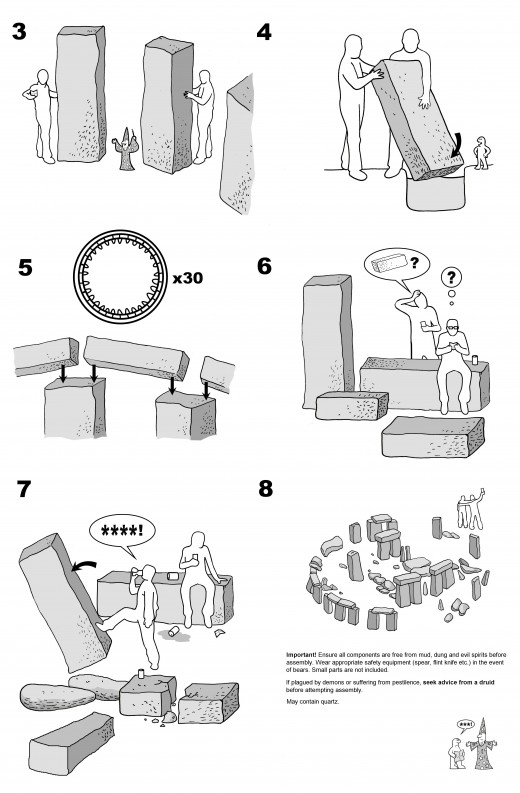
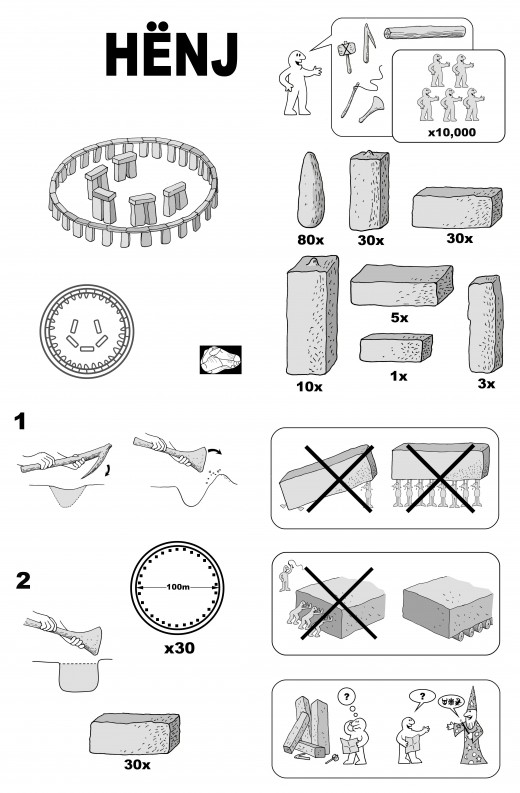
Ikea Stonehenge (HENJ) DIY flat-pack henge.

18 02 2011

Ikea Henge

Ikea Henge

Ikea Henge (Henj)

Ikea Henge (Henj)


Don’t forget “When all else fails, read the instructions”

Have a great weekend…………..
Merlin @ Stonehenge
The Stonehenge Website


Sarsen stones – Shaped like wood 42 centuries ago

5 02 2011

Sarsen stones are the very large stones that forms the outer circle at Stonehenge.

These stones are a very hard type of sandstone. Now to give one a clear idea as to how hard this particular stone is we will take a look at the Mohs scale.

The Mohs scale is simply a measurement used to measure the surface resistance to abrasion of any hard substance.

That just means that if we take a hammer and bash the stone how much will it resist before we can knock a chunk off it.

Sarsen stone measures a seven (7) on the Mohs scale.

Now, if we compare the surface resistance of sarsen stone to that of steel we find that steel measures 6,7 on the same scale.

So, we now know that sarsen stone is a very hard stone and we can appreciate how difficult it must have been to shape the stone with ancient tools.

Sarsen stones were worked and dressed with other sarsen stone which were round balls of stone known as mauls. The mauls were of various sizes and can today be viewed at the Salisbury museum.

From exploration at Stonehenge it would appear that there were 30 stones that were used as “uprights”.

Of these “uprights” 29 of them were shaped to the same basic size.

When the sarsen “uprights” were placed into position they were then capped with a line of sarsen stone lintels.

The lintels weighs up to seven tons ( 7,000kg.) each.

To fix the lintels securely in position thirteen feet or 4m. above the ground these lintels were locked together like pieces in a jigsaw.

The lintels were held in place on the upright sarsen stones by mortice-and-tenon joints which was carved out of the solid stone.

The lintels in the circle were then locked end-to-end by a method known as vertical tongue and groove joints.

The vertical tongue and groove jointing techniqueThe jointing techniques used on the sarsen stones are all from the wood joiners craft.

Another amazing feature is that the lintel circle of sarsen stones were shaped to follow the curve of the circle which is both a design and engineering feature.

Merlin @ Stonehenge
The Stonehenge Stone Circle Website


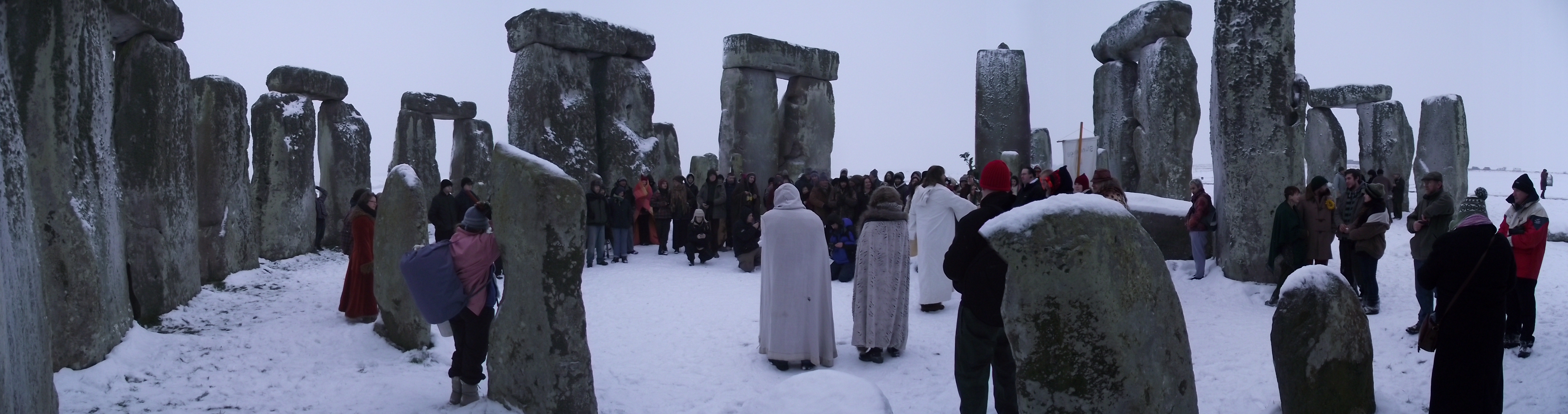
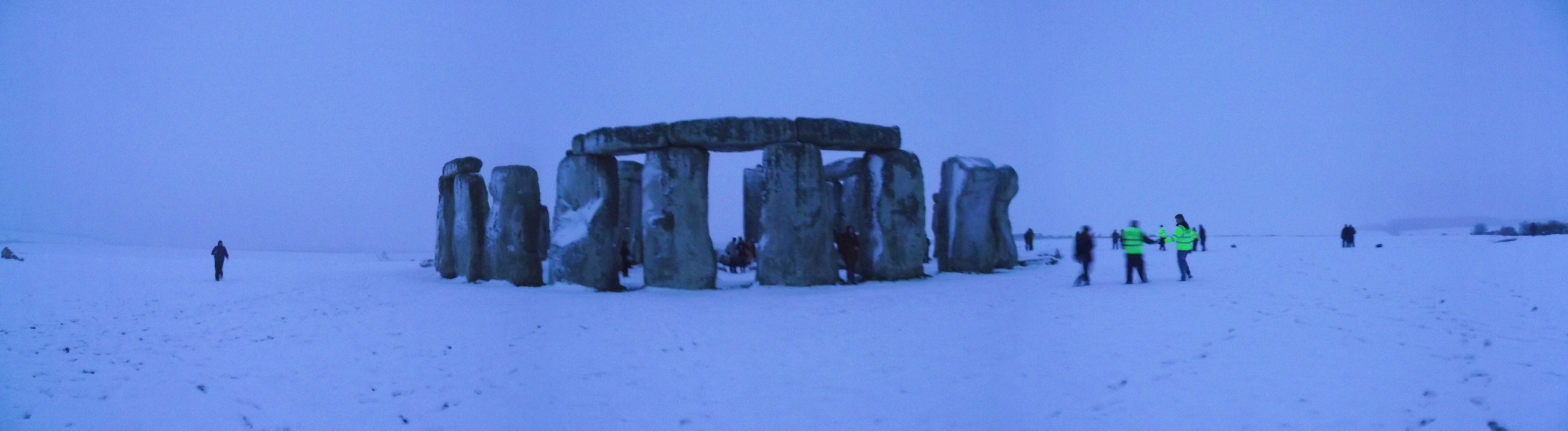
Stonehenge Winter Solstice Panoramic pictures

21 12 2010

Stonehenge Winter Solstice 2010 Panoramic

Stonehenge Winter Solstice Panoramic

Stonehenge Winter Solstice Panoramic (Copyright)

Stonehenge Winter Solstice Panoramic

Stonehenge Winter Solstice Panoramic

Stonehenge Winter Solstice Panoramic (Copyright)

Images are subject to Copyright.  Full Terms and Conditions of Submission and Use of Pictures can be requested.

All rights reserved. All images included herein this  Internet Web Site publication are the copyright and property of the photographer and the text/design/html files are the property of The Stonehenge News Blog. All images and text are copyright in accordance  with the terms of the United Kingdom’s Copyright, Designs and Patent Act 1988, and  are protected under the United Kingdom and international copyright laws and  treaties which provide substantial penalties for infringement.
The use of any images or other materials included herein, in whole or in part,  for any purpose other than for the private purpose of the user, including,  but not limited to, copying, reproduction, publication (including on Internet Web  Site), storage in a retrieval system (other than internet browser), manipulation (digital or otherwise),  or transmitted in any form or by any means, electronic, mechanical, photocopying,  recording or otherwise, is expressly prohibited without the written permission of  The Stonehenge News blog or and the photographer 

What is © Copyright?

The images on this website are known as “intellectual property”.  In law, they are hardly different from other forms of property (such as  your computer), as the creation of images also requires personal skill,  equipment, time and money. To take and distribute images without consent  is a form of theft and is therefore illegal. The images on this  Internet web site publication are not royalty free and a fee is required  for each specific usage. All of the images have been visibly and invisibly watermarked so that  they can be identified if used without permission, whether whole or in part. International  law now permits substantial penalty charges for infringement of copyright.

Other Web Pages

Unfortunately you may not use any of the images in your web pages without express written  permission as this constitutes publishing  the images and could conflict with the interests of our many clients. If, for instance, a  corporation buys a picture for a specific purpose which conflicts with  your website, then the corporation could take legal action against you.  We have to say “no” in order to protect you and our clients.

More Stonehenge Winter Solstice 2010 images – click here
Merlin @ Stonehenge


Woodhenge: Is this one of the greatest discoveries of archaeology…or a simple farmer’s fence?

12 12 2010

The discovery of a wooden version of Stonehenge – a few hundred yards from the famous monument – was hailed as one of the most important archaeological finds for decades.

But now experts are at loggerheads after claims that what was thought to be a Neolithic temple was a rather more humble affair – in fact the remains of a wooden fence.

One leading expert on Stonehenge criticised the announcement of the ‘remarkable’ find in July as ‘hasty’ and warned it could become a ‘PR embarrassment’.

The site, ringed, in a Seventies chart, which experts say shows a fenceMapped: The site, ringed, in a Seventies chart, which experts say shows a fence


The radar image said to reveal the post holes of a Neolithic temple‘Evidence’: The radar image said to reveal the post holes of a Neolithic temple

The discovery of what appeared to be a previously unknown ‘henge’, or earthwork, by a team of archaeologists conducting a multi-million-pound study of Salisbury Plain was widely reported amid great excitement.

The team said they had found evidence of a ring of 24 3ft-wide pits that could have supported timber posts up to 12ft tall, surrounded by an 80ft-wide ditch and bank.

They explained that, just like Stonehenge, the entrances to the site were aligned so that on the summer solstice the sun’s rays would enter the centre of the ring. Holes where the wooden posts once stood were identified below the ground using the latest high-resolution geophysical radar-imaging equipment.

An artist's impression of how Woodhenge may have been 5,000 years agoCircle of confusion: An artist’s impression of how Woodhenge may have been 5,000 years ago

Team leader Professor Vince Gaffney of Birmingham University said the ritual monument had been built about 5,000 years ago, making it roughly the same age as its stone counterpart 980 yards away, and it could have been used for Stone Age feasts or elaborate funerals.

He said the find showed Stonehenge had not existed in ‘splendid isolation’ and he predicted further discoveries during the three-year survey of five square miles of countryside around Stonehenge.

But sceptics have now suggested that the evidence is far from conclusive, especially as it appears from images of the plot produced by the Birmingham team that the ring of post holes was not arranged in a circle but was angular and more like a hexagon.

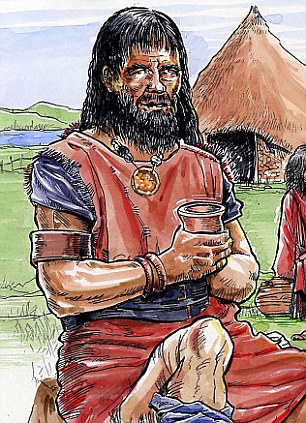
How a Neolithic visitor may have lookedHow a Neolithic visitor may have looked

Mike Pitts, editor of the magazine British Archaeology and an acknowledged expert on Stonehenge, said he had been prompted to study maps of the area after receiving a letter from an American reader.

In the spot where Prof Gaffney had claimed to have uncovered his post holes, Mr Pitts said he and
colleagues examined a Seventies Ordnance Survey map – and saw a fence marked out.

He thought it probably was an early 20th Century construction, erected by the then Government’s Office of Works or a local farmer to protect what was thought to have been the most important site in a cluster of burial mounds that were ancient but later than Stonehenge.

Mr Pitts said: ‘Vince Gaffney says his discovery encircles a burial mound within its circumference, but unless he has some unpublished material to substantiate his discovery, I am in no doubt that this was a modern fence line.

‘If I’m right then the post holes contained modern fencing stakes and they are actually in a hexagonal shape, not a circle.’

He added: ‘I think that perhaps what has happened is that the professor’s field workers have presented him with the wrong picture and he’s shot from the hip and made an over-hasty announcement. He’s generally known for the high quality of his work and his enthusiasm which, on this occasion, may have let him down.

‘The full publication of his results and small-scale excavations of the site would clinch the matter.’

But Prof Gaffney said: ‘We have mapped numerous fences and we know what they look like. The features appear to be 3ft across and as deep as 3ft. I have never seen a fence line that required holes that are 3ft across and 3ft deep.’

He said that in the fuzzy, black-and-white radar image the post holes appeared angular but that was partly due to the poor resolution of the picture and because such monuments were not perfect circles.

He went on: ‘The poles that would have stood in them would have been more like telegraph poles. You would not use them to build a fence.’

Prof Gaffney added that no metal such as old nails had been found in the holes, which would have
been expected.

‘On balance, we would still suggest this is a ritual monument of the late Neolithic period.’

 I love it when the ‘experts’ use the term ‘ritual‘ – in other words they do not know!
Related artile: New Woodhenge found

Read more: http://www.dailymail.co.uk/sciencetech/article-1337890/Woodhenge-Is-greatest-discoveries-archaeology–simple-farmers-fence.html#ixzz1Dj4rwwBM

Merlin @ Stonehenge
The Stonehenge Stone Circle Website


Stonehenge Built With Balls?

12 12 2010

New experiment suggests monumental stones could have rolled on rails.

It’s one of Stonehenge‘s greatest mysteries: How did Stone Age Britons move 45-ton slabs across dozens of miles to create the 4,500-year-old stone circle?

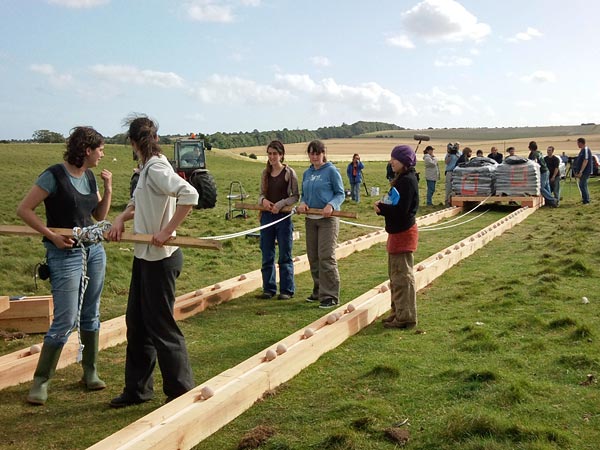
U.K. archaeology students attempt to prove a rail-and-ball system could have moved Stonehenge stones

U.K. archaeology students attempt to prove a rail-and-ball system could have moved Stonehenge stones

Now a new theory says that, while the ancient builders didn’t have wheels, they may well have had balls. (See Stonehenge pictures.)

A previous theory suggested that the builders used wooden rollers—carved tree trunks laid side by side on a constructed hard surface. Another imagined huge wooden sleds atop greased wooden rails.

But critics say the rollers’ hard pathway would have left telltale gouges in the landscape, which have never been found. And the sled system, while plausible, would have required huge amounts of manpower—hundreds of men at a time to move one of the largest Stonehenge stones, according to a 1997 study.

Andrew Young, though, says Stonehenge’s slabs, may have been rolled over a series of balls lined up in grooved rails, according to a November 30 statement from Exeter University in the U.K., where Young is a doctoral student in biosciences.

Young first came up with the ball bearings idea when he noticed that carved stone balls were often found near Neolithic stone circles in Aberdeenshire, Scotland (map).

“I measured and weighed a number of these stone balls and realized that they are all precisely the same size—around 70 millimeters [3 inches] in diameter—which made me think they must have been made to be used in unison, rather than alone,” he told National Geographic News.

The balls, Young admitted, have been found near stone circles only in Aberdeenshire and the Orkney Islands (map)—not on Stonehenge’s Salisbury Plain.

But, he speculated, at southern sites, including Stonehenge (map), builders may have preferred wooden balls, which would have rotted away long ago. For one thing, wooden balls are much faster to carve. For another, they’re much lighter to transport.

Proof of Concept

To test his theory, Young first made a small-scale model of the ball-and-rail setup.

“I discovered I could push over a hundred kilograms [220 pounds] of concrete using just one finger,” he said.

With the help of his supervisor, Bruce Bradley, and partial funding from the PBS series Nova, Young recently scaled up his experiment to see if the ball-and-track system could be used to move a Stonehenge-weight stone.

Sure enough, they found that, with just seven people pushing, they could easily move a four-ton load—about as heavy as Stonehenge’s smaller stones.

Using the ball system, Young said, “I estimate it would be possible to cover 20 miles [32 kilometers] in a day” by leapfrogging track segments.

But the inner circle’s “sarsen” stones weigh not 4 tons but up to about 45 tons. Young suspects a Stone Age system could have handled much heavier loads than his experimental one.

For one thing, he thinks oxen, not people, provided the pulling power—an idea supported by the remains of burned ox bones found in ditches around many stone circles.

For another, Britain’s old-growth forests hadn’t yet been razed 4,500 years ago, so the builders would have had easy access to cured oak. This tough wood—which was beyond the modern project’s budget—would have resulted in a stronger, more resilient system than the soft, “greenwood” system the researchers built.
Stonehenge Experiment Needs Scaling Up

Civil engineer Mark Whitby, who’s been involved with other Stonehenge-construction experiments, thinks the ball method could work for smaller stones but isn’t convinced it could shift a sarsen.

“The problem will be when the tip of the ball bears on the timber trough, it will bite” into the trough, possibly splitting the rail, said Whitby, who runs London-based +Whitby Structural Engineers. “When transporting lighter stones, this won’t be a problem. But when they get to 30 and 40 tons, it will be.”

Instead, Whitby prefers the sled theory—and even helped prove a sled could move a 40-ton replica sarsen for a 1997 BBC documentary.

Archaeologist David Batchelor, meanwhile, thinks the ball idea is plausible but isn’t completely convinced.

The ball technique “seems to be a development of the sledge method,” said Batchelor, of the government agency English Heritage. “But the added complexity needed to channel the track runners and then make the ball bearings all of one size seems to me a lot of work, which is probably unnecessary when animal-fat grease does the job.”

Research leader Young counters that the sled system, even with its animal-fat lubrication, still results in a lot of friction.

“Using wooden balls almost removes friction from the system and makes for a really efficient method of moving heavy weights around,” he said.

Even so, Young realizes he needs to prove the new system can be scaled up to handle heavier loads. To that end, Young’s team is seeking funding to repeat the experiment—this time with harder wood, stone balls, and oxen

What a load of old balls……………………………..
Merlin @ Stonehenge
The Stonehenge Stone Circle Website