Stonehenge Art – The Prehistory collection

3 01 2011
Art of Stonehenge
As well as collecting objects from Stonehenge, Salisbury Museum has an extensive range of paintings, prints and drawings of the monument. These include some of the earliest known depictions of the stone circle, as well as works by contemporary artists.Stonehenge
By John Britton and W. Lowry
1816
Stonehenge, Wiltshire, England (Plans)Britton believed that the romanised Britons constructed Stonehenge at the end of the fifth century AD, about 1500 years ago. Nowadays archaeologists believe that Stonehenge is a lot older. The first phase probably dates from about 5000 years ago and the final phase around 4000 years ago.

Stonehenge: Plan of Avenue
By George Maunoir Heywood Sumner
Stonehenge: Plan of Avenue1916
This image was used in a guidebook to Stonehenge, called Stonehenge Today and Yesterday, by Frank Stevens, O.B.E. Stevens succeeded his father, Edward, as curator of the Salisbury and South Wiltshire Museum. Under his management it became one of the best provincial museums in the country. He was also passionate about education. He taught local school children about the history, archaeology and natural history of the area. Frank Stevens died in 1945.

Stonehenge: The Wheel of Time or The Perpetual Calendar of the Druids
By Martin and Hood
Stonehenge: The Wheel of Time or The Perpetual Calendar of the Druids1851 – 1875
This picture was used in a book written by the Rev. Edward Duke to illustrate his own theories about Stonehenge. Duke (1779-?1849) was born in Hungerford, Berkshire, but moved to Wiltshire in 1805 when he inherited the Elizabethan manor house in Lake. He was a learned man and very interested in archaeology. Sir Richard Colt Hoare helped him to excavate a barrow on his estate. Duke made frequent contributions to the Gentleman’s Magazine, mainly regarding the antiquities of Wiltshire. He published a book, called The Druidical Temples of Wiltshire, which is the culmination of his opinions. As well as being a clergyman, Duke, was a magistrate and helped the poor of the county.

The Borgia Ring
By Unknown
The Borgia Ring1826 – 1875
This image is from the Illustrated London News and it depicts a scene from a drama called The Borgia Ring that appeared at the Adelphi Theatre. The theatre was renamed the Adelphi in 1819. Distinguished actors and actresses appeared in its plays, including Madame Celeste who was the first heroine of what became known as Adelphi drama. It was pulled down in 1858 and then under new management from 1879 it was famous for melodramas, by writers such as Wilkie Collins, for the next twenty years.

The Druid’s Sacrifice
By William Overend Geller
The Druid’s Sacrifice1832
There is no historical or archaeological evidence that the druids constructed or worshipped at Stonehenge. The idea was popularised in the 18th century by Dr William Stukeley. The druids were part of Celtic society. One of their main functions was probably to supervise sacrifices and religious ceremonies. It is likely that they also recounted orally in verse the traditional stories about the tribe as well as upheld the law and acted as judges. Until the 20th century images of druids were heavily influenced by the writings of Roman authors.

The first spring clean
By William Heath Robinson
The first spring clean1921
This cartoon was first published in the magazine ‘Let’s Laugh’. Heath Robinson dated it 1921 BC. The joke in this date is actually quite accurate for dating the monument!


The Front View of Stonehenge
By William Stukeley
1740
The Front View of StonehengeThis image combines two prints that were in a book about Stonehenge by Dr William Stukeley. Stukeley drew them and then Harris engraved the plan and Gerard Van der Gucht engraved the main picture.


The North East Side of Stonehenge

By Edward Rooker
1751 – 1800
The North East Side of StonehengeA copy of this engraving appeared in Hervey’s New System of Geography written by Frederic Hervey in 1785. D.Fenning originally wrote this book and then Hervey edited a revised version. The landscape behind the monument is reminiscent of the bleak downland of Salisbury Plain but errors in the scale of the stones suggest that the artist did not draw this picture from life.

The Stupendous Stones called Stonehenge on Salisbury Plain
By Alexander Hogg
The Stupendous Stones called Stonehenge on Salisbury Plain1794
This simple and clear image shows a very accurate view of Stonehenge. However the scale of the figures in the foreground is completely wrong. They are far too small and serve only to make the stones look bigger than they really are. Wonderful Magazine, from which this picture is taken, specialised in articles on strange sights, creatures and phenomena. It was not beyond exaggeration as is demonstrated here.

Three prehistoric monuments
By W. Hamper
Three prehistoric monuments1806
This image appeared in an issue of the Gentleman’s Magazine in July 1806 (plate I page 600). The three images show Avebury and Stonehenge in Wiltshire and the Rollright Stones in Oxfordshire. All three stone circles attracted the attention of the early antiquarians.


Unknown
By Conrad Martin Metz and James Heath
Unknown1776 – 1825
This image has been clearly influenced by Italian Renaissance art. The stones have been portrayed quite accurately but the setting, particularly the shepherd in the lower left corner, is classical in style. This is typical of the fashion for artworks during this period. It also reinforces the emerging idea that Great Britain was becoming the most important empire in the world and therefore, the new Rome.

Large Stonehenge
By David Charles Read
Large Stonehenge1830
This is a beautifully atmospheric picture that shows off the skills of the artist very well. The sketchy effects of etching have been cleverly used to control the light in the image. The darkness increases the impressive size and presence of the stones, whilst enough moonlight is allowed through the clouds to reveal the people. Perhaps they are lovers, perhaps they are travellers. Either way, the picture has the feeling of an episode from a romantic novel.

Grand Conventional Festival of the Britons
By Samuel Rush Meyrick and Charles Hamilton Smith
Grand Conventional Festival of the Britons1801 – 1850
This picture is a low quality reproduction of Meyrick and Smith’s Grand Conventional Festival of the Britons. Until the 19th century all images of druids were heavily influenced by the illustrations in Britannia Antiqua Illustrata, written by Aylett Sammes (published 1676). Then in 1815 Meyrick and Smith issued a book, called The Costume of the Original Inhabitants of the British Isles. Their drawings were influential as they introduced British prehistoric ornaments as costume accessories. However, the authenticity of their images is questionable as they combined elements of dress from different periods of history, such as Early Bronze Age, Late Bronze Age, Celtic and Medieval.

External links:
logo

The Stonehenge Stone Circle Website


The Great Stones Way – Britain’s newest long-distance walking trail opens in March 2011

8 12 2010

The Great Stones Way, a superb new 30 mile walking trail between the World Heritage Sites at Avebury and Stonehenge, will become one of Britain’s best loved and most used walking routes. 

Passing through the landscapes of the Wiltshire Downs, the Vale of Pewsey, Salisbury Plain and the Avon Valley, The Great Stones Way will be a great walk in itself. The combination of immense vistas and magnificent archaeology along the route will be irresistible – no other walking route has so much ancient heritage packed into such an attractive 30 miles.

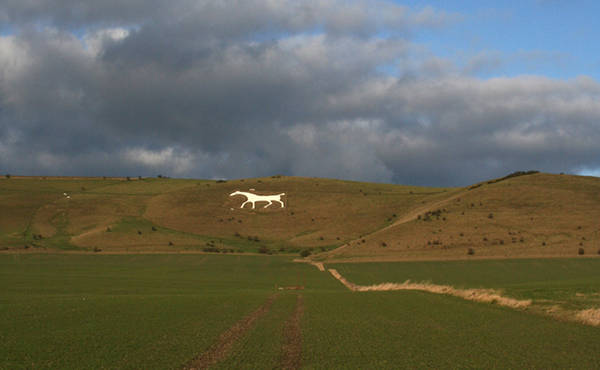
Alton Barnes Chalk Hill Figure

The Great Stones Way is being developed by The Friends of The Ridgeway using existing footpaths and rights of way. Ian Ritchie, Chairman of The Friends of The Ridgeway says: “The Great Stones Way is a vital part of our ambition to open up the whole 360 miles of the Great Ridgeway from the south coast to East Anglia.  The section between Avebury and Stonehenge is currently a big gap in that route, and The Great Stones Way will fill it brilliantly.”

The Great Stones Way will be launched on Saturday 26 March 2011 with a series of walks along the trail.  Ian Ritchie explains: “Ambitious and experienced walkers will want to do the whole 30 miles in one day, and there will be an alternative 13 mile route from Casterley Camp on Salisbury Plain to Stonehenge.  A gentle four miles from Durrington to Stonehenge will suit people who want to walk a shorter distance.”

In addition to the two great stone circles at the World Heritage Sites of Avebury and Stonehenge, The Great Stones Way passes Silbury Hill, West Kennet Long Barrow, The Sanctuary, the Wansdyke, Adam’s Grave, Marden Henge, Broadbury Banks, Durrington Walls and Woodhenge. 

“Because The Great Stones Way could take some people up to three days to walk its entire length, we are creating a series of shorter circular trails of varying lengths and challenges to suit walkers of all abilities,” says Ian Ritchie. The whole experience will be enhanced by a dedicated local bus service, the Henge Hopper, which will enable walkers to minimise the use of their cars and to plan their own walks along The Great Stones Way

The Friends of The Ridgeway commissioned a professional feasibility study which estimated that opening up The Great Stones Way will bring more than 250,000 visitors to the area and over £6million into the local rural economy each year.  This will benefit accommodation providers in nearby towns and villages as well as several pubs and village shops along the trail.

Claire Perry, Devizes MP supports the new walking trail: “I believe that The Great Stones Way will be a vital link at the heart of the Ridgeway.  It will take walkers over some of the most ancient and important paths in our great country and link two extraordinary World Heritage Sites.  To be able to walk along a well signposted and well surfaced path will be a pleasure for both British and overseas walkers and will bring important benefits to our local economy.”

The Friends of The Ridgeway group has already held several public meetings with parish councils and communities along the route, and more are planned.  The group is fund-raising to improve signage, install disability access gates, repair the path surface in places, and to produce The Great Stones Way guidebook. 

Details of the inaugural walk will be published on The Great Stones Way website www.greatstonesway.org.uk (currently under construction). Anyone who would like to take part or contribute to fund-raising can visit the website for more information or contact The Friends of the Ridgeway via www.ridgewayfriends.org.uk

If you have not got the tme or the energy there are a few tour companies offering guided tours using cars or mini coaches.  You could try the Stonehenge Tour Company based in London, the excellent Histouries UK private guided tours from Bath or London or Salisbury Guided Tours.  We also have several discounted tours available on our website – click here

Merlin @ Stonehenge
The Stonehenge Stone Circle Website


Pagan Mistletoe Symbolism and Legend

4 12 2010

Mistletoe and Christmas After Celtic Pagans were converted to

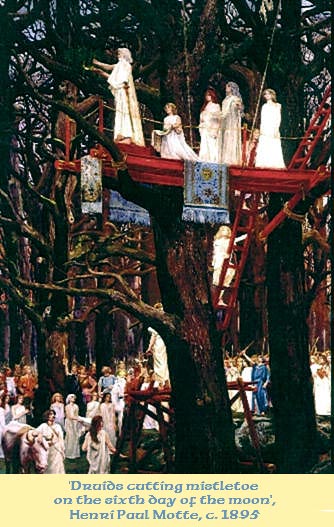
Druids cutting Mistletoe

Druids cutting Mistletoe

Christianity, Catholic bishops, with one exception, didn’t allow the mistletoe to be used in churches because it was one of the major symbols of Paganism. Before the Reformation, a priest at the Cathedral of York brought a bundle of mistletoe into the sanctuary each year during Christmastide and put it on the altar as symbolic of Jesus being the Divine Healer of nations.

‘Mistletoe, one of the most magickal and sacred plants of Paganism, symbolizes life and fertility and protects against poison. It was considered an aphrodisiac. ‘

The English used mistletoe as a Christmas decoration for their homes. In Medieval times, branches of mistletoe were hung from ceilings and put over houses and barn doors to repel evil spirits. People believed the plant could extinguish flames. Although much of the Pagan symbolism was forgotten, the plant represented good will, happiness, good fortune and friendship.

‘The sacred mistletoe is a hemiparasite, partial parasite that grows on branches or trunks of trees and has roots that penetrate into the tree for food. The American plant grows on trees while the European mistletoe can also be a green shrub with small yellow flowers and white berries. The plant contains toxins that can cause physical reactions including gastrointestinal disturbances and a slowed heartbeat.’

Mistletoe Sacred to Celtic Druids

The plant has qualities including the power of healing, rendering poisons harmless, good luck, great blessings, bestowing fertility on humans and animals, protection from witchcraft and banishing evil spirits. Enemies who met Druids under the forest mistletoe laid down their weapons, exchanged friendly greetings and kept a truce until the next day. The Celts suspended mistletoe over doorways or in rooms as a symbol of good will and peace to all who visited.

‘Mistletoe was revered by the ancient Druids both magically and medicinally. It’s possible that modern mistletoe traditions have their roots in ancient beliefs.’

Druid Mistletoe Ceremony

The plant is a fertility symbol and the soul of the oak tree. Belief was that the mistletoe could come to the oak tree during a lightning flash. Mistletoe was gathered at mid-summer and winter solstices. The plant, when it grew on the venerated oak tree, was especially sacred to the Celts. On the sixth night of the full moon after Yule, white-robed Druid priests gathered oak mistletoe by cutting the plant with golden sickles. Two white bulls were sacrificed with prayers that the recipients of mistletoe would prosper.

Mistletoe and the Ancient Druids

Pliny the Elder, a Roman historian interested primarily in natural history, recorded valuable information about the Druids and their religious and healing practices. These ancient priests of Celtic lands revered mistletoe as sacred. Pliny stated in Natural History, XVI, 95 that, “The Druids — that is what they call their magicians — hold nothing more sacred than mistletoe and a tree on which it is growing…Mistletoe is rare, and when found, it is gathered with great ceremony, and particularly on the sixth day of the moon.”

In the scene quoted above, the Druids are preparing for a ritual sacrifice which involves a white-robed priest carrying a golden scythe while climbing an oak tree to ritually cut the mistletoe. According to Pliny, it was the Valonia oak the Druid’s believed was the most sacred tree to gather mistletoe from and that it would heal poison and encourage fertility.

Mistletoe in Celtic Art

Celtic art is resplendent with what are believed to be mistletoe motifs. Some artifacts have been found that resemble human male heads adorned with a crown of comma-shaped leaves that resemble mistletoe. Historians believe these finds may be representations of crowned Druid priests.

External links:
http://www.mistletoe.org.uk/ A survey of Mistletoe use in Britain
http://www.mistletoes-r-us.co.uk/  Mistletoe matters
http://www.archaeology.co.uk/books/blood-and-mistletoe-the-history-of-the-druids-in-britain.htm The History of Druids – Blood and Mistletoe

 Next blog will be about -‘Yule’

Merlin @ Stonehenge
The Stonehenge Stone Circle Website



Ancient UK standing stone guided people through sacred landscape

29 11 2010

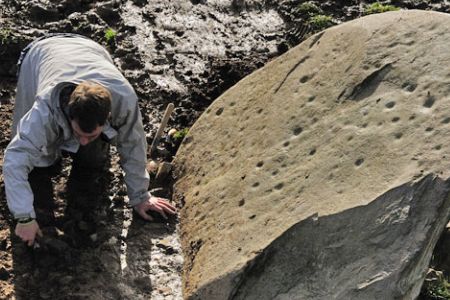
Archeologists say Trefael, a standing stone near Newport south-west Wales, was used as a ritual marker to guide communities through a scared landscape.

Studies showed that the cupmarks gouged onto the solitary stone represent a section of the night sky that includes the star constellations of Cassiopeia, Orion, Sirius and the North Star.

There are more than 75 cupmarks on the stone, which were revealed through complete exposure of the stone during recent excavations, Archeo News reported.

Until 40 years ago archaeologists assumed that the stone was part of a capstone covering a small burial chamber.

Later geophysical surveys unveiled the remains of a kidney-shaped anomaly, looking like remnants of the cairn that once surrounded the chamber, with an entrance to the east.

Excavations confirmed the site to be a portal dolmen, also exposing a cairn deposit within the eastern and northern sections of the trench.

A clear vertical cut was also found in section, which was parallel with the dip of the former capstone. This showed that the cairn had been excavated into and the capstone set and packed within the existing cairn, probably used as a standing stone during the Early Bronze Age when new burial-ritual monuments were introduced in Western Britain.

Archeologists found medieval and post-medieval pottery shards and two Mesolithic shale beads. They are planning to conduct further excavations in the area to assess the later prehistoric landscape setting and a contour survey of the monument.

Merlin @ Stonehenge
The Stonehenge Stone Circle Website


Stonehenge Private Access tours 2011 – Go beyond the fences!

4 11 2010

Hot off the press – Stonehenge Access Dates!
I have just been sent 2011 dates for Stonehenge ‘private access’ tours (see below)  If you are planning on visiting Stonehenge in the next 12 months then I highly recommend joing one of these trips.

Stonehenge Inner Circle Tours - Go beyond the fences

Stonehenge Inner Circle Tours – Go beyond the fences

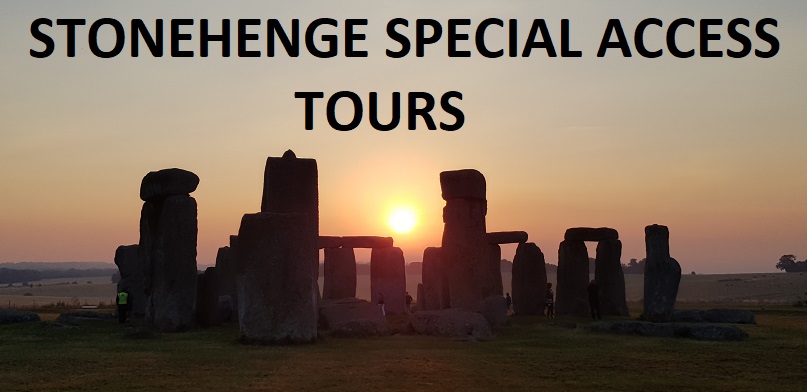
For those of you who have not visited this sacred site, I should mention that the complex is roped off. Visitors observe the stones from a distance and are not permitted within the temple complex……….Stonehenge special access tours allow you to be amongst the stones and to experience the magic.

There are a few sightseeing tour operators who offer this service and I have just been advised of the 2011 dates.  There are limited spaces and I highly recommend booking sooner rather than later – this is a very popular tour.  A fantastic photograph opportunity!

  • Stonehenge Special Access dates 2011
    January 2011 – 2nd, 14th, 21st, 24th, 31st
    February 2011 – 4th, 7th, 18th, 28th
    March 2011 – 7th, 14th, 25th, 28th
    April 2011 – 3rd, 6th, ,7th, 10th, 11th, 14th, 17th, 20th, 21st, 24th, 25th, 28th
    May 2011 – 1st, 4th, 5th, 8th, 9th, 12th, 15th, 18th, 22nd, 23rd, 26th, 29th
    June 2011 – 1st, 2nd, 5th, 6th, 9th, 12th, 15th, 21st
    July 2011 – 3rd, 6th, 7th, 11th, 10th, 14th, 17th, 18th, 21st, 24th, 28th, 31st
    August 2011 – 4th, 7th, 8th, 10th, 11th, 14th, 17th, 18th, 21st, 22nd, 25th, 28th
    September 2011 – 1st, 5th, 8th, 11th, 15th, 18th, 29th

Private tours can often be arranged for alternative other dates for families and small groups  but need to be booked well  in advance

These Stonehenge access tours can be booked through the excellent  ‘Stonehenge Tour Company’  website.  For a selection of other Stonehenge Tours from London that can also include:  Bath, Lacock Village, Salisbury Cathedral, Windsor Castle, Avebury Stone Circle, The Cotswolds, Oxford etc click here

The Stonehenge Tour Company

The Stonehenge Tour Company

Avebury Stone Circle

One or two operators offer tours that include Stonehenge and Avebury plus nearby Silbury Hill, West Kennet Long Barrow, Chalk hill figures and even crop circles (April – September) Try The Stonehenge Tour CompanyHistouries UK and Salisbury Guided ToursShould you need any unbias advice on organising a tour to Stonehenge please do email me – tours@stonehenge-stone-circle.co.uk

Merlin @ Stonehenge
The Stonehenge Stone Circle Website


Druids mark festival after becoming official religion

1 11 2010

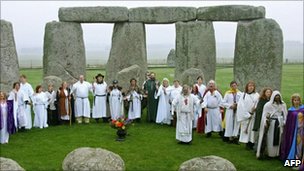
Druids are celebrating their first major festival since their beliefs were granted official status as a religion.

Samhain

Sanhain

For them and other pagans, 31 October is not Halloween, but Samhain, and marks the turning of the year from light into dark.

Earlier this month, the Charities Commission ruled that the Druid Network should have the same status as other faiths such as Christianity and Islam.

Pagans do not worship one single god, but look for the spiritual in nature.

The number of pagans, including druids, witches and wiccans, has grown in recent years.

Many believe that the absence of rules, the focus on the environment and particular regard for the female have a strong resonance in contemporary society.

Druids worship the spirits they believe inhabit the earth. Among them are those embodied in forces of nature, such as thunder, and places, like mountains and rivers.

Their rituals, including Samhain, are focused particularly on the turning of the seasons.

After a four-year inquiry, the Charity Commission decided that druidry offered coherent practices for the worship of a supreme being, and provided a beneficial moral framework.

Earlier this month the Charities Commission gave the Druid Network the status of a religion.

Happy New Year Pagans!
Merlin @ Stonehenge
The Stonehenge Stone Circle Website
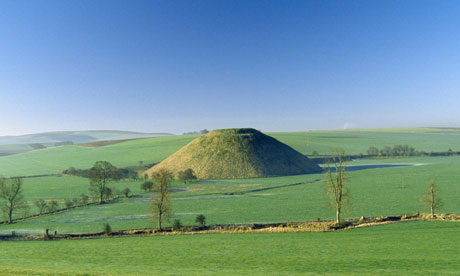


Silbury Hill – David Attenborough’s big dig

26 10 2010

Silbury Hill is as ancient and enigmatic as Stonehenge. David Attenborough tells us why he set out to crack it

Tomb or temple? ... Silbury Hill, Wiltshire.

Tomb or temple? ... Silbury Hill, Wiltshire.


The past,” says David Attenborough, “is a haunting and fascinating place.” The great naturalist is revealing a little-known side of himself: his love of archaeology – and his fascination with Silbury Hill in Wiltshire. The tallest prehistoric man-made mound in Europe, Silbury Hill rises to a height of 37 metres, making it comparable with the Egyptian pyramids and the ziggurats of Mesopotamia.

In a new English Heritage book about the hill, Attenborough tells how, in 1968 as controller of BBC2, he commissioned a programme that involved tunnelling into its depths to discover why it was there. At the time, the programme was judged a flop, since it found no treasure, no tomb, no real answers at all.

The-Story-of-Silbury-Hill

The-Story-of-Silbury-Hill

Attenborough is now seeking to set the record straight. He argues that, far from failing, TV’s first live dig triggered an unlikely chain of events that recently led to the tunnel being reopened and re-examined, using modern techniques. “They did not unearth any material treasure either,” he writes, but instead “added more details to our knowledge and understanding.” And this, you could say, is the true purpose of archaeology. In fact, the reopening of the tunnel vindicated the project Attenborough is so proud of: it revealed perhaps as much as will ever be known about this most mysterious of ancient monuments.

Silbury Hill is near Avebury, a quaint English village set inside a prehistoric stone circle. The village is part of a world heritage site that takes in Stonehenge and Silbury Hill. Raised in the same era as the mighty Stonehenge, and just as much of an enigma, the hill boasts chalk sides covered with grass. Construction of the vast, flat-topped cone would have required hundreds of workers and taken an age, but the people who built it left no records as to why.

BBC2 was a new channel in the 60s, with a brief to experiment. “We were going to do new television,” says Attenborough. “Everything we did would be in some way identifiable as new. With archaeology we thought, ‘Why can’t we do a live excavation?’ We would have cameras there so, if necessary, we could interrupt other programmes.”

The plan was to dig a tunnel into the heart of the hill. Professor Richard Atkinson, who led the dig, had interesting ideas about what might be in there. “Richard was the first to notice Mycenean daggers on Stonehenge,” says Attenborough. These made Atkinson believe Stonehenge was built by a culture in contact with ancient Greece, whose chief wanted a dramatic tomb.

This was TV as real adventure, and it captured the public imagination. Some saw it as a treasure hunt; others as a mix of horror and science-fiction. “Atkinson,” says Attenborough, “didn’t necessarily think there was going to be a burial [site]. The press said, ‘This is a treasure hunt, isn’t it?’ I said, ‘No, it’s about little bits of mud.'”

As the tunnel took shape, with news reported continually, nothing much emerged. “People kept saying, ‘It’s a failure,'” says Attenborough. “But we did discover how it was made.” Some people maintained the dig was actually harmful. “Since then, if there have been slumps in the top, people have said, ‘Ah ha, it’s the BBC’s tunnel.’ ”

In 2000, not just a slump but a hole appeared. Was the tunnel collapsing? No: this was caused by an 18th-century shaft, but archaeologists were still worried. They decided to reopen the BBC tunnel, deploying the latest tools and tests, and then seal it forever.

The new dig suggested that the hill was not a tomb, but a temple – perhaps the greatest in Europe 4,000 years ago. It also showed the hill started as a sacred site, where people came bearing stones; they may have believed they possessed healing powers. Certainly, stones are embedded in the structure and are thought to be highly meaningful by archaeologists. It is like Britain’s later cathedrals, which rose up over shrines. Sun worship flourished in prehistoric Britain, so perhaps this was – like those ancient ziggurats – a stairway to heaven to let priests get closer to the sun.

Atkinson’s tunnel is now sealed, but its creation marked a time when TV set out to bring drama and glamour to archaeology. As Attenborough says: “Anybody would be thrilled to find a Roman coin in their garden. I know I would.”

Visit Silbury Hill, Stonehenge and Avebury in a small group day tour – The Stonehenge Tour Company are the only operators who offer such a trip.  Histouries UK based in nearby Salisbury and Bath also bespoke private guided tours of the region.  You can look at more discounted tour operators here

Merlin @ Stonehenge
The Stonehenge Stone Circle Website


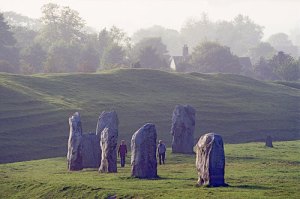
Delight for Druids says Avebury priest

18 10 2010

It has taken more than 11,000 years but finally the Druids, who lead the seasonal celebrations at Avebury and Stonehenge, can say they belong to an officially recognised religion.

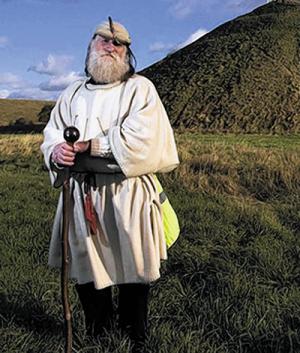
No one is more delighted at this recognition than Druid priest Terry Dobney, who lives at West Kennett, and styles himself as the Archdruid of Avebury and Keeper of the Stones.

Every Midsummer’s Day Mr Dobney, 62, can be seen wearing his ceremonial robe, carrying his staff and with a pheasant feather in his flat cap leading the Summer Solstice celebrations in the stone circle at Avebury.

This week the Charity Commissioners revealed they were granting the Druid Network, the umbrella organisation for Druid groups across the UK, charitable status for the first time.

That decision establishes Druidry as a recognised religion under UK charity law for the first time giving it the same status as Christianity, Islam and Hinduism.

The ruling recognised that the Druid Network served “to advance religion for the public benefit” although in practice, said Phil Ryder, chairman of the Druid Network trustees, it means very little financial benefit for the Druids but established an important principle giving them official recognition.

Mr Ryder said: “It has been a long and frustrating process, exacerbated by the fact that the Charity Commissioners had no understanding of our beliefs and practices and examined us on every aspect of them.”

As well as regulating secular charities the Charity Commissioners decide what qualifies as a legitimate and genuine faith.

Mr Dobney, a practising Druid for more than 40 years, said: “It is high time that the Druids were recognised not only as a religion but as being one of the oldest religions in the world.

“Druidism dates back to more than 11,500 years ago and pre-dates Judaism.

“The early Druids were the priestly cast who ran societies and provided the leaders.”

To become a recognised Druid, he said, entrants had to serve an apprenticeship for seven years under a senior Druid and could not call themselves a Druid until completing 21 years of training.

As well as leading the summer solstice and other seasonal celebrations at Avebury, Mr Dobney also conducts Druid handfastings (marriages) and other religious ceremonies throughout the year.

Merlin @ Stonehenge
The Stonehenge Stone Circle Website