Ticking Stonehenge off your bucket list.

30 11 2019

For people across the world- Stonehenge is a must see location, it’s majesty as well as it’s mystery has made it a mainstay on everyone’s bucket list. 

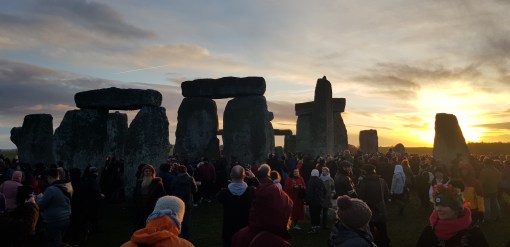
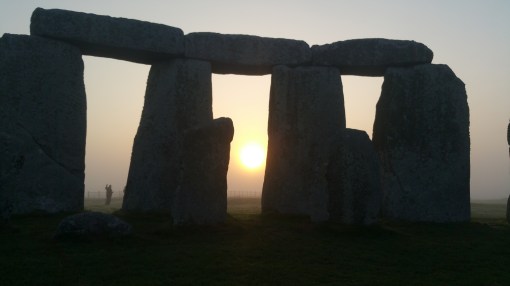
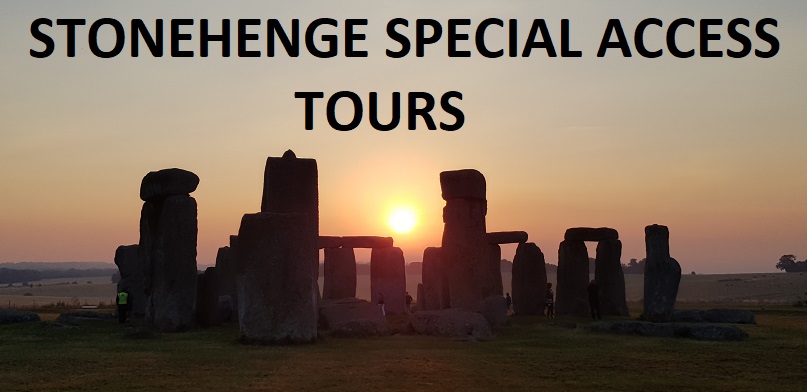
Stonehenge sunset

However, here lies the problem. Is Stonehenge merely a pretty collection of stones which need only be sited to be ticked off the list? There is no doubt that the site itself, taken as it is, is fulfilling. However- the occasion of ticking such a magnificent and ancient spectacle off a list of things to do on this earth before you die, should be done properly. The site and the whole surrounding area deserve more than tentative voyeurism. To truly ‘tick off’ Stonehenge, one must engage with its history its myths and crucially observe the entire  surrounding area which is a veritable tapestry of Neolithic history. A tapestry which considered in its entirety enriches the ultimate site to see- Stonehenge itself. 

I want to take you on a preliminary journey around Neolithic Wiltshire’s most fascinating sites- all a walking distance from the stones, which an expert guide can take you on for a holistic experience- Weaving together the history and myth of this most beautiful landscape.

On ground level-  you and the stones in front of you, it is hard to appreciate anything else. However, imagine you could fly straight up in the air and take a birds eye view- looking down on the ancient henge and its famous stones- so they are a wonderful miniature series of concentric circles…

…then go higher and take in more and more of the landscape and you’ll notice the ground is littered with meaningful scars- tell tale signs that the entire area surrounding Stonehenge has been heaving with meaning for 5,000 years. 

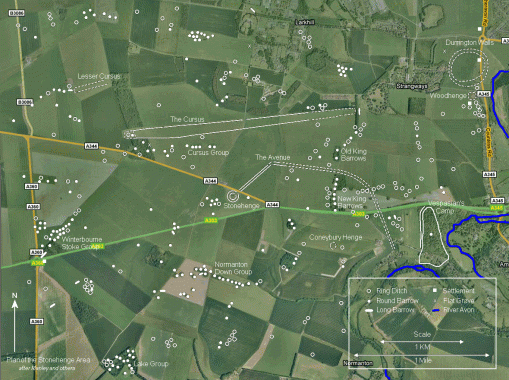
Luckily the wonder of the modern day means we needn’t defy gravity to appreciate the Neolithic saturation of the landscape- a simple satellite picture reveals all the key location you need to visit.

stonehenge-map

Durrington Walls 

Starting 2 miles east of the stones with Durrington walls. This was once a Neolithic settlement and may have even been the largest village in Northern Europe sometime between 2800-2100 B.C.

Woodhenge 

Heading immediately south from Durrington walls we soon will encounter Woodhenge, the elemental antithesis of Stonehenge itself. Sadly, due to the nature of wood,  the former structure has long since rotted away. This ancient site may well have been lost forever if it wasn’t for aerial photographs which revealed dark spots in wheat crops. These dark spots signalled the former post holes of large wooden posts which formed the ancient structure. Today the post holes have been filled with concrete to partially recreate the previous composition of woodhenge. It represents a magnificent symbiosis of past and present, modern techniques ensuring the survival of ancient monuments and their memory and preserve the heritage of Wiltshire .

The Cursus

Around 4000 years ago from our aerial view the Cursus would have been a bright white scar across the land, thanks to wiltshires famously chalky ground. In the Neolithic period the cursus was a 3k avenue cut into the earth for an unknown purpose.

The cursus is so named because the famous antiquarian William Stuckley and the Cursus’ discoverer- imagined roman chariots riding along its length (cursus meaning race course in Latin). Although the earth is no longer dredged along the cursus it still makes a fascinating route to wander along and to ponder, with its purpose still not totally understood

The Cursus group

At the west end of the cursus you might expect to get a good view of the Stonehenge- however your view is blocked. Instead you  are met with the curious view of a ridge of land, topped with a barrow; a Neolithic burial mound. Between the west end of the Cursus and Stonehenge itself lie the ‘Cursus Group’ an assortment of sixteen  of these Neolithic round barrows. The land literally bulges with history at this point- on top of the ridge you can see the land ripple with various barrows as you survey it- before your eyes are drawn magnetically to the stones themselves. But before you reach them it is fascinating to hear the tales of the barrows, how they had once concealed pottery, weaponry and even jewels for thousands of years.

Beyond tales of treasures it is edifying for those who wander the mounds to ponder their ancient logic- for there certainly appears to be a system- but it is yet to be determined. 

Stonehenge Avenue

Heading East from the swollen turf of the Cursus barrows you will intersect the penultimate Neolithic wonder of our imaginary tour. Like the Cursus, Stonehenge Avenue is an ancient Avenue, stretching for 3 kilometres. And like the cursus Stonehenge Avenue would have been an brilliant white scar on the earth- an alabaster pathway connecting Stonehenge with the river Avon. 

Today the avenue is still recognisable, If a slightly more furtive path then it once was but is nonetheless the pathway to the enigmatic stones, linking up with the henge as though drawn on by a higher being.

75435835_389325018446272_3664361428594196480_o

Photo taken by Stonehenge Dronescapes. Visit their Facebook Page for more amazing photos of Stonehenge and Wiltshire.

Stonehenge Stone Circle

At last you reach the stones themselves. The colossal upright sarsen stones, rendering you minuscule in comparison- whilst the horizontal blue stones, quarried from South Wales, add the real dimension of wonder to this wonder of the world. The stones are the crowning sight to this antiquarian tour of Wiltshire’s Neolithic sights. 

Words can hardly to this magnificent structure justice and it really must be beheld to be appreciated. What is certain is that the truest appreciation of this cultural icon is ascertained through a thorough engagement with its surroundings- appreciating the wider history and indeed mystery of the land and truly attempting to cast your mind back to the remote past; ticking Stonehenge off your bucket list in the process.

Relevant Stonehenge Links:
English Heritage – Interactive Maps of the Stonehenge Landscape – click here
Stonehenge Guided Tours – The Stonehenge Touring Experts – click here
National Trust – The Stonehenge Landscape – click here
Stonehenge – Neolithic / Bronze Age Henge and Stone Circle. Click here
Salisbury and Stonehenge Guided Tours – The local megalithic tour operator – click here
Stonehenge Dronescapesclick here

The Stonehenge News Blog
Follow us on Twitter and Facebook for all the latest Stonehenge News
http://www.Stonehenge.News


Celebrate the stars above Stonehenge this half-term.

11 10 2019

Enjoy a closer look at the relationship between Stonehenge and the skies above the monument this October half term with moon filled family fun.

MOON MAYHEM AT HALF-TERMStonehenge Full Moon

Running throughout the day at the Stonehenge visitor centre, this drop-in activity explores our long held fascination with the moon in a lively show that covers everything from werewolves to Galileo, and from H G Wells to Neil Armstrong – with a lot of fast-paced costume changes.

Families of all ages will enjoy this two-man show, taking place at the Stonehenge visitor centre.

This season of celestial themed events marks the anniversary of the moon landing and the launch of SkyScape,

Saturday 26th October – Sunday 3rd November
No booking required for Moon Mayhem, although advance booking for Stonehenge admission tickets is recommended.  Visit the English Heritage website for full details

Can’t make it to Stonehenge this half term?  You can still soak up the atmosphere thanks to Skyscape, a new feed of the sky above the Stones.  Skygazers from all over the world can experience sunrise over the ancient monument , and see the journey of the moon and stars from within the stone circle any time of the day or night by visiting www.Stonehengeskyscape.co.uk

STONEHENGE AND AVEBURY WORLD HERITAGE SITE, AND ITS ASTRONOMICAL IMPORTANCE: 20th NOVEMBER 2019 – Click here
More English Heritage Stonehenge Events – click here
National Trust Stonehenge Landscape Events – Click here
Guided Tours of Stonehenge from London, Bath and Salisbury – Click here
Solar Astronomy at Stonehenge Blog – Click here

The Stonehenge News Blog
Follow us on Twitter and Facebook for all the latest Stonehenge News
http://www.Stonehenge.News


Stonehenge Autumn Equinox Open Access Arrangements: 23rd September 2019

8 09 2019

THE Autumn Equinox is rapidly approaching as the last days of summer slowly come to an end. English Heritage are expected to offer a short period of access, from first light or safe enough to enter the monument field (approximately 06.30am) until 08:30am on the 23rd September this year.

The Autumn Equinox (Mabon)
The 2019 Autumn Equinox is at 08.50 GMT on the September 23rd
Sunrise will be 6.55am

IMG_20180320_155928_570

Mabon is a harvest festival, the second of three, that encourages pagans to “reap what they sow,” both literally and figuratively. It is the time when night and day stand equal in duration; thus is it a time to express gratitude, complete projects and honor a moment of balance.

IMG_20190716_103103_985

What is the Equinox?

The equinox is when day and night are actually the same length. It happens several days before the spring equinox, and a few days after the autumn one.

The reason day and night are only almost equal on the equinox is because the sun looks like a disk in the sky, so the top half rises above the horizon before the centre, according to the Met Office.

The Earth’s atmosphere also refracts the sunlight, so it seems to rise before its centre reaches the horizon. This causes the sun to provide more daylight than many people might expect, offering 12 hours and 10 minutes on the equinox.

The word ‘equinox’ itself actually mean ‘equal’ (equi) and ‘night’ (nox).

Respecting the Stones
The conditions of entry for the Managed Open Access.  Click here

If you are considering visiting Stonehenge for the Autumn Equinox and do not have transport you can join a specialist organised small group tour.  Use a reputable tour operator who respect the conditions of entry.  Stonehenge Guided Tours are the longest established company offering award winning discreet tours from London and Bath – click here for their exclusive Autumn Equinox tour. Solstice Events offer small group sunrise tours using only local expert guides.

Follow us on Twitter and Facebook for Equinox updates and Stonehenge news
The Stonehenge News Blog


Stonehenge monoliths may have been dragged there using greasy sledges lubricated with pig fat

21 07 2019

This new theory is based on pig fat residue on ancient pottery found near the famous monument and fits in with the generally accepted concept that the monoliths were dragged by people all the way from quarries in west Wales.

Stonehenge

Archaeologist Lisa-Marie Shillito say residues of fat on pottery discovered near the monument suggest Neolithic people greased the sleds used to move the huge stones with lard.

  • Scientists claim the enormous stones were dragged using ‘greased sledges’
    Newcastle University archaeologists found fat residues on shards of pottery
    They suggest the same lard could have been used to lubricate the sledges

The pig fat concept was proposed by researchers from Newcastle University after they studied pottery found at Durrington Walls, a Neolithic settlement that is just a couple of miles away from Stonehenge.

According to Science magazine’s Eva Frederick, archaeologists previously posited that the high concentrations of lard left in bucket-sized ceramic containers at the prehistoric village resulted from elaborate feasts hosted by Stonehenge’s builders. Shillito believes otherwise, arguing that the size and shape of the pottery make it better suited for storing animal fat than cooking and serving meals. Additionally, the archaeologist notes in a statement from Newcastle, “The animal bones that have been excavated at the site show that many of the pigs were ‘spit roasted’ rather than chopped up as you would expect if they were being cooked in the pots.”

Analysis of residues of absorbed fat is a widely-used technique which can reveal what foods different type of pottery was used for. There are still many unanswered questions surrounding the construction of Stonehenge’, she says.

‘Until now, there has been a general assumption that the traces of animal fat absorbed by these pieces of pottery were related to the cooking and consumption of food, and this steered initial interpretations in that direction.

‘But there may have been other things going on as well, and these residues could be tantalising evidence of the greased sled theory.

‘Archaeological interpretations of pottery residues can sometimes only give us part of the picture.

‘We need to think about the wider context of what else we know and take a ‘multi-proxy’ approach to identify other possibilities if we hope to get a better understanding.’

RELEVANT LINKS TO THIS STORY:

ROCK SLIDE Stonehenge builders may have ‘dragged rocks into place on sledges greased up with PIG FAT –  THE SUN

Did Stonehenge’s Builders Use Lard to Move Its Boulders Into Place? SMITHSONIAN MAGAZINE

STONEHENGE: NEOLITHIC PEOPLE MOVED ENORMOUS ROCKS USING PIG FAT FOR LUBRICATION, ARCHAEOLOGIST SAYS – THE NEWS WEEK

Stonehenge was ‘dragged into position using LARD’: Massive stones of the 5,000-year-old Wiltshire monument may have been slipped into place using ‘greased sledges’ lubricated with pig fat – THE DAILY MAIL

The Stonehenge News Blog
Follow us on Twitter and Facebook for all the latest Stonehenge News
http://www.Stonehenge.News


The first-ever scale model of Stonehenge that lets researchers explore how the monument would have sounded in its heyday has been created by UK researchers.

12 07 2019

Scientists turn to ‘laser accurate’ model to test Stonehenge acoustics

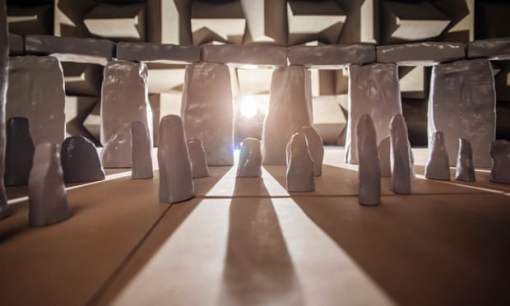
A diminutive model of Stonehenge could help crack the acoustic secrets of the ancient site, according to scientists who have built a version of the megaliths at a 12th of their size.

sonic

The team say the 1:12 model, with a stone circle spanning 2.6 metres, has an edge over other replicas of Stonhenge, such as the full-scale one near Maryhill,Washington, for being based on laser scan data. The data collected by Historic England allowed the team to produce a highly accurate representation.

Academics worked with English Heritage using laser scans of the stones and architectural research to create the shape and position of the stones in an acoustic chamber.

In 2012, a team of academics carried out acoustic experiments using a full-sized concrete reconstruction of the monument in Maryhill in the United States.

RELATIVE LINKS: 
Scientists turn to ‘laser accurate’ model to test Stonehenge acoustics.  THE GUARDIAN
Stonehenge mini model reveals sound of monument.  BBC NEWS

The Stonehenge News Blog
Follow us on Twitter and Facebook for all the latest Stonehenge News
http://www.Stonehenge.News


The Quarter Festivals and the Druids

9 07 2019

Public access to Stonehenge currently takes place on four of the so-called ‘quarter festivals’. What exactly are the quarter festivals? And why are these occasions so celebrated by the Druids?

Druids: Stonehenge Summer Solstice

Quarter festivals are sets of four dates that divide the year into four equal quarters. The dates when Stonehenge has open access to the public are the solar quarter festivals, defined by the movements of the sun. The summer and winter solstices (usually 21 June and 21 December) are the days when the noontime sun is, respectively, highest and lowest in the sky and so the hours of daylight are, respectively, their longest and their shortest. The spring and autumn equinoxes (usually 21 March and 21 September) are the dates when the sun rises exactly in the east and sets exactly in the west and so the night and day are of equal length. These observable facts about the sun in the sky have made these points in the calendar sacred times in cultures all over the world – including at Stonehenge, whose axis is aligned to the directions of summer solstice sunrise and winter solstice sunset.

Druids: Stonehenge Summer Solstice

Druids: Stonehenge Summer Solstice

But there’s another set of quarter festivals – fitting in between the solar festivals – that were celebrated by the ancient Celts. They’re known as ‘lunar festivals’ because they were determined by the full moon. They didn’t fall on regular calendar dates like the solar festivals, since the cycles of the moon don’t match exactly with the calendar of the year defined by the sun’s movements (in reality the earth’s orbit around the sun). However, in modern usage these four originally lunar festivals have gained fixed calendar dates. Using the Irish terminology, the two most important are Samhain (31 October) and Beltane (1 May), which divide the year into summer and winter halves. The other two are Imbolc (1 February) and Lughnasa (1 August).

20190621_051000

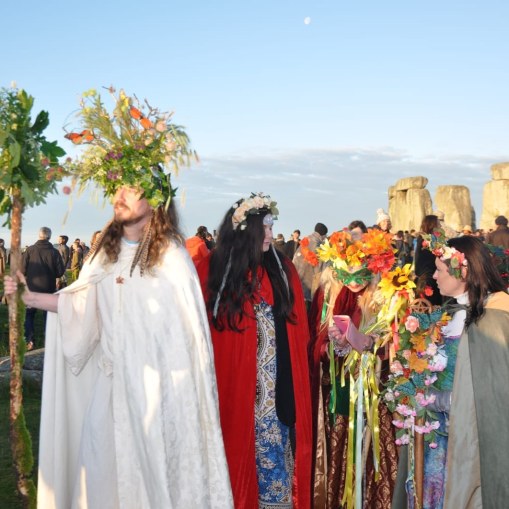
The fixing of their dates links these four festivals to the corresponding Christian festivals and names by which they’re best known in English. Imbolc has become St Brigid’s Day, and the following day, 2 February, is Candlemas. Lughnasa corresponds to the harvest festival of Lammas. Samhain has become Halloween, the eve of All Saints’ Day, also known as Hallowmas. Of the four festivals, Beltane – May Day in English – has perhaps best preserved its pagan origins in the perennial customs of maypoles and may queens, although in modern times it has gained a new significance as Labour Day, the holy day of socialism.

20180620_201312

The lunar festivals were also called ‘fire festivals’ because the ancient Celts celebrated

them with bonfires. The establishment of Bonfire Night on 5 November shifted the fires of Halloween by a few days and attached to them a new political significance. In my view, it’s high time that British custom got over its symbolic need to demonise Roman Catholics (as represented by Guy Fawkes) and moved the bonfires back to Halloween where they belong. In Celtic – especially Irish – tradition there are many stories associated with the lunar festivals, especially with Samhain, when the veil between this world and the otherworld is very thin – a great opportunity for adventures back forth between the worlds.


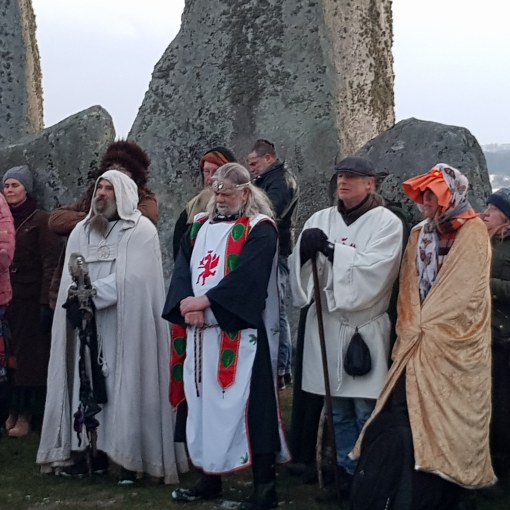
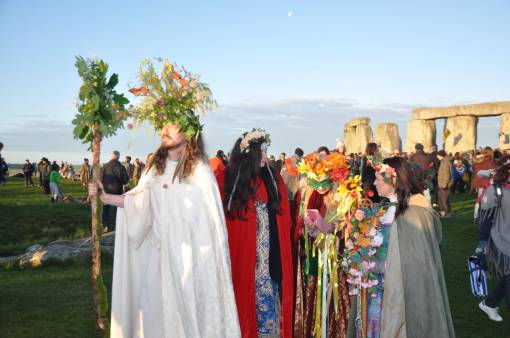
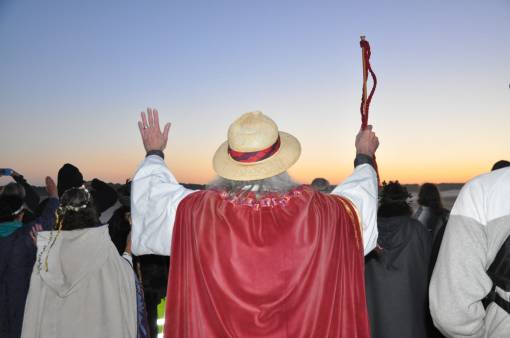
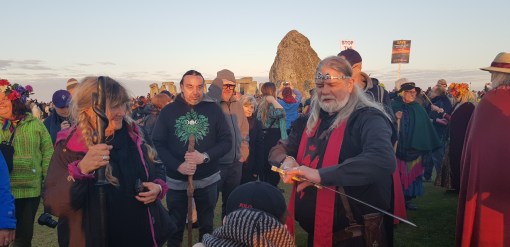
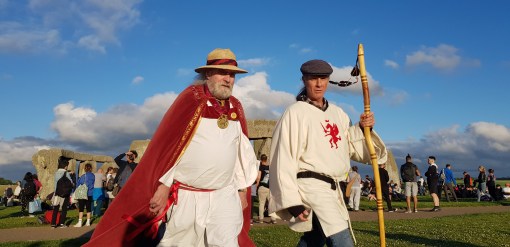
Modern Druids conduct ceremonies on the four lunar festivals in the tradition of the ancient Celts. They also conduct ceremonies on the four, more universal, solar festivals. This makes a total of eight quarter festivals that provide the backbone of the Druids’ sacred calendar. It is thanks to modern Druids’ custom of doing ceremony at Stonehenge on the solar festivals that public access has been negotiated on those days. I understand that the Druids are also conducting ceremonies near Stonehenge on the lunar festivals too, in order to establish a custom of religious usage in this location which they hope in time will enable public access on these four dates as well.

Article by guest blogger and author/storyteller Anthony Nanson.  Sponsored by Stonehenge Guide Tours

Follow us on Twitter and Facebook for all the latest Stonehenge news and stories.
The Stonehenge News Blog
http://www.Stonehenge.News


View the sky above Stonehenge LIVE now with Skyscape. See how this ancient monument relates to the skies above it.

24 06 2019

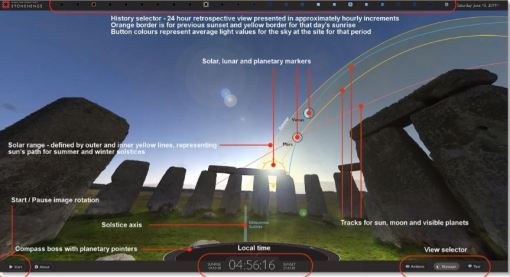
A new website has been created by English Heritage to enable people around the world to experience the skies above the iconic stone circle, to learn about movements of the sun, moon and planets and to see the solar alignment at Stonehenge.

sky

The visuals are a representation of the view from within Stonehenge, a composite from various sources, not the literal view. Visit the skyscape website here

Day view
The view of the daytime sky is accurate to within a window of approximately five minutes, with the position of the sun accurate to a similar margin. You can use the highlighted squares at the top to view the last sunrise and sunset. Weather conditions are accurate – you may sometimes see raindrops on the camera!

Night view
After dark we switch from a photographic depiction to a computer generated one, which accurately displays the live location of the stars and the five visible planets. Neptune, Uranus and Pluto (as a dwarf planet) are consciously not included, as, being invisible to the naked eye, they remained undiscovered until the 18th century or later, and were consequently unknown to the builders of Stonehenge. As the night sky is a computer model it does not reflect weather conditions at the site.

Enjoy the experience!
Aside from the technical and informational aspects of Skyscape it’s also our hope that you’ll enjoy it from a more human perspective. We’ve created a webpage which offers a small escape, a pleasant place to visit, to which you can return frequently, even within a single day, and connect with the land, the stones and the skies above.

To capture the sky, a custom Raspberry Pi based, solar powered camera equipped with a 220° Fish Eye lens was built. You can see the status of the camera at freeboard.io .

How to use the site
Skyscape makes use of many modern web standards, so performs best with a modern browser and operating system. Older software, such as Internet Explorer, cannot always provide a good experience. Latest versions of browsers such as FirefoxChrome, Edge and Safari will perform best.

Visit the Skyscape website  here

If you are experiencing issues, try updating your system and graphics drivers to the latest version.

Follow us on Twitter and Facebook for all the latest Stonehenge news and stories.
The Stonehenge News Blog
http://www.Stonehenge.News


Thousands of people gathered to greet the sun as it rose over Stonehenge for the summer solstice.

23 06 2019

About 10,000 people gathered at the Stonehenge to greet the start of the longest day of the year, according to Wiltshire Police. The celebrations at Stonehenge came as people descended on sites across the UK to celebrate the first day of summer.

This slideshow requires JavaScript.

Kate Logan, from English Heritage, said: “There was a lovely, friendly atmosphere, the sun shone and the dawn was greeted with loud cheers.”  For the first time, people from around the world were also able to join in from the comfort of their homes as English Heritage launched a live feed from a camera set up close to the stones.

The crowds encountered a chilly morning accompanied by clear skies as the sun rose at 4.52am. 

On the summer solstice, the sun rises behind the Heel Stone, the ancient entrance to the Stone Circle, and rays of sunlight are channelled into the centre of the monument.

Summer solstice takes place as one of the Earth’s poles has its maximum tilt toward the sun and the sun reaches its highest position in the sky, ensuring the longest period of daylight in the year.

It is believed that solstices have been celebrated at Stonehenge for thousands of years.

Follow us on Twitter and Facebook for all the latest Stonehenge news and stories.
The Stonehenge News Blog
http://www.Stonehenge.News


RELEVANT LINKS:
Evening Standard
BBC
TIME MAGAZINE
MSN


Merlin and the Making of Stonehenge

8 06 2019

The archaeologists have their ideas about how and why Stonehenge was built. The annals of legend have another story, one that involves Merlin the magician plus the uncle and father of King Arthur.

The story begins not in Neolithic times but in the troubled years of the fifth century, after

46739440934_98a8f1b736_z (1)

21st Century Merlin at Stonehenge

the Roman legions had withdrawn from Britain. The Saxons had invaded and were advancing rapidly across the land. The native British sought to resist them and to sustain the remnants of Romano-British civilisation. So there was terrible fighting between Saxon and Briton. So much bloodshed that their respective leaders agreed to meet at a spot on Salisbury Plain to try to negotiate a peace treaty.

The thing is, some people take a more hardball approach to ‘negotiation’ than others do. It had been agreed that the leaders should meet together unarmed, but the Saxon chieftains treacherously smuggled in their knives. The leaders stood in a circle in which Saxon and Briton alternated. They began to parlay. But not for long. At a signal, all the Saxon chieftains drew out their knives and each stabbed the Briton standing immediately to his left.

So the Saxons had the upper hand for some time. Till a British prince in exile in France, Aurelius Ambrosius, returned to Britain with his brother Uther Pendragon. Ambrosius won a major victory against the Saxons. Having done so, he desired to honour the British chiefs who’d been murdered on Salisbury Plain, by building a monument in the exact spot where the atrocity had occurred.

He called for advice from a wise man of prodigious repute, Merlin, who told him of a fabulous stone circle that had been built by giants – hence its name ‘the Giants’ Dance’ – on a mountain in Ireland. Ambrosius sent Merlin with Uther Pendragon to lead an expedition to Ireland to steal the Giants’ Dance. There was fighting of course, because the Irish quite understandably wanted to keep the structure in Ireland. But Uther’s warriors prevailed.

There was then the problem of how to transport this huge stone circle. Merlin applied his esoteric knowledge to uproot the stones, transport them on ships, and then re-erect the monument on Salisbury Plain – at the very spot where the Saxon chieftains had so treacherously slain the British leaders.

When, in due course, Aurelius Ambrosius died, he was buried in the Giants’ Dance – or Stonehenge, as it became known. So too was Uther Pendragon. Uther was the father of the future King Arthur. According to the legend, Arthur was expected to be buried there too. But Arthur never dies and is instead transported, badly wounded, to the Isle of Avalon, there to sleep and dream, waiting to return in his country’s hour of need. That being so, perhaps we ought to hope he might return quite soon!

We have this story from Geoffrey of Monmouth’s The History of the Kings of Britain, written in Oxford in the 12th century. You can find a fuller telling of the tale in Kirsty Hartsiotis’s Wiltshire Folk Tales.

One doesn’t want to pull the rug out from beneath a lovely, enchanting legend, but of course there’s no easy way to match up this story with the archaeological knowledge that Stonehenge was built in Neolithic times. But there are elements that do fit. For one thing, the use of Stonehenge as a burial ground. For another, the likely transportation of the bluestones on watercraft from what is now Pembrokeshire in West Wales. An intriguing observation is that sea communications between Ireland and West Wales throughout antiquity mean that this western extremity of Wales could have been colonised by people from Ireland and therefore might, in a cultural rather than narrowly geographical sense, have been regarded as part of ‘Ireland’. Finally, although legend presents Merlin as a magician, the esoteric skills he demonstrates in the story in uprooting, transporting, and erecting the megaliths invite us to view him as symbolic of the engineering experience that some individuals must have possessed in the age of Stonehenge’s construction.

Article by guest blogger and author/storyteller Anthony Nanson

Recent Blog: Druid Leader King Arthur Uther Pendragon, Head of the Loyal Arthurian Warband.

English Heritage: The King Arthur Story and links to Arthurian locations

BBC HistoryKing Arthur, ‘Once and Future King’

Stonehenge Guided Tours offer King Arthur Tours including Stonehenge and associated sites in the South West of England.

Follow us on Twitter and Facebook for all the latest Stonehenge news and stories.
The Stonehenge News Blog
http://www.Stonehenge.News


Stonehenge Summer Solstice Open Access 2019

20 05 2019

Stonehenge is an ancient prehistoric world heritage site which has been a place of worship and celebration at the time of Summer Solstice for thousands of years. Stonehenge is a world renowned historic Monument and part of a World Heritage Site. It is seen by many who attend as a sacred place.  

Summer Solstice Sunrise Celebrations at Stonehenge

Summer Solstice Sunrise Celebrations at Stonehenge

Please note that last normal admissions to Stonehenge is on Thursday 20th June at 13:00 and the site will close at 15:00 in preparation for Summer Solstice Managed Open Access. Stonehenge will re-open for normal admissions on the afternoon of Friday 21et June. Please check our social media channels for the exact time.

English Heritage is pleased to provide free Managed Open Access to Stonehenge for Summer Solstice. We ask that if you are planning to join us for this peaceful and special occasion that you read the Conditions of Entry and the information provided on the following pages before deciding whether to come.

Stonehenge is a significant World Heritage Site and to many it is sacred – please respect the stones and all those who are attending.

Admission to the Summer Solstice at Stonehenge is free of charge.  We hope the weather will be kind and wish you a peaceful and celebratory solstice.

THURSDAY 20th JUNE 2019  
SOLSTICE CAR PARK OPENS 19.00 hours
ACCESS TO STONEHENGE MONUMENT FIELD 19.00 hours
SUNSET 21.26 hours
FRIDAY 21st JUNE 2019  
SUNRISE 04.52 hours
LAST ADMISSION TO SOLSTICE CAR PARK 06.00 hours (or when full)
STONEHENGE MONUMENT FIELD CLOSES

SOLSTICE CAR PARK TO BE VACATED

08.00 hours

12.00 hours (Noon)

For further information about Managed Open Access for Summer Solstice at Stonehenge, please call English Heriage Customer Services Solstice Information Hotline on 0370 333 1181.

RELEVANT LINKS:
Summer Solstice at Stonehenge. From Past to Present. Stonehenge New Blog
Why Thousands Of Pagans Gather At Stonehenge For The Solstice Stonehenge News Blog
Respect the Stones: Stonehenge News Blog

The Stonehenge News Blog
Follow us on Twitter and Facebook for all the latest Stonehenge News and Summer Solstice updates
http://www.Stonehenge.News