Stonehenge Tours

9 12 2009


I frequently get requests from tourists wishing to visit Stonehenge requesting who to travel with – here we go…………..

The best way to visit Stonehenge is on a guided sightseeing tour. The majority of visitors are from overseas and do not have their own transport, therfore the best way to see Stonehenge is on a scheduled tour. Most tours depart from central London and usually include other destinations i.e Windsor Castle, Bath, Salisbury, The Cotswolds – not all in the same day I hasten to add. This is because Stoneheneg is almost 2 hours from London and the tour operators tend to do a circular tour taking in other tourist attractions. I have listed the options below:

1.Stonehenge, Salisbury and Bath Day Trip from London
2.Stonehenge, Windsor Castle and Bath Day Trip from London
3.Small Group Stonehenge, Windsor Castle and Bath Day Trip from London
4.London to Stonehenge Shuttle Bus & Independent Day Trip
5.Late-morning Departure to Stonehenge and Roman Baths
6.Private Viewing of Stonehenge including Bath and Lacock
7.Two-Day Trip: Stonehenge and Bath Overnight

Sadly not all operators offer a great experience. I am familiar with the good and the bad and have provided a link to a Stonehenge tour website that has managed to negotiate special discounts and only use the best companies and approved guides. The advantage of booking through them is that you get ‘real time’ availability and instant booking confirmation.
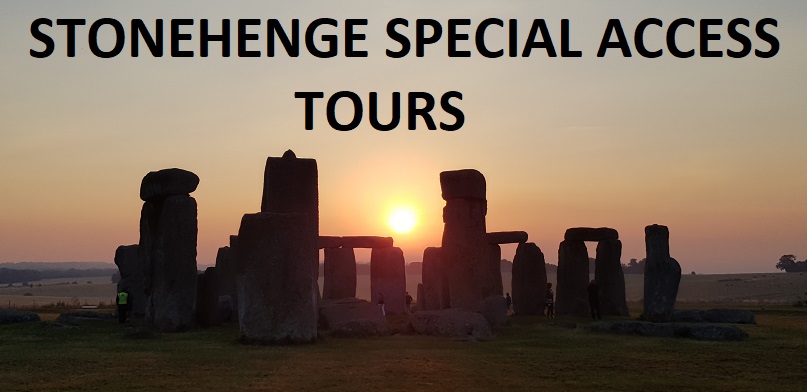
Stonehenge is the most visited attraction in Britain and by far the most popular tour so booking well in advance is essential, especialy if you are tring to join a ‘Stonehenge special access’ tour where there are very limited dates.

Click here to view all the Stonehenege Tours avaialble – enjoy and good luck!

Should you prefer a more personal experience and would like to visit Avebury Stone circle, Old Sarum, buriel mounds, Silbury Hill and even some crop circles please contact me for a private tour – I’m not greedy and a garantee a truly memorable day.
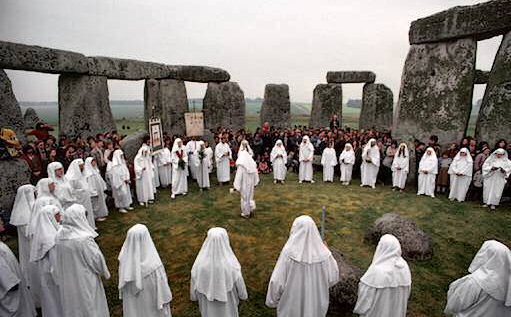


Was Jesus taught by the Druids ?

9 12 2009

As a book of record the New Testament doesn’t do too well on the early life of Jesus Christ.

The large holes may explain why so many outlandish theories have been able to build up about what the Son of God got up to as a boy.

But among those myths most perpetuated is that he visited Britain

Now a film has sought to add flesh to the fable by claiming it’s perfectly plausible the Messiah made an educational trip to Glastonbury.

And Did Those Feet explores the idea that Jesus accompanied his supposed uncle, Joseph of Arimathaea, on a business trip to the tin mines of the South-West.

Whilst there, it is claimed he took the opportunity to further his maths by studying under druids.

Unsurprisingly, the documentary stops short of concluding the visit did take place, noting ‘Jesus’s shoe has not turned up’. However, the makers insist that while the visit is unproven, it is possible.

The theory is that he arrived by sea, following established trading routes, before visiting several places in the West Country.

In the film, Dr Gordon Strachan, a Church of Scotland minister, says it is plausible Jesus came to further his education. The country is thought to have been at the forefront of learning 2,000 years ago, with mathematics particularly strong.

Ted Harrison, the film’s director, said: ‘If somebody was wanting to learn about the spirituality and thinking not just of the Jews but also the classical and Greek world he would have to come to Britain, which was the centre of learning at the time.

‘Jesus was a young man curious to find out about all sorts of things.

‘We know there is a huge gap in the life of Jesus between when he was born and when his ministry started.

‘He would have come to learn what was being taught about astronomy and geometry which was being taught at “universities” run by druids at the time.’

Mr Harrison, a former BBC religious affairs correspondent, says Jesus may just have been a boy when he left the Middle East for England.


Great British Heritage Pass

7 12 2009


If you plan to visit Stonehenge and other English Heritage sites buying a Heritage Pass will save time and money –

Combine great value and great sightseeing with the Great British Heritage Pass. Giving you free entry to nearly 600 attractions in England, Scotland, Wales and Northern Ireland, the multi-day heritage pass takes you on an amazing journey through Britain’s rich cultural heritage.

Britain has a vibrant history, and scores of brilliantly preserved stately homes, palaces, castles, gardens and famous monuments to visit. Plan your visit using the Great British Heritage Pass and the free 40-page guidebook you’ll receive and save money along the way.

With the Great British Heritage Pass you’ll have FREE ENTRY to nearly 600 attractions, including:

•Stonehenge
•Edinburgh Castle
•Palace of Holyroodhouse
•Roman Baths
•Shakespeare’s Birthplace
•Leeds Castle
•St. Paul’s Cathedral
•Royal Albert Hall
•Anne Hathaway’s Cottage
•Stirling Castle
•Cardiff Castle
•Caernarfon Castle
•Tintern Abbey

Additional information

The Great British Heritage Pass

Inclusions:
•FREE 40 page Guidebook
•FREE Map of Great Britain
•The Great British Heritage Pass
•FREE entry to over 600 attractions

If you wish to purchase a pass the cheapest place to buy one is at this link – click here


Stonehenge Winter Solstice 2009 – 8.09am 21st December

7 12 2009

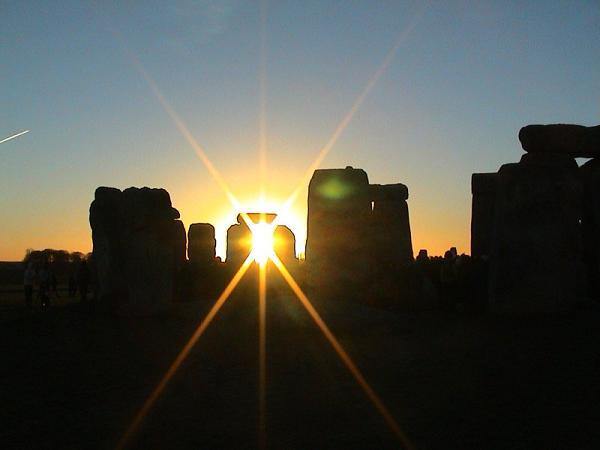
This year, the Solstice sunrise is on the morning of Monday the 21st December. Sunrise itself is around 08.09 a.m. (exact times will be posted nearer to the event). open the site to the public from 07.30 a.m. for a couple of hours.
when I do get the times I will post them on the main page.

I will be there again to see the sunrise ( one day it will be visible I am sure) and get up close to the wonderful stones and celebrate the shortest day of the year with the normal mixture of interesting and lovely people. Needless to say I will be posting lots of images ‘live’ from the centre! Watch this space……………


English Heritage forced to pulp its aptly titled Ghastly Book Of Stonehenge over crass errors

5 12 2009

Stonehenge: The guide, meant for children, is riddled with mistakes

The Government body responsible for maintaining the nation’s historic monuments has been forced to withdraw a children’s guide to Stonehenge because it was littered with factual errors.
The book, called The Ghastly Book Of Stonehenge, has become a laughing stock among archaeologists because of its many blunders.
English Heritage, which receives £129million a year in Government funding, has recalled 4,500 copies of the £3 book and now plans to pulp them.

A spokeswoman said last night that an ‘incorrect proof’ – an earlier, unedited version of the book – had been sent to the printers.
The schoolboy errors include a passage in which the Bronze Age was mistakenly placed before the Stone Age, and an Ice Age mammoth was used to illustrate a chart showing Iron Age to medieval times.
Mammoths finally became extinct around 1700BC – almost 1,000 years before the Iron Age began in Britain.
An entry about 5th Century king Aurelius Ambrosius – believed to be the historical basis for King Arthur – mistakenly called him Aureole Ambrosias, a spelling error that appears to have been copied from the internet.
One paragraph states that Bronze Age bluestones, which archaeologists believe were transported to the site in Wiltshire from Wales, arrived in around 2550BC, while ‘about 200 to 300 years’ later, ‘New Stone Age people added some much bigger stones’.
Grammatical errors are also rife, including examples such as ‘Prehistoric carvings of daggers and axes on the stones is discovered by a photographer’

Distances and directions on maps are often wrong or contradictory with the stone circle at Avebury said to be ‘about 20km’ from Stonehenge in the text while on the fold-out map it’s 46km.
Page references are often wrong and anyone who wanted to find the entry about Merlin and Aurelius Ambrosius would be directed to Page 30, when it’s actually six pages later on.
The mistakes in the book, by children’s author Tracey Turner, were spotted by a reader of British Archaeology magazine, which lampooned the errors in its latest edition.
Editor Mike Pitts said: ‘I couldn’t believe it. It was supposed to be written in a style that makes it accessible to children but the result was a catalogue of errors too many to list, so I thought it our duty to publish the story.
‘Not only that but the book was written in a style that really pokes fun at the people of the past in a condescending way and I think that devalues and demeans what happened at Stonehenge.
‘There’s even a silly reference to a site at Robin Hood’s Ball near Stonehenge as being “a prehistoric nightclub”.
‘King Aurelius Ambrosius is a central mythical figure in the story of Stonehenge who is said to have told Merlin to build the Henge on the site of a great and bloody battle but to spell his name wrong so that he becomes King Nipples Rice Pudding just takes the biscuit.’
An English Heritage spokeswoman said last night: ‘The Ghastly Book of Stonehenge was withdrawn as soon as it became apparent an incorrect proof containing a number of factual errors had gone to print.
‘The Ghastly series was conceived in 2005 as part of a wider strategy to improve family learning at our sites.
‘However, over the past couple of years, publishing at English Heritage has undergone quite a radical rethink and we are unlikely to be printing books such as these again.
‘We will instead focus on providing free, downloadable resources to support teachers and families visiting our website.
‘We have also completely reviewed our editorial procedures to ensure that such a mistake doesn’t happen again.’


‘Bring your own barbecues’ were popular at Stonehenge 5,000 years ago

2 12 2009


Stonehenge was a popular area for feasting in the Neolithic period

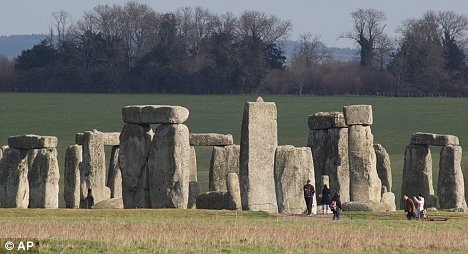
Stonehenge attracts thousands of Druids, tourists and music festival revellers from far afield each year. Now a new analysis of ancient animal teeth has revealed it was a popular feasting area as far back as 5,000 years ago.
Stone-age people drove cattle across the country to ‘bring-your-own’ beef barbecues near Stonehenge, the tests revealed.
The analysis of the teeth found at Durrington Walls, a 5,000-year-old village, showed the animals had come from at least 60 miles away.

Dr Jane Evans from the British Geological Survey said the discovery showed a number of feasts were held at the Stonehenge site.

She added that people travelled from as far away as Wales to get there but brought their own food rather than shopping for beef locally.

‘People are coming from considerable distances and dispersion in order to have feasts,’ Dr Evans said.

‘People were bringing their food supplies to this site. There wasn’t a farming community that supplied travellers with local beef. It was a case of bringing your own beef barbecue.’
The discovery was made by analysis of different types of a chemical element called strontium found in the soil and absorbed through food into animal and human teeth.
Different types or isotopes of strontium are found in soils of different geological make-up, and the nearest match to those found in the cattle teeth are in Wales, Dr Evans said at the BA Festival of Science in Liverpool.
The Stone Age Neolithic site is a massive circular earthwork close to Stonehenge that was used from around 3,000 BC to 2,500 BC, until around the time the stones at Stonehenge were put in place in the Bronze Age.
An archaeological dig at the site in the 1960s revealed a circular timber structure and a vast collection of animal bones.

Dr Evans added the discovery shed light on communications and movement in the Neolithic period, and showed the already-known relationship between the Stonehenge area and Wales stretched back into the Stone Age.


Heavy rock music: Stonehenge was a ‘neolithic rave venue’

30 11 2009

The mysterious Stonehenge was a dance arena for ancient revellers listening to ‘trance-style’ music, according to one professor who is an expert in sound.

Stonehenge has baffled archaeologists who have argued for decades over the stone circle’s 5,000-year history – but now academic Dr Rupert Till believes he has solved the riddle by suggesting it may have been used for ancient raves.
Part-time DJ Dr Till, an expert in acoustics and music technology at Huddersfield University, believes the standing stones of Stonehenge had the ideal acoustics to amplify a ‘repetitive trance rhythm’ not dissimilar to some kinds of modern trance music.

Stonehenge would have had strange acoustic effects thousands of years ago

The original Stonehenge probably had a ‘very pleasant, almost concert-like acoustic’ that our ancestors slowly perfected over many generations. Because Stonehenge itself is partially collapsed, Dr Till, used a computer model to conduct experiments in sound.
The most exciting discoveries came when he and colleague Dr Bruno Fazenda visited a full-size concrete replica of Stonehenge, which was built as a war memorial by American road builder Sam Hill at Maryhill in Washington state.
He said: ‘We were able to get some interesting results when we visited the replica by using computer-based acoustic analysis software, a 3D soundfield microphone, a dodecahedronic (12-faced) speaker, and a huge bass speaker.
‘We have also been able to reproduce the sound of someone speaking or clapping in Stonehenge 5,000 years ago.

‘The most interesting thing is we managed to get the whole space (at Maryhill) to resonate, almost like a wine glass will ring if you run a finger round it.

‘While that was happening a simple drum beat sounded incredibly dramatic. The space had real character; it felt that we had gone somewhere special.’

Building on previous research, Dr Till believes ancient Britons had a good ear for sounds and shaped the stones to create the best acoustics.

He went on: ‘Other archaeologists’ research shows that Stonehenge has a specific acoustic design. The stones are all curved and reflect the sound perfectly. The lintels are also curved. They must have noticed that when they placed a stone in a particular place it would have sounded different.’
Dr Till recently spoke to academics at Bristol University about Stonehenge rituals and a research network is being set up to look closer at Neolithic sites.

‘There are two main theories about what Stonehenge was used for,’ he says.

‘One is that it was a healing space, the other that it was a place of the dead.
‘Both of these imply ritual activity, but very little is actually known about the way people sang, danced or performed rituals there because these things left no trace in the archaeological record.

‘However, our research shows that there are particular spots in the site that produce unusual particular acoustic effects, intimating that perhaps a priest or a shaman may have stood there, leading the ritual.

‘This kind of ritual may also have been for healing, so this acoustic study may tie the two main competing theories about Stonehenge together.’
The data is still being analysed, but it is clear that Stonehenge did have a ‘very unusual sound’ says Dr Till.

‘By simulating this sound we can hope to understand more about English culture from 5,000 years ago, and perhaps better understand both our ancestors and our culture today.’


Stonehenge tops list of Britain’s ‘seven wonders’

30 11 2009


Stonehenge has been voted as the UK’s top wonder in a new list of the country’s unmissable attractions.

The ancient site beat competition from other notable UK landmarks including Snowdonia and Edinburgh Castle to top the survey of the ‘Seven Wonders of Britain’.
The poll, by holiday firm cottages4you, asked 1,000 holidaymakers what made a great British break.
It found that as a nation we are lovers of Britain’s natural beauty as we shun modern-made attractions for natural and historic sights, with prehistoric monument Stonehenge topping the list.

The survey also found that while a third of 18-24-year-olds said fish and chips on the pier was the most memorable British holiday activity, over 35-year-olds were wowed by the UK’s countryside and scenery.

Apart from Stonehenge, the list includes Hadrian’s Wall, the White Cliffs of Dover, Loch Ness and Cheddar Gorge.

There are so many fantastic places to visit in the UK from mountains and beaches to historic monuments and stately homes, I’m sure those taking their first UK holiday for a few years will be spoilt for choice.’
Yet despite the British love affair with holidaying at home (60 per cent have already taken one break in the UK this year) we are still not so adventurous when it comes to exploring our green and pleasant land – London and the Lake District were voted as the most popular destinations

The ‘Seven Wonders of Britain’ are:
Stonehenge
Hadrian’s Wall
The White Cliffs of Dover
Loch Ness
Snowdonia
Edinburgh Castle
Cheddar Gorge


New Stonehenge Tour – The Stonehenge Express

27 11 2009

A new tour has been launched by the sightseeing coach tour company Evan Evans, based in London. Itinerary as follows;
Afternoon Express Coach Service from London to Stonehenge, including admission into Stonehenge.

Included Highlights•Express Service to Stonehenge by luxury Motor-coach
•Entrance to Stonehenge included
•Information Fact Sheet and Audio Guide
•Extended Visit

The great and ancient stone circle of Stonehenge is one of the great wonders of the world and has been awarded World Heritage Status. Why it was built is a mystery, it has been a pagan place of worship, an astronomical clock and a Bronze age burial ground. Its origins date back almost 5,000 years. Decide for yourself while you discover this unique monument.

Board our luxury coach for a direct Express service to Stonehenge. On arrival our driver will take you onto the site, where you can enjoy the stones at your leisure with a fascinating audio-guide tour, in the language of your choice.

Languages on the Audio Guide: English, Italian, Swedish, Russian, German, Mandarin, Spanish, Japanese, French, Dutch.


DAYS OF OPERATION

Days of operation: Tuesday, Thursday and Saturday
Tour Starts: 12.15pm, The Original Tour Visitors Centre, Trafalgar Square
Tour Finishes: 6.30 pm

Adults: £29.00 Children (3-16): £26.00
Seniors (60+)/Students (with ID): £28.00

To book this tour – click here


Heritage Lottery Boost for new Stonehenge Visitor Centre

27 11 2009

The Heritage Lottery Fund (HLF) has given its funding green light to English
Heritage’s proposals to improve the setting and visitor facilities of Stonehenge, it
was announced today (19th November).
The HLF first-round pass* means that English Heritage can now progress to the
second stage of the HLF application process. As part of the process, English
Heritage has up to two years to finalise its proposals for the £4.95m of HLF support
that they are seeking for their £27.5m project.
Stonehenge receives over 40,000 education visitors every year from both the UK and
around the world. The existing visitor facilities at Stonehenge have no provision for
education and interpretation, with all education activities currently being conducted
outdoors.
A new, multi-functional education area at the proposed new visitor centre at Airman’s
Corner will provide space and facilities for school groups. Community groups and
family activities will also be catered for.
A new, dedicated exhibition and interpretation space will also, for the first time,
provide a much needed introduction to Stonehenge, helping visitors to better
understand the monument and its setting.
Loraine Knowles, Stonehenge Project Director at English Heritage, said: “This is
fantastic news. We are delighted that the Heritage Lottery Fund supports the

project. The project has immense potential for education and training, as well as at
last providing a visitor experience fitting for the country’s most famous monument.”
Carole Souter, Chief Executive of the Heritage Lottery Fund, said: “Stonehenge is
one of the UK’s most important archaeological landmarks and a place that has
intrigued and delighted people for thousands of years. The Heritage Lottery Fund’s
initial support for these plans to better protect and present the site reflects our
strong belief that Stonehenge is an iconic part of our heritage.”

Notes to Editors:
*A first-round pass means the project meets the HLF criteria for funding and they believe
it has potential to deliver high-quality benefits and value for Lottery money. The application
was in competition with other supportable projects, so a first-round pass is an endorsement
of outline proposals.
However, a first-round pass does not guarantee the applicant will receive a grant as the
second-round application will still be in competition for funding, and no money is set aside
at this stage. Having been awarded a first-round pass, the project now has up to two years
to submit fully developed proposals to compete for a firm award.
Using money raised through the National Lottery, the Heritage Lottery Fund (HLF) sustains
and transforms a wide range of heritage for present and future generations to take part in,
learn from and enjoy. From museums, parks and historic places to archaeology, natural
environment and cultural traditions, we invest in every part of our diverse heritage. HLF has
supported more than 28,800 projects, allocating over £4.3billion across the UK.