The Henge Hopper

3 04 2011

The Wiltshire Heritage Museum is planning to launch a bus service to link Stonehenge and Avebury. At the moment, it is extremely difficult to travel between the two, and the Museum hopes to be able to boost tourism in the Vale of Pewsey and the Avon Valley. They hope to launch a service in due course.
Stonehenge

Stonehenge

The Community Bus Service will be operated by minibuses, and the route would take in a range of archaeological sites and monuments in the Stonehenge and Avebury World Heritage Site, including Silbury Hill, West Kennet Long Barrow and Woodhenge.

The ‘hop on, hop off’ service would include free entry to the Wiltshire Heritage Museum in Devizes, encouraging people to discover the collections excavated from the World Heritage Site.

The Henge Hopper enables you to visit:

Avebury
Britain’s largest stone circle, at the centre of a remarkable complex of monuments, including stone circles, burial mounds, two stone-lined avenues and Silbury Hill.

Alexander Keiler Museum, Avebury Manor
Explore the world famous stone circle. The bus starts from just outside the Museum, which features fascinating finds from Alexander Keiler’s excavations at Avebury, and, in the barn, interactive displays bring the Avebury landscape to life. Explore also Avebury Manor and its wonderful garden. Cafe, toilets and shop.

Silbury Hill
The largest man-made mound in Europe, mysterious Silbury Hill compares in height and volume to the roughly contemporary Egyptian pyramids.

West Kennet Long Barrow
One of the largest, most impressive and most accessible Neolithic chambered tombs in Britain. Built in around 3650 BC, it was used for a short time as a burial chamber, nearly 50 people being buried here before the chambers were blocked.

Wansdyke / White Horse Trail
Massive Saxon defensive ditch and bank running along the top of the North Wessex Downs. Walk along the Wansdyke, following the White Horse Trail, with stunning views over the Vale of Pewsey.

Marden Henge
Britain’s largest henge, Excavations in 2010 have revealed much about its fascinating story.

Alton Barnes White Horse
Dominates the landscape of the Vale of Pewsey.

Adam’s Grave / Wansdyke
Neolithic chambered tomb on the summit of the Downs. Walk along the Wansdyke, following the White Horse Trail.

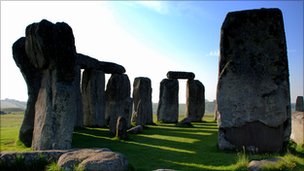
Stonehenge

The most sophisticated stone circle in the world, at the centre of a remarkable sacred landscape. Includes the cursus, a 3km long earthwork and the Avenue, leading from the River Avon.

Winterbourne Stoke

The most impressive barrow cemetery – a Neolithic long barrow and a line of Bronze Age burial mounds.

Normanton Down
Cemetery of over 50 round barrows, including the famous Bush Barrow.

Amesbury

Amesbury is an attractive small town embraced by a loop of the River Avon as it cuts through the high plateau of Salisbury Plain. The town has served the needs of travellers for centuries. Highlights include the Amesbury is the closest settlement to Stonehenge.

Durrington Walls / Woodhenge
Durrington Walls is a massive henge, the site of the recent discovery of Neolithic houses, where the people who used Stonehenge may have lived. Nearby is Woodhenge, where excavations showed a series of concentric circles of wooden posts, enclosed by a bank and ditch.

Where to Stay
Local accomodation listed by VisitWiltshire.

Alternatvley you could join a guided sightseeing coach tour with ‘The Stonehenge Tour Company’ or a privat tour with ‘Histouries UK’ or ‘SalisburyGuidedTours‘ based is Salisbury

The Henge Hopper – http://www.stonehenge-avebury-bus.org.uk/
Stonehehenge Tour Companies – http://www.stonehenge-stone-circle.co.uk/stonehenge-tours.htm

However you get there, get there…………………….

Merlin @ Stonehenge
The Stonehenge Stone Circle Website


The Amesbury Archer. The King of Stonehenge

14 02 2011
The Amesbury Archer

I ofter talk about the ‘Amesury Archer’ on my Stonehenge tours and wanted to put some facts into my blog for those visitors who keep asking for more information.  
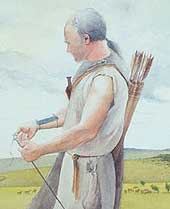
An excavation in Wiltshire some years ago revealed the grave of a Bronze Age archer, buried with a rich array of precious metal goods and a quiver of arrows. Was this the King of Stonehenge?

An Early Bronze Age grave

In the spring of 2002 what started as a routine excavation was undertaken in advance of the building of a new school at Amesbury in Wiltshire. By the end of the excavation the richest Bronze Age burial yet found in Britain had been discovered. The Bronze Age man discovered there had been buried not far from the great temple of Stonehenge. He was a man who owned and could work the new and magical metals of gold and copper. And he had come from what is now central Europe, perhaps around the Alps. Was he a king of Stonehenge?

Early Bronze Age pottery showed that they were over 2,500 years older than the Roman graves.

On the site of the proposed new school there was a small Roman cemetery but, it seemed, little else. In the far corner of the site, though, there were two features that looked different. Had they been caused by trees being blown over? Or were they something else? They certainly did not look like Roman graves.

Excavation work started on a Friday morning, and the reason for the difference between the Roman graves and the two other features rapidly became clear. The features were indeed graves, but the Early Bronze Age pottery in one of them showed that they were over 2,500 years older than the Roman graves. And the grave with the pottery was unusually large.

The Amesbury Archer

Golden artefacts - either earrings or hair tresses These golden artefacts may have been earrings or hair tresses . One of the next finds revealed something unusual – a gold ‘earring’. This type of jewellery may be the oldest type of gold object made in Britain. These objects are very rare, and they usually occur in pairs, and as it was the Friday of the May Bank Holiday weekend it was decided that the excavation of the grave should be completed that day. This might involve staying on a little bit late on a Friday afternoon, but not, it was thought, very late.

What no one knew then was that the grave, the burial of the Amesbury Archer as he has come to be known, was to be the most well-furnished Early Bronze Age burial ever seen in Britain. The graves could not be left unprotected, so a ‘little bit’ late turned into ‘very, very’ late, as it became clear that this was a very important find.

The excavation showed that there was probably a timber mortuary building in the larger grave. Because of this not all the earth had been put back into the grave at the time of the burial, so it seems likely that a small burial mound or barrow surmounted the grave.

What no one knew then was that the grave, the burial of the Amesbury Archer as he has come to be known, was to be the most well-furnished Early Bronze Age burial ever seen in Britain. The graves could not be left unprotected, so a ‘little bit’ late turned into ‘very, very’ late, as it became clear that this was a very important find.

The excavation showed that there was probably a timber mortuary building in the larger grave. Because of this not all the earth had been put back into the grave at the time of the burial, so it seems likely that a small burial mound or barrow surmounted the grave.

King of Stonehenge?

The stones of Stonehenge seen at sunrise

The stones of Stonehenge seen at sunrise

The site of Stonehenge at sunrise. The radiocarbon dates show that the Archer lived between 2,400 and 2,200 years BC. The burial lies about 5km (2 miles) south-east of Stonehenge and it was at about this time that the massive stone circles, and the avenue leading to the River Avon from the site, were built. The great temples of Woodhenge and Durrington Walls, both a similar distance away, continued to be used and modified throughout this time.In the past, burials of this date were considered rich if they contained more than a handful of objects, especially if one of the objects was of copper or bronze, or even gold. Although the finds buried with the Archer are all of well known types (within the Beaker cultural package that is found across much of central and western Europe at this time), the number of objects found with him, almost 100, is without compare.

Had these two men been part of a ruling élite?

The burial is also one of the earliest of its type in Britain, some of the finds are of the highest quality, and the gold is the earliest yet found in Britain. Furthermore the copper knives came from Spain and western France – an indication of the wide contacts of their owner. Above all, though, the associations between these finds are of particular importance.

Can it be a coincidence that the richest Early Bronze Age burial in Britain, and its companion, should be so close to the great temples of Durrington Walls? Had these two men been part of a ruling elite? Had one of them been a king?

A European élite

Copper knives from the Amesbury Archer's grave

Copper knives from the Amesbury Archer's grave

The Archer’s copper knives  As the archaeologists discussed these questions, further surprising facts became clear. Some archaeologists have argued that, for the period in question, there is no certain evidence for the sort of social differences that might suggest a ranked society. The discovery of the burial of the Amesbury Archer and his companion, however, showed for the first time that at this date there were individuals – and perhaps even families – of greater wealth and status than others. That this elite had ties across Europe is shown by the sensational discovery that the Archer comes from central Europe.The enamel on our teeth stores a chemical record of the environment where we have grown up. It is possible by using Oxygen Isotope Analysis to measure this record. The Archer’s teeth show that as a child he lived in a colder climate than that of Britain today, in central Europe, and perhaps close to the Alps.

He was raised in central Europe but he died near to one of the greatest temples in Europe.

Much work remains to be done. At the moment we do not know why the Amesbury Archer came to live, and perhaps raise a family, near Stonehenge. Was he brought up in the family of distant allies? Did he arrive in order to seal an alliance by taking a partner? Was he a settler or a pilgrim? Or was he an outsider with the magical skills of alchemy?

We will never know all the answers, but we can say this. He was a strong man, who overcame pain and handicap. He could work new and exotic metals. His mourners gave him the richest burial of his time. He was raised in central Europe but he died near to one of the greatest temples in Europe. We may not know if he was a king, but it is still an astonishing story. It is a Bronze Age biography.

If you are visiting Stonehenge or on a Stonehenge tour take the time to visit the Salisbury and South Wiltshire Museum –
http://www.salisburymuseum.org.uk/collections/stonehenge-prehistory/amesbury-archer.html

Books

Bronze Age Britain Mike Parker Pearson (Batsford/English Heritage 1993)

Hengeworld by Mike Pitts (Century, 2000)

The Stonehenge People: Life and Death at the World’s Greatest Stone Circle by Aubrey Burl (Barrie Jenkins, 1989)

Stonehenge by Julian Richards (Batsford/English Heritage, 1991)

Merlin @ Stonhenge
The Stonehenge Stone Circle Website