Stonehenge transformation work well on schedule

20 02 2013

Work to transform Stonehenge, which officially started on site in July last year, is progressing well.

This year, the centenary of the 1913 Ancient Monuments Act, will culminate in the opening of English Heritage’s new Stonehenge exhibition galleries and visitor centre at the end of the year.

Work on the Stonehenge site is due to be completed by the end of this year

Work on the Stonehenge site is due to be completed by the end of this year

Building work is currently taking shape at Airman’s Corner, 1.5 miles to the west and out of view of the stones, where the new galleries and facilities will be located.

The sensitively designed building will comprise two “pods” which will house museum-quality exhibitions, a spacious café with indoor and outdoor seating, a bigger shop and dedicated education space

Main contractor Vinci Construction is about to erect a ’bird-cage’ scaffold which will be used to install the undulating canopy roof, a distinctive feature of the building’s design, while a visitor car park and coach park, with capacity for 500 and 30 vehicles respectively, have been laid out and are clearly visible.

Precious objects on loan from the Wiltshire Heritage Museum in Devizes and the Salisbury and South Wiltshire Museum are currently being conserved by English Heritage staff ready for display.

They will form the centrepiece of the permanent exhibition at the new building, helping to tell the story of Stonehenge in vivid detail.

Next month volunteers will help with an archaeological experiment at Old Sarum Castle near Salisbury where prototypes of Neolithic houses excavated at Durrington Walls will be built. The lessons learned from this experiment will inform the reconstruction of three Neolithic houses at the outdoor gallery of the new visitor centre in Spring 2014, offering visitors a glimpse of the lives of prehistoric people.

The A344 road between Stonehenge Bottom and Byway 12 will be closed at the end of June, once the new roundabout at Airman’s Corner is operational. Work will follow to remove the fences along this section of road and the road surface itself will be removed and grassed over.

No part of the Stonehenge operation will close while the works are being carried out, and the switchover to the new visitor centre will happen overnight. Until then, access to the existing Stonehenge car park will continue along the A344 but from the west via the A360 and Airman’s Corner.

The date of the opening at the end of 2013 will be announced later in the year.

Full article in the Wiltshire Times: http://www.wiltshiretimes.co.uk/news/10237112.Stonehenge_transformation_work_well_on_schedule/

Merlin @ Stonehenge
The Stonehenge News Blog


Stonehenge to appear on One Show

15 02 2013

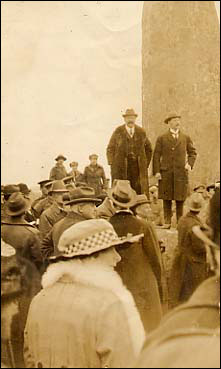
A HUNDRED years ago landowner Cecil Chubb bought Stonehenge for £6,600 and donated it to the nation.

And the iconic stones are set to feature on the BBC’s The One Show as Ben Marshall from Salisbury-based chartered surveyors Woolley & Wallis talk to presenter Giles Brandreth about one of the biggest deals in the firm’s history.

salisbury-stonhenge Current Woolley & Wallis partner John Woolley – great grandson of the original John Turton Woolley involved in the sale – said: “It is a great honour that our firm was involved in this purchase.

“I can’t see anything quite like it coming under the hammer today.”

The firm’s original partner John Turton Woolley acted for Shrewton landowner Chubb when he was the successful bidder of lot 15 on September 21, 1915.

Mr Chubb became Sir Cecil three years later when he was knighted by then prime minister Lloyd George after he gave the monument to the nation.

The Stones had been in private hands since the middle ages but when the heir to the Amesbury estate, Edward Antrobus, was killed in the First World War, the estate was put up for sale at an auction run by Knight Frank at The Palace Theatre, Salisbury.

Chubb is said to have bought the stones on a whim for his wife, who was reportedly not overly pleased that he had spent the equivalent of £392,000 in today’s money on the gift.

In 2010 a survey of 500 estate agents valued the 30-acre site at £51million

Full Article: By Morwenna Blake (Salisbury Journal) – http://www.salisburyjournal.co.uk

Conditions of the Deed: Free admission into Stonehenge

For Sir Cecil, however, Stonehenge belonged to the nation, and in 1918 after owning it for just three years he formerly handed it over to the country with a number of conditions.

His conditions were that the entrance fee should never be more then a shilling (5p) and that local residents should have free access.

“The 1918 deed of gift didn’t actually specify free access for local residents,” says Joy Kaarnijoki at English Heritage, “it was an agreement with the Parish Council.

“The road passed very close to the stones. The Council agreed that the rights of way could be diverted further from the stone circle on condition that local residents would be granted free access.”

Whether it was stipulated by Sir Cecil Chubb himself, or not, it’s an agreement that has continued to the present day.

According to English Heritage, the 30,000 local residents living in and around Stonehenge can still take up the offer of free access to one of England’s most famous monuments.

Link: http://en.wikipedia.org/wiki/Cecil_Chubb

Merlin @ Stonehenge


Ancient Avebury site has so much potential

12 02 2013

A TWO-man Avebury stone circle research team say the site should capitalise on a World Heritage boost.

The Which? Travel magazine hailed Avebury as the second greatest World Heritage site, behind only the ancient Mexican city of Monte Alban and ahead of attractions including the Great Pyramid and the Taj Mahal.

Avebury_Stone Circle, WiltshireThis was music to the ears of author Eric M Crook and artist Maurice Giraffe from Swindon, who have spent decades investigating not just Avebury but other ancient sites such as Stonehenge and Silbury Hill.

Mr Crook, 88, is the author of a study called Wiltshire: A Journey-man’s Tale. Many of the book’s illustrations are the work of Mr Giraffe, 55, who combines artistic and technical drawing skills to plot the relative positions of stones.

Mr Crook said of the Which? Travel accolade: “It’s fantastic for this to happen, and we would hope that maybe somebody has taken notice of our comments over the years about this place being so important.”

Mr Giraffe added: “I too am very, very pleased that Avebury has been nominated within the top 10.

“At the same time, what draws the attention is that seven of the 10 are building complexes. There is only one stone circle.

“Avebury should now improve its facilities for visitors. Shelters from the rain would be useful, and so would pathways for wheeled access around the stones. We’d like to see uplighters installed so the stones can be seen better at night.”

The two also suggest night time tours and regular grass cutting, as well as restricting access by grazing sheep.

The researchers believe the archaeological establishment has missed clues about ceremonial and navigational uses for such prehistoric places.

They say their research indicates that the surviving Avebury stones were once part of a vast amphitheatre featuring many thousands of carved human and animal faces, and these faces would have appeared to come to life in flickering firelight.

The researchers say remnants of these carvings can still be seen in fragments hacked from the stones down the years, whether for recycling or because the early Christian church objected to the old religions.

Mr Crook said: “Many churches were built with the old stones, and also other properties across Wiltshire.”

Wiltshire: A Journeyman’s Tale costs £9.99 and can be ordered from Amazon and book shops.
Article (By Barrie Hudson – http://www.swindonadvertiser.co.uk)

Merlin says: ‘Not sure about the uplighters idea’ ?

Merlin @ Stonehenge
Stonehenge News Blog



Stonehenge Lecture by Mike Pearson. Wiltshire Heritage Museum

28 01 2013

Prof Mike Parker Pearson, who will be presenting the latest scientific results from laboratory analysis following a decade of fieldwork in the Stonehenge World Heritage Site. 2(:30 pm, Saturday, 23 February, 2013)

A striking and original interpretation of the awesome Stone Age site from one of the world's foremost archaeologists on death and burial"

A striking and original interpretation of the awesome Stone Age site from one of the world’s foremost archaeologists on death and burial”

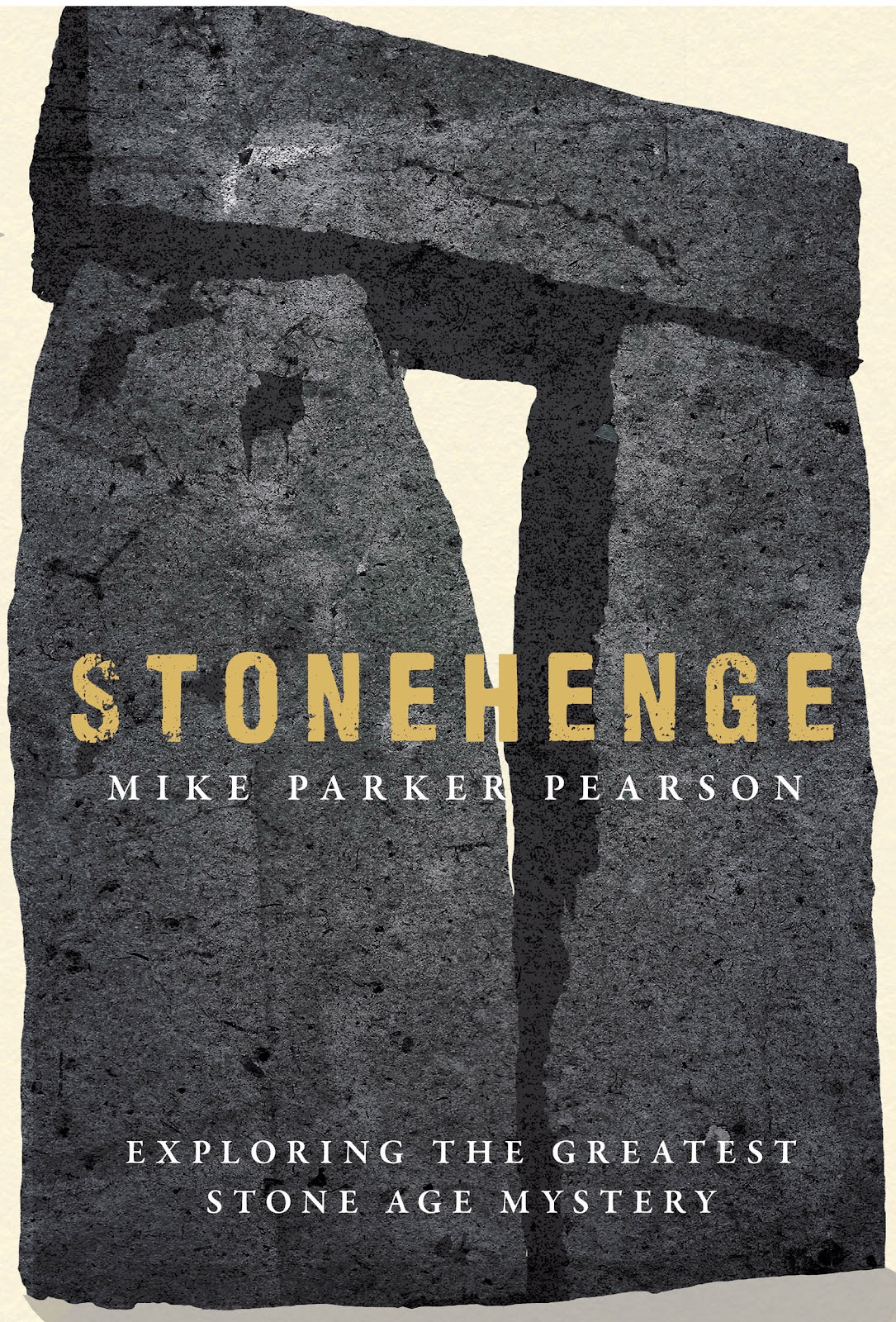
New research over the last year has provided fascinating insights into the lives of the people of Stonehenge and why they built this enigmatic and mysterious monument. Mike Parker Pearson will talk about his new book Stonehenge: exploring the greatest Stone Age mystery, and will present the latest scientific results coming out of laboratory analysis following a decade of fieldwork in the Stonehenge World Heritage Site. This includes new light on the people buried at Stonehenge, and on the settlement of the builders at the nearby henge of Durrington Walls. He will also reveal the results of new research into the provisioning of Stonehenge, including the search for its quarries in Wiltshire and west Wales, to show how the act of building Stonehenge involved people from all over prehistoric Britain.

Mike has spent many years researching Stonehenge and its environment, particularly during the Stonehenge Riverside project. He is Professor of British Later Prehistory at UCL Institute of Archaeology.
http://www.wiltshireheritage.org.uk

Booking:

* Tel: 01380 727369 (office hours Tuesday to Friday 10am to 5pm)

Saturday afternoon lectures start at 2.30pm and last approx. one hour.
This lecture is being held at Devizes Town Hall, just a short walk from the Museum.

 Cost:   £6 (£3.50 WANHS members)

‘See you there’
Merlin @ Stonehenge


Crowds see in winter solstice at Stonehenge

22 12 2012

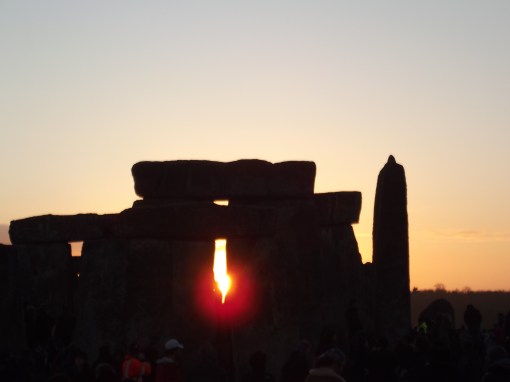
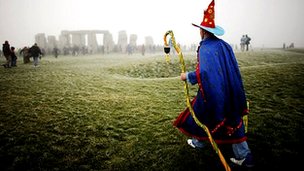
Thousands of people have gathered at Stonehenge to watch the sun rise over the ancient monument for the winter solstice

Stonehenge-Winter-Solstice-2012 (35)

Around 5,000 people are thought to have converged on Stonehenge in Wiltshire, to celebrate the 2012 winter solstice, which is around five times the number at last year’s festivities.

This year’s winter solstice coincided with the Mayan Apocalypse, so an “End of the World Party” was held at the monument.

During the winter solstice, the sun is closer to the horizon than at any other time in the year, meaning shorter days and longer nights.

The day after the winter solstice marks the beginning of lengthening days, leading up to the summer solstice in June.

Watch a video here: http://www.telegraph.co.uk/telegraphtv/9760577/Crowds-see-in-winter-solstice-at-Stonehenge.html

A good time had by all…………

Merlin at Stonehenge

mpu-bottom advertisement


OU students’ Stonehenge dig put to the vote for award

19 12 2012

Excavations by Open University students that could point to the origins of Stonehenge, have been nominated for Research Project of the Year by Current Archaeology magazine.

http://www.open.ac.uk/platform/news-and-features/ou-students-stonehenge-dig-put-to-the-vote-for-awardYou can vote for the project, which is called Vespasian’s Camp: Cradle of Stonehenge? on the Current Archaeology website here.

The project is led by OU tutor David Jacques who has recruited more than 100 OU students to work on the site, alongside volunteers from the nearby town of Amesbury, since the dig began in 2005.

The ongoing dig, at a previously unexplored site 1.5 km east of Stonehenge, is uncovering evidence which suggests the area was an important centre for Stone Age hunters several thousand years before the famous stone circle was built.

“Many experts are now wondering if Stonehenge is where it is because of this new site, because radiocarbon dates obtained from it show a continued use of the site from the 8th millennium BC through to the 5th millennium BC,” says David Jacques.

“This is the longest continually used place yet found in the Stonehenge landscape, and it connects the hunter-gatherer Mesolithic period to close to the Neolithic period, when Stonehenge starts to be constructed.

“It must have been a very special place to be used for 3000 years, a point confirmed by Professor Tim Darvill of Bournemouth University, who also described it as ‘the most important discovery at Stonehenge in many years’.”

The excavation team have uncovered the largest cache of Mesolithic tools ever found in the area, together with evidence of gargantuan Stone Age feasts.

They’ve also found weapons and other objects left as offerings to a god or goddess during the much later Bronze or early Iron Age, suggesting the site had a sacred tradition stretching over thousands of years.

The dig has also inspired the local community to create a museum at Amesbury to house the finds.

To find out more see the story here where you can watch a video and follow links to press reports.

Stonehenge News Blog sponsored by ‘Stonehenge Guided Tours’

Merlin @ Stonehenge


Stonehenge Project Update. December 2012

8 12 2012

As Stonehenge gears up for winter, we wanted to let you know we’re making good progress with the new visitor centre at Airman’s Corner. This time next year, work will have been completed and we’ll be busy preparing for the opening.

As you can see from the photo below, the visitor centre and the car park are  taking shape behind the hoardings. The building should be water-tight by Christmas and a ‘bird cage’ scaffold will be used in the New Year to help install the delicate canopy roof.

Aerial view of Airman's Corner

Aerial view of Airman’s Corner

We’ve taken great care with the design and construction of the building – disruption to the ground has been kept to a minimum and we have used locally sourced materials wherever possible.

The new visitor centre taking shape

The new visitor centre taking shape

At Last, a Proper Place to Tell Stonehenge’s Story

A visit to the stones will, for the first time, be enhanced by special exhibition galleries curated by English Heritage experts which will tell the story of Stonehenge and its relationship with the wider landscape. They will feature important objects excavated near Stonehenge kindly loaned by the Wiltshire Heritage Museum and the Salisbury and South Wiltshire Museum.

Curators discussing the objects on loan from the two local museums

Curators discussing the objects on loan from the two local museums

Neolithic Builders Needed

One exciting feature of the outdoor gallery is the reconstruction of three Neolithic houses based on rare evidence of buildings unearthed near Stonehenge. We need volunteers to help us build three prototype houses at Old Sarum Castle in spring 2013 and then build the actual houses at the new visitor centre in autumn 2013. To find out more or to register your interest, please go to Stonehenge volunteering.

An attempt at reconstructing a Neolithic house in East Sussex

An attempt at reconstructing a Neolithic house in East Sussex

Business As Usual at Stonehenge

The construction work is not visible from Stonehenge at all; throughout the construction period Stonehenge will continue to welcome visitors at its existing facilities.

An opening date for the new visitor building will be announced in 2013, and the switch-over to the new facilities will be overnight so that there will be no disruption to visitors.

When the new visitor centre and its captivating galleries open in winter 2013, we will start dismantling the existing facilities and restore the landscape around the stones. We look forward to keeping you posted as these exciting developments progress.

Computer-generated image of the new visitor centre when completed

Computer-generated image of the new visitor centre when completed

Road Improvements

We understand the closure of the A344 has raised some concerns – it’s a vital change to help create a more tranquil and dignified setting for Stonehenge, but we are working hard to mitigate the impact. The Highways Agency is carrying out works to improve the capacity of Longbarrow Roundabout to cope with the diverted traffic (see details below) and the section of the A344 between Stonehenge Bottom and Byway 12 will only close when these improvements are complete in May 2013. The rest of the road will remain open until we move operations to Airman’s Corner.

Work is also underway to improve the Airman’s Corner roundabout. During the construction, we’re keeping the use of traffic lights to a minimum but some are needed to ensure safe traffic flow.

Longbarrow Roundabout Roadworks (A303/A360 Junction)

The Highways Agency has started a six-month scheme to improve the Longbarrow roundabout at the junction of the A360 and A303. The proposed improvements to the northern and eastern approaches to the roundabout will accommodate changes in traffic flows following the planned A344 closure in May 2013. New lanes will be added to the roundabout to take the extra traffic caused by the closure of the A344 and the centre of the roundabout itself will be realigned.

During the works, there will be lane closures on the northern and eastern approaches to Longbarrow roundabout and a temporary 40mph speed limit in place. The A360 south of Longbarrow will be closed for up to eight days and nights on dates to be confirmed in either February or March 2013. Diversion routes will be in operation using the A345 or the A36 depending on journey destinations.

Contact us

If you have any questions regarding the project please email English Heritage atstonehenge.project@english-heritage.org.uk

Link source: http://www.english-heritage.org.uk

Stonhenge News Blog sponsored by Stonehenge Guided Tours – www.StonehengeTours.com

Merlin @ Stonehenge


Building Stonehenge: A New Timeline Revealed

3 12 2012

Ancient people probably assembled the massive sandstone horseshoe at Stonehenge more than 4,600 years ago, while the smaller bluestones were imported from Wales later, a new study suggests.

ulian Richards in 2008, excavating a previously unsuspected cremation burial close to the edge of Aubrey Hole 7. Carbon dating suggests this burial was almost certainly made before the main ditch circuit was dug

ulian Richards in 2008, excavating a previously unsuspected cremation burial close to the edge of Aubrey Hole 7. Carbon dating suggests this burial was almost certainly made before the main ditch circuit was dug

The conclusion, detailed in the December issue of the journal Antiquity, challenges earlier timelines that proposed the smaller stones were raised first.

“The sequence proposed for the site is really the wrong way around,” said study co-author Timothy Darvill, an archaeologist at Bournemouth University in England. “The original idea that it starts small and gets bigger is wrong. It starts big and stays big. The new scheme puts the big stones at the center at the site as the first stage.”

The new timeline, which relies on statistical methods to tighten the dates when the stones were put into place, overturns the notion that ancient societies spent hundreds of years building each area of Stonehenge. Instead, a few generations likely built each of the major elements of the site, said Robert Ixer, a researcher who discovered the origin of the bluestones, but who was not involved in the study.
“It’s a very timely paper and a very important paper,” Ixer said. “A lot of us have got to go back and rethink when the stones arrived.”

Mysterious monument

The Wiltshire, England, site of Stonehenge is one of the world’s most enduring mysteries. No one knows why prehistoric people built the enigmatic megaliths, although researchers over the years have argued the site was originally a sun calendar, a symbol of unity, or a burial monument.

Though only some of the stones remain, at the center of the site once sat an oval of bluestones, or igneous rocks (those formed from magma) that turn a bluish hue when wet or freshly cut. Surrounding the bluestones are five giant sandstone megaliths called trilithons, or two vertical standing slabs capped by a horizontal stone, arranged in the shape of a horseshoe.

Around the horseshoe, ancient builders erected a circular ring of bluestones. The sandstone boulders, or sarsens, can weigh up to 40 tons (36,287 kilograms), while the much smaller bluestones weigh a mere 4 tons (3,628 kg).

Past researchers believed the bluestone oval and circle were erected earlier than the massive sandstone horseshoe.

But when Darvill and his colleagues began excavations at the site in 2008, they found the previous chronology didn’t add up. The team estimated the age of new artifacts from the site, such as an antler-bone pick stuck within the stones. Combining the new information with dating from past excavations, the team created a new timeline for Stonehenge’s construction.

Like past researchers, the team believes that ancient people first used the site 5,000 years ago, when they dug a circular ditch and mound, or henge, about 361 feet (110 meters) in diameter.

But the new analysis suggests around 2600 B.C. the Neolithic people built the giant sandstone horseshoe, drawing the stone from nearby quarries. Only then did builders arrange the much smaller bluestones, which were probably imported from Wales. Those bluestones were then rearranged at various positions throughout the site over the next millennium, Darvill said.

“They sort out the local stuff first, and then they bring in the stones from Wales to add to the complexity of the structure,” Darvill told LiveScience.

The new dating allows the archaeologists to tie the structure to specific people who lived in the area at the time, Darvill said. The builders of the larger sandstone structures were pig farmers found only in the British Isles. In contrast, the bluestone builders would’ve been the Beaker people, sheep and cow herders who lived throughout Europe and are known for the distinctive, bell-shape pottery they left behind.

The new timeline “connects everything together, it gives us a good sequence of events outside, and it gives us a set of cultural associations with the different stages of construction,” Darvill said.

Tia Ghose, LiveScience Staff Writer
http://www.livescience.com/25157-stonehenge-megaliths-timeline-enigma.html
Date: 30 November 2012 Time: 01:23 PM ET

“Stonehenge remodelled”
Timothy Darvill, Peter Marshall, Mike Parker Pearson & Geoff Wainwright
ANTIQUITY 86 (2012): 1021–1040

What did Stonehenge look like? How did it begin?

The new Antiquity features an article by Tim Darvill, Pete Marshall, Mike Parker Pearson & Geoff Wainwright called “Stonehenge remodelled”. It’s designed to be the definitive summary of the current rethinking about the monument’s construction history. You can see an abstract here, though you need to subscribe to read the paper. There is a much fuller study published by English Heritage available online

Link: http://mikepitts.wordpress.com/2012/12/01/stonehenge-in-five-easy-stages-or-perhaps-six/

Blog sponsore by ‘Stonehenge Guided Tours’ www.StonehengeTours.com

Merlin at Stonehenge


Writer gives his view on how and why Stonehenge was built

30 11 2012

Former building engineer Simon Mallon, of Frome, enjoyed a 40-year career before turning his hand to writing.

His latest novel On the Edge of the Blue gives a fascinating explanation of how and why Stonehenge was built.

stonehenge-bluestonesMr Mallon said: “The sheer effort expended by the constructors of the first Stonehenge suggests Europe’s most iconic ancient structure was created for a magnificent purpose. But what purpose?

“Astrological, mathematical, medical, all laudable ideas based on nothing more than guesswork and hunches and so very wrong.

“Stonehenge is older than it looks, it was built to defeat the greatest threat mankind ever faced, the Ice Age and it succeeded.”

Mr Mallon believes that the henge stood on the side of a massive lake, and that the Preseli stone that was used to build it was brought across the frozen sea from the Pembrokeshire mountains to Bristol and then on across the lake.

Link source: http://www.thisissomerset.co.uk
Relative link: http://brian-mountainman.blogspot.co.uk/ (The Bluetone Enigma)

Merlin says “There are many varying theories that have and are proposed for “why Stonehenge was built” and we are all entitled to our views. No one will have the complete answer”

Sponsored by ‘Stonehenge Guided tours’ www.StonehengeTours.com

Merlin @ Stonhenge


2nd Historic Stonehenge – Amesbury Lantern Procession along the original Avenue

22 11 2012

AMESBURY will be holding its second lantern parade on Friday, December 21st

Following the success of last year’s event, the parade has been organised to bring the community together before Christmas.

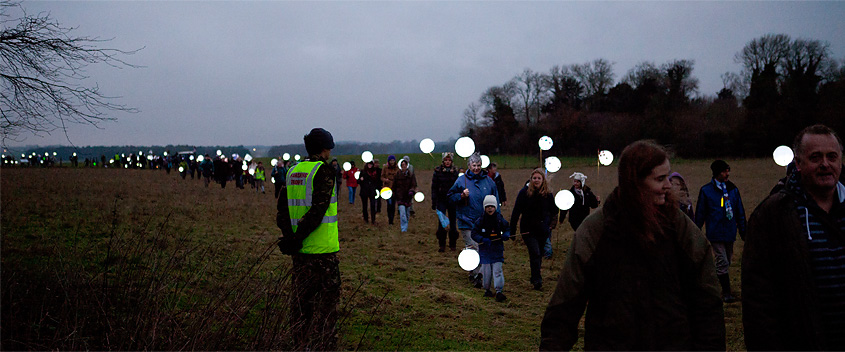
More than 500 people are to hold a procession from Stonehenge to Amesbury

More than 500 people are to hold a procession from Stonehenge to Amesbury

The 2nd Lantern Parade from Stonehenge to Amesbury will take place on Friday 21st December 2012 (not the 20th as we suggested earlier). This year’s route will be different to the one taken last year too. From the heel stone it will follow the original Avenue route to Kings Barrow Ridge, turning left on to the byways to join Countess Road (North) at the junction with Byway 9a & 37 and then following the footpath in to Amesbury to the Methodist Church.

Tickets cost £5 including bus travel from Amesbury to Stonehenge and a lantern, which can be decorated, with a prize for the best one.

If people already have a lantern they can take it along and buy a bus ticket for £2

There will be no parking at Stonehenge for the event and refreshments will be available after the procession, which starts at 4pm.

More information and tickets are available from the Bowman Centre or the Amesbury Community and Visitor Centre, call Alice Membery on             01980 622999       or emaildeputyclerk@amesburytc.org.uk.

More about the Lantern Parade

The parade, along the original processional route of the avenue, is believed to have been started centuries ago when the ancient monument was first built.

“We’ve just discovered that life began in Amesbury as early as 8,250 years ago with a settlement by the River Avon,” said Mr Rhind-Tutt.

Sun sets
“And the processional route would have been the route that led people from Amesbury to Stonehenge.”

During the winter solstice the sun is closer to the horizon than at any other time in the year, meaning shorter days and longer nights.

And the recreation of the procession has been timed to leave Stonehenge as the sun sets on the eve of the longest night of the year.

“It’s about a mile-and-a-half but it isn’t like walking down a road,” said Mr Rhind-Tutt.

“In daylight you can do it an hour – in the dark it may take up to two hours but it’s proving extremely popular and we’ve even got a stilt walker signed up.”

Link Source:
 http://www.salisburyjournal.co.uk/
http://www.bbc.co.uk/news/uk-england-wiltshire-16284687

Stonehenge: This year’s lantern procession details

Stonehenge news blog sponsored by ‘Stonehenge Guided Tours’  www.StonehenegTours.com

Merlin says “It was a fantastic experience last year and I look forward to the procession this Solstice”

Merlin @ Stonehenge