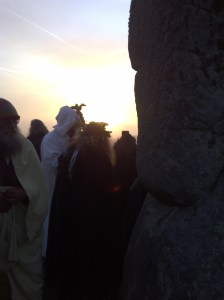
Stonehenge Winter Solstice 2012

11 12 2012

English Heritage will once again allow people access to Stonehenge for the celebration of the Winter Solstice, the first day of the winter season. Sunrise is at 8.09am on Friday 21 December and visitors will be able to access the monument as soon as it is light enough to do so safely. Entrance is free and will be available from roughly 7.30am until 9am, when the site will close – before re-opening as per usual to paying visitors at 9.30am.

Stonehenge Winter Solstice 2012

Stonehenge Winter Solstice 2011

The exact time of the Solstice this year, when the Earth’s axial tilt is farthest away from the sun, is at 11.11am on 21 December, however it is generally accepted that the celebration of this special event takes place at dawn and therefore access is permitted at Stonehenge earlier that morning.

Over the last few years, the popularity of Winter Solstice has grown considerably, with many families and young people joining the druid and pagan community in the celebrations. Two years ago, 2,000 people attended Winter Solstice and in 2011 that figure more than doubled to a record 5,000 people.

Peter Carson, Head of Stonehenge, said: “We are delighted to offer people a warm welcome to Stonehenge this Winter Solstice but as facilities are limited, we are not able to accommodate any more people than last year. We don’t have the luxury of using nearby fields in winter for parking and encourage people to make use of the special bus service running from Salisbury. We are working very closely with the local authorities and agencies plus the druid and pagan community to ensure that access to Stonehenge will once again be a success.”

Additional notes
Access may not be possible if the ground conditions are considered poor or if it is felt that access might result in severe damage to the monument.
Public have in previous years used byway 12 for parking on the morning of 21st December. Additional car parking for approximately 800 cars will be available on the A344 (which will be closed to through traffic), plus the Stonehenge Visitor Centre Car Park.

Connected:
New theory of a Winter Solstice Sunrise Alignment –Solstice and the Winter Solstice leaflet (ISBN 9780957093010)
(Background on the Winter Solstice Sunrise Alignment theory is here)
Countdown to doomsday. Stonehenge Winter Solstice 2012

Link source: http://www.sarsen.org/2012/11/winter-solstice-at-stonehenge-2012.html

Winter Solstice updates: Follow Stonhenge on Twitter –  https://twitter.com/ST0NEHENGE

Merlin says “Respect the Stones”

Merlin @ Stonehenge


Stonehenge Project Update. December 2012

8 12 2012

As Stonehenge gears up for winter, we wanted to let you know we’re making good progress with the new visitor centre at Airman’s Corner. This time next year, work will have been completed and we’ll be busy preparing for the opening.

As you can see from the photo below, the visitor centre and the car park are  taking shape behind the hoardings. The building should be water-tight by Christmas and a ‘bird cage’ scaffold will be used in the New Year to help install the delicate canopy roof.

Aerial view of Airman's Corner

Aerial view of Airman’s Corner

We’ve taken great care with the design and construction of the building – disruption to the ground has been kept to a minimum and we have used locally sourced materials wherever possible.

The new visitor centre taking shape

The new visitor centre taking shape

At Last, a Proper Place to Tell Stonehenge’s Story

A visit to the stones will, for the first time, be enhanced by special exhibition galleries curated by English Heritage experts which will tell the story of Stonehenge and its relationship with the wider landscape. They will feature important objects excavated near Stonehenge kindly loaned by the Wiltshire Heritage Museum and the Salisbury and South Wiltshire Museum.

Curators discussing the objects on loan from the two local museums

Curators discussing the objects on loan from the two local museums

Neolithic Builders Needed

One exciting feature of the outdoor gallery is the reconstruction of three Neolithic houses based on rare evidence of buildings unearthed near Stonehenge. We need volunteers to help us build three prototype houses at Old Sarum Castle in spring 2013 and then build the actual houses at the new visitor centre in autumn 2013. To find out more or to register your interest, please go to Stonehenge volunteering.

An attempt at reconstructing a Neolithic house in East Sussex

An attempt at reconstructing a Neolithic house in East Sussex

Business As Usual at Stonehenge

The construction work is not visible from Stonehenge at all; throughout the construction period Stonehenge will continue to welcome visitors at its existing facilities.

An opening date for the new visitor building will be announced in 2013, and the switch-over to the new facilities will be overnight so that there will be no disruption to visitors.

When the new visitor centre and its captivating galleries open in winter 2013, we will start dismantling the existing facilities and restore the landscape around the stones. We look forward to keeping you posted as these exciting developments progress.

Computer-generated image of the new visitor centre when completed

Computer-generated image of the new visitor centre when completed

Road Improvements

We understand the closure of the A344 has raised some concerns – it’s a vital change to help create a more tranquil and dignified setting for Stonehenge, but we are working hard to mitigate the impact. The Highways Agency is carrying out works to improve the capacity of Longbarrow Roundabout to cope with the diverted traffic (see details below) and the section of the A344 between Stonehenge Bottom and Byway 12 will only close when these improvements are complete in May 2013. The rest of the road will remain open until we move operations to Airman’s Corner.

Work is also underway to improve the Airman’s Corner roundabout. During the construction, we’re keeping the use of traffic lights to a minimum but some are needed to ensure safe traffic flow.

Longbarrow Roundabout Roadworks (A303/A360 Junction)

The Highways Agency has started a six-month scheme to improve the Longbarrow roundabout at the junction of the A360 and A303. The proposed improvements to the northern and eastern approaches to the roundabout will accommodate changes in traffic flows following the planned A344 closure in May 2013. New lanes will be added to the roundabout to take the extra traffic caused by the closure of the A344 and the centre of the roundabout itself will be realigned.

During the works, there will be lane closures on the northern and eastern approaches to Longbarrow roundabout and a temporary 40mph speed limit in place. The A360 south of Longbarrow will be closed for up to eight days and nights on dates to be confirmed in either February or March 2013. Diversion routes will be in operation using the A345 or the A36 depending on journey destinations.

Contact us

If you have any questions regarding the project please email English Heritage atstonehenge.project@english-heritage.org.uk

Link source: http://www.english-heritage.org.uk

Stonhenge News Blog sponsored by Stonehenge Guided Tours – www.StonehengeTours.com

Merlin @ Stonehenge


Building Stonehenge: A New Timeline Revealed

3 12 2012

Ancient people probably assembled the massive sandstone horseshoe at Stonehenge more than 4,600 years ago, while the smaller bluestones were imported from Wales later, a new study suggests.
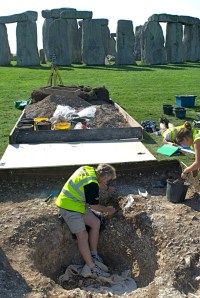
ulian Richards in 2008, excavating a previously unsuspected cremation burial close to the edge of Aubrey Hole 7. Carbon dating suggests this burial was almost certainly made before the main ditch circuit was dug

ulian Richards in 2008, excavating a previously unsuspected cremation burial close to the edge of Aubrey Hole 7. Carbon dating suggests this burial was almost certainly made before the main ditch circuit was dug

The conclusion, detailed in the December issue of the journal Antiquity, challenges earlier timelines that proposed the smaller stones were raised first.

“The sequence proposed for the site is really the wrong way around,” said study co-author Timothy Darvill, an archaeologist at Bournemouth University in England. “The original idea that it starts small and gets bigger is wrong. It starts big and stays big. The new scheme puts the big stones at the center at the site as the first stage.”

The new timeline, which relies on statistical methods to tighten the dates when the stones were put into place, overturns the notion that ancient societies spent hundreds of years building each area of Stonehenge. Instead, a few generations likely built each of the major elements of the site, said Robert Ixer, a researcher who discovered the origin of the bluestones, but who was not involved in the study.
“It’s a very timely paper and a very important paper,” Ixer said. “A lot of us have got to go back and rethink when the stones arrived.”

Mysterious monument

The Wiltshire, England, site of Stonehenge is one of the world’s most enduring mysteries. No one knows why prehistoric people built the enigmatic megaliths, although researchers over the years have argued the site was originally a sun calendar, a symbol of unity, or a burial monument.

Though only some of the stones remain, at the center of the site once sat an oval of bluestones, or igneous rocks (those formed from magma) that turn a bluish hue when wet or freshly cut. Surrounding the bluestones are five giant sandstone megaliths called trilithons, or two vertical standing slabs capped by a horizontal stone, arranged in the shape of a horseshoe.

Around the horseshoe, ancient builders erected a circular ring of bluestones. The sandstone boulders, or sarsens, can weigh up to 40 tons (36,287 kilograms), while the much smaller bluestones weigh a mere 4 tons (3,628 kg).

Past researchers believed the bluestone oval and circle were erected earlier than the massive sandstone horseshoe.

But when Darvill and his colleagues began excavations at the site in 2008, they found the previous chronology didn’t add up. The team estimated the age of new artifacts from the site, such as an antler-bone pick stuck within the stones. Combining the new information with dating from past excavations, the team created a new timeline for Stonehenge’s construction.

Like past researchers, the team believes that ancient people first used the site 5,000 years ago, when they dug a circular ditch and mound, or henge, about 361 feet (110 meters) in diameter.

But the new analysis suggests around 2600 B.C. the Neolithic people built the giant sandstone horseshoe, drawing the stone from nearby quarries. Only then did builders arrange the much smaller bluestones, which were probably imported from Wales. Those bluestones were then rearranged at various positions throughout the site over the next millennium, Darvill said.

“They sort out the local stuff first, and then they bring in the stones from Wales to add to the complexity of the structure,” Darvill told LiveScience.

The new dating allows the archaeologists to tie the structure to specific people who lived in the area at the time, Darvill said. The builders of the larger sandstone structures were pig farmers found only in the British Isles. In contrast, the bluestone builders would’ve been the Beaker people, sheep and cow herders who lived throughout Europe and are known for the distinctive, bell-shape pottery they left behind.

The new timeline “connects everything together, it gives us a good sequence of events outside, and it gives us a set of cultural associations with the different stages of construction,” Darvill said.

Tia Ghose, LiveScience Staff Writer
http://www.livescience.com/25157-stonehenge-megaliths-timeline-enigma.html
Date: 30 November 2012 Time: 01:23 PM ET

“Stonehenge remodelled”
Timothy Darvill, Peter Marshall, Mike Parker Pearson & Geoff Wainwright
ANTIQUITY 86 (2012): 1021–1040

What did Stonehenge look like? How did it begin?

The new Antiquity features an article by Tim Darvill, Pete Marshall, Mike Parker Pearson & Geoff Wainwright called “Stonehenge remodelled”. It’s designed to be the definitive summary of the current rethinking about the monument’s construction history. You can see an abstract here, though you need to subscribe to read the paper. There is a much fuller study published by English Heritage available online

Link: http://mikepitts.wordpress.com/2012/12/01/stonehenge-in-five-easy-stages-or-perhaps-six/

Blog sponsore by ‘Stonehenge Guided Tours’ www.StonehengeTours.com

Merlin at Stonehenge