Chichen Itza points to Stonehenge – GPS research proves

26 07 2011

Jarome Vahai’s research on early GPS devices fascinated a group of students and scholars at this year’s Stanford Honors Research Symposium

Pyramids and monoliths around the world perform four functions that modern GPS devices perform, according to a newly released study by Jarome Vahai. The ancient navigational device researcher recently told a captivated audience at the 2011 Stanford Honors Research Symposium that ancient structures helped societies tell time, measure the circumference of the earth, pinpoint their location on the earth and identify their location during travel—just like modern GPS devices.

GPS systems are used for many things, including exploration, expanding territories, and conducting import/export trade and commerce over great distances.

“Early civilizations thought the same way we think now,” said Jarome Vahai. “We use GPS devices to locate where we are and how to get to other places—and so did they.” Vahai notes that as tools have improved, building structures like the pyramids has become unnecessary.

Many of the ancient landmarks that are still in existence are positioned in ways that mark the longest and shortest days of the year by the patterns of shadows they cast at equinox. In addition to showing calendar position, shadows could also be used to tell time during the day.

The Giza pyramids and shadows were also used by Eratosthenes to calculate the circumference of the earth. Ancient civilizations understood they were on a round, turning planet because their stone markers line up with one another around the globe. Some even line up with other planets and constellations, says Vahai.

Vahai’s research shows that markings identified at the pyramid at Chichen Itza point to the pyramids at Giza; others point to Stonehenge, the pyramids in China, and the great Cambodian temple Angkor Wat. He has also found that the stone markers of Ha’amonga, known as Tonga’s Stonehenge, line up with Fiji, Hawaii, Samoa, New Zealand and the Cook Islands.

“These ancient structures were lasting landmarks that told people where they are located in relation to other parts of the world,” said Vahai.

The usefulness of landmarks in the ancient world cannot be understated. Rulers had expansive empires that covered huge amounts of land, and protecting those lands could be challenging. Babylon and Giza are located in places that are difficult to find and get to, probably for security reasons. The large structures were helpful landmarks.

“I am very proud that Stanford selected my research; they only accept about 20% of submissions,” said Vahai. “The audience was extremely engaged—the moderator was so wrapped up in the topic, we ended up going over the time limit.”

Sponsored by ‘The Stonehenge Tour Company’ www.StonehengeTours.com

Merlin at Stonehenge
The Stonehenge Stone Circle Website


Taking a Guided Tour of Stonehenge Aotearoa – Hire a Henge!

14 07 2011

Taking a Guided Tour of Stonehenge (New Zealand?)

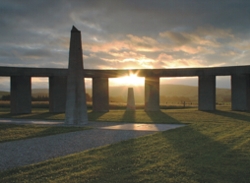
Stonehenge Aotearoa, a full-size model based on the ancient English stone circle, shows how the Sun, Moon and stars can be used “for life and survival”.
stonehenge-audio-visual

Apart from its majestic and mysterious appearance a stone circle has little meaning unless one knows how it works and why people built them eons ago.  The people who built Stonehenge Aotearoa have put together a special presentation that unravels ancient mysteries and takes the visitor on a journey of discovery.  Our tours include tales from antiquity of the solstices and equinoxes and signs of the Zodiac.  You will discover how stones, posts and shadows were used to unlock mysteries of the earth and sky which formed a cornerstone to the rise of civilization.

Allow enough time
A guided tour runs for just over an hour.  Do allow yourself time to check in before the presentation begins. We suggest that you arrive not less than 10 minutes before your tour is scheduled to start.   In addition, it is advisable to allow some free time following your tour.  Visitors often wish to ask questions, take a second look at some of the stone structures, or visit our Stonehenge shop.

When ?
Stonehenge Guided Tours are available to the public at 11am on Saturdays, Sundays and public holidays. At other times you may book a private tour – see below.  From December 27 through to January 15 there will be a tour every day at 11am.   The number of participants on any one tour are limited so bookings are recommended. 

What does it cost?
Adults $15, Senior Citizens (65+) $12, Students (13-17yrs) $10, Children (pre-teens) $6. Bookings recommended: Phone (06) 377 1600 or book online here.

PRIVATE & GROUP TOURS

may be held on any day at a time by arrangement. The fees per person are the same as those for a public tour:- $15 for adults, $12 for senior citizens (65+), $10 for students (13-17yrs), $6 for children (pre-teens), except that there is a minimum charge of $90. Thus, if you have 6 adults in your party this will cover the $90 minimum charge. Phone (06) 377 1600 or book online here.

Each tour is tailored to the weather conditions. It usually begins in our lecture theatre with an introductory talk on the historical significance of stone circles and the reasons why star-lore formed a cornerstone to the rise of civilization.  This part of the presentation may include an audio-visual about the Stonehenge on Salisbury Plain and Stonehenge Aotearoa.  We then explore the stone circle, listen to tales from antiquity, and discover how stones and shadows can be used to unlock mysteries of the universe.

 SUNRISE & SUNSET TOURS
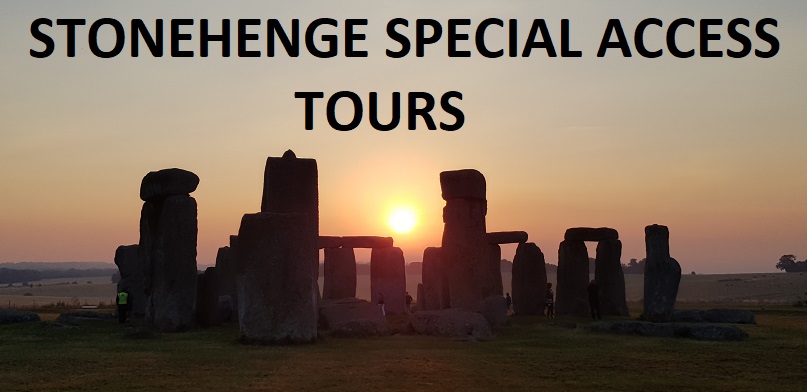
Stonehenge Aotearoa can be magnificent at the time of sunrise or sunset.  These tours include (weather permiting) viewing the sun rise or set over the Henge. Of special interest is the times of the equinoxes and solstices when the sun can be observed to rise or set over one of the heel stones.  At these times we often have a special presentation about the equinox or solstice.  See “Special Events”.

Unless otherwise advertised Sunrise and Sunset Tours are only  available by arrangement as private or group bookings. 

 Maybe we should build one of these in Wilsthire?
Visit our sponsors for tours of the real Stonehenge – www.StonehengeTours.com

Merlin @ Stonehenge
The Stonehenge Stone Circle Website


Total Lunar Eclipse visible at Stonehenge tonight

15 06 2011

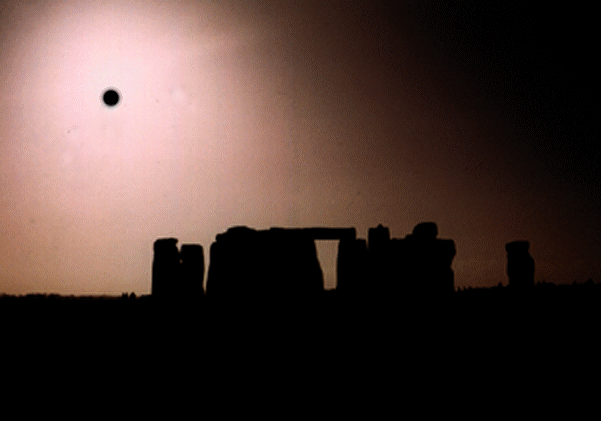
Todays’s total eclipse of the Moon may be the most striking for years but observers at Stonehenge must be content with a view of only the closing act of the drama.
Lunar Eclipse Stonehenge
The Moon stands over the southern Indian Ocean as it passes through the central dark umbra of the Earth’s shadow, plunging deeper into the shadow than during any eclipse since 2000. This may well result in an unusually dark eclipse, with the Moon’s disc turning a deep reddish-brown as all direct sunlight is blocked.

In fact, the umbra is never black. A little light must reach the Moon from the parts of the Sun’s outer atmosphere, the corona, that are not hidden by the Earth. But more sunlight is refracted and scattered around the edge of the Earth by our planet’s atmosphere. Just as sunsets and sunrises appear orange or red, so this light is predominantly red.

The umbra is not illuminated evenly, though, since less of this indirect light penetrates to its core and the amount reaching different zones of the umbra is affected by varying atmospheric conditions. In particular, dust thrown up by major volcanic eruptions can render the atmosphere less transparent and the eclipsed Moon so dark that it practically disappears.

Our image shows the previous total lunar eclipse as viewed from Florida last December. On that occasion, the Moon traversed the northern part of the umbra and its southern regions, which just missed the shadow’s core, are relatively dark. This week, the Moon passes about a half Moon’s-breadth farther southwards with respect to the shadow, so it will be interesting to discover just how dark and colourful it appears.

Wednesday’s eclipse begins when the Moon’s eastern limb begins to enter the penumbra of the Earth’s shadow at 18:25 BST. While within the penumbra, some direct sunlight falls on the Moon but little darkening of the disc will be noticed until a few minutes before the Moon begins to enter the umbra at 19:23. Totality, with the Moon entirely within the umbra, lasts from 20:22 until 22:03 with mid eclipse at 21:13. The Moon’s W limb has withdrawn from the umbra by 23:02 and finally exits the penumbra at 00:01.

For Britain, other than the far NW, the Moon rises in the SE during the latter half of totality. Observers in SE England may just glimpse the end of totality, but most of us may see nothing until it begins to emerge from the umbra. From London and Manchester, for example, the Moon stands less than 5° and 3° high respectively at 22:03 BST, with the Sun only a little way below the NW horizon and the sky brightly twilit. The Moon should be more obvious another 5° higher in a darker sky by 23:02.

Sponsored by ‘The Stonehenge Tour Company’ www.StonehengeTours.com

Merlin @ Stonehenge
The Stonehenge Stone Circle Website


John Aubrey (12 March 1626 – 7 June 1697)

7 06 2011

John Aubrey died today 1697

John Aubrey

John Aubrey

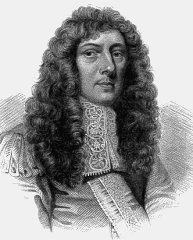
John Aubrey was an English antiquary and miscellaneous writer. He was born in Kingston, Wiltshire, and educated at Trinity College, Oxford. His most famous work is “Lives of Eminent Men”, which was not published, however, until 1823. He also wrote “Miscellanies” (1696), a collection of stories and folklore, the “Natural History of Wiltshire” (edited by John Britton, 1847), and a “Perambulation of Surrey”. His most important contribution to the study of British antiquities, the lengthy and discursive “Monumenta Britannica”, remains in manuscript. A scheme was afoot in 1692 to publish the manuscript and a prospectus and a specimen page were issued in 1693, but nothing more came of the project. It contains the results of Aubry’s field-work at Avebury and Stonehenge and notes on many other ancient sites, including Wayland’s Smithy. Apparently the original title of the manuscript was to be “Templa Druidum”.

It was Aubrey who, in 1648, at the age of 22, while out hunting with some friends near Avebury in Wiltshire, recognized in the earthworks and great stones placed about the landscape in and about the village a great prehistoric temple. In the following century, William Stukeley was to develop the claim that Avebury was as an ancient cult centre of the Druids.

In addition to his ‘discovery’ of the Avebury complex, Aubrey is also remembered for his inclusion in a plan of Stonehenge in his “Monumenta Britannica” of a series of slight depressions immediately inside the enclosing earthwork. Curiously, Stukeley does not record them in his painstaking examination of the site, and it was not until excavations undertaken in 1921-25 by the Society of Antiquaries that they were found to be holes cut in the chalk to hold timber uprights. A total of 56 holes were discovered and named the Aubrey holes in honour of John Aubrey’s observation. These holes are now recognized as belonging to the first phase of the monument’s construction.

What a guy…………………….

Sponsored by ‘The Stonehenge Tour Company’ www.StonehengeTours.com

Merlin at Stonehenge
The Stonehenge Stone Circle Website


Archaeostrononomer Gerald Hawkins died today 2003

26 05 2011

Gerald Stanley Hawkins
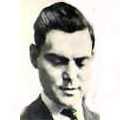
Gerald Hawkins

Gerald Hawkins

Astronomer who claimed Stonehenge was a computer

· Gerald Stanley Hawkins, archaeoastronomer and author, born April 20 1928; died May 26 2003.

(1928–2003) was an English astronomer and author most famous for his work in the field of archaeoastronomy. A professor and chair of the astronomy department at Boston University in the United States. In 1965 he published an analysis of Stonehenge in which he was the first to propose its purpose as an ancient astronomical observatory used to predict movements of sun and stars. Archeologists and other scholars have since demonstrated such sophisticated, complex planning and construction at other prehistoric earthwork sites, such as Cahokia in the United States.

Gerald Hawkins’ work
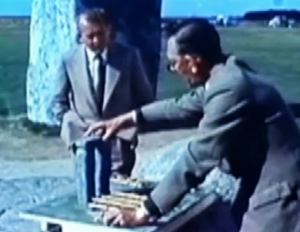
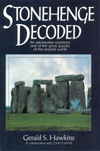
Gerald Hawkins’ work on Stonehenge was first published in Nature in 1963 following analyses he had carried out using the Harvard-Smithsonian IBM computer. Hawkins found not one or two alignments but dozens. He had studied 165 significant features at the monument and used the computer to check every alignment between them against every rising and setting point for the sun, moon, planets, and bright stars in the positions they would have been in 1500 BC. Thirteen solar and eleven lunar correlations were very precise against the early features at the site with precision falling during the megalithic stages. Hawkins also proposed a method for using the Aubrey holes to predict lunar eclipses by moving markers from hole to hole. In 1965 Hawkins wrote (with J. B. White) Stonehenge Decoded, which detailed his findings and proposed that the monument was a ‘Neolithic computer’.

Atkinson replied with his article “Moonshine on Stonehenge” in Antiquity in 1966, pointing out that some of the pits which Hawkins had used for his sight lines were more likely to have been natural depressions, and that he had allowed a margin of error of up to 2 degrees in his alignments. Atkinson found that the probability of so many alignments being visible from 165 points to be close to 0.5 (or rather 50:50) rather that the “one in a million” possibility which Hawkins had claimed. That the Station Stones stood on top of the earlier Aubrey Holes meant that many of Hawkins’ alignments between the two features were illusory. The same article by Atkinson contains further criticisms of the interpretation of Aubrey Holes as astronomical markers, and of Fred Hoyle’s work.
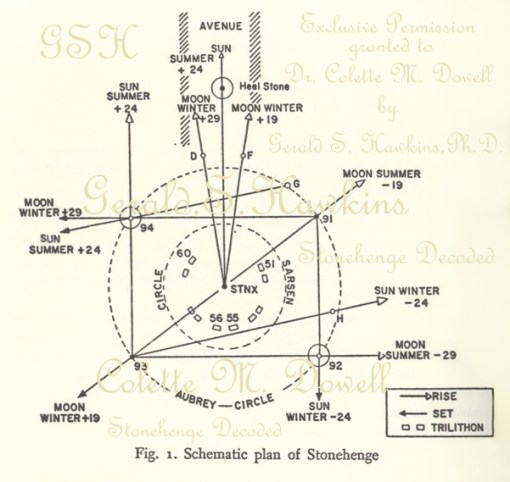
A question exists over whether the English climate would have permitted accurate observation of astronomical events. Modern researchers were looking for alignments with phenomena they already knew existed; the prehistoric users of the site did not have this advantage.

Later Stonehenge theories

Although Stonehenge has become an increasingly popular destination during the summer solstice, with 26,000 people visiting in 2010, scholars have developed growing evidence that indicates prehistoric people visited the site only during the winter solstice. The only megalithic monuments in the British Isles to contain a clear, compelling solar alignment are Newgrange and Maeshowe, which both famously face the winter solstice sunrise.

The most recent such evidence supporting the theory of winter visits includes bones and teeth from pigs which were slaughtered at nearby Durrington Walls. Their age at death indicating that they were slaughtered either in December or January every year. Mike Parker Pearson of the University of Sheffield has said, “We have no evidence that anyone was in the landscape in summer.”

From the Guardian 2003

In 1961, Gerald Hawkins, who has died of a heart attack aged 75, was professor of physics and astronomy at Boston University in Massachusetts. It was then that he returned to Salisbury Plain to film the sun rise over the marker Heelstone at Stonehenge. Assistants meanwhile plotted every stone and pit, punched coordinates on to cards and fed them, and astronomical data, into an IBM 704.This was at a time when computers were rare and glamorous. Asking that age’s technological wonder to decipher the ancient world’s icon was a gesture of timely genius. The journal Nature published Hawkins’s first results in 1963. Two years later Stonehenge Decoded, written by Hawkins with John B White, was published in the US.The IBM machines, Hawkins argued, showed Stonehenge to be a neolithic computer-observatory for predicting eclipses of the sun and moon. From New York to Iraq, newspapers praised the professor and his computer for rewriting prehistory. Stone-age savages were revealed as skilled scientists.

Archaeologists were less happy. They sniffed at his “overconfident style”, resented his publicity and questioned his results. Hawkins’s statistics were shown to be dodgy; he had contrived a computer from a monument believed to have developed piecemeal over centuries.

Stonehenge excavator Richard Atkinson described Hawkins’s book as: “tendentious, arrogant, slipshod, and unconvincing” – for him the builders of Stonehenge were “howling barbarians”.

The popular archaeologist Jacquetta Hawkes, meanwhile, observed that “every age has the Stonehenge it deserves – or desires”.

Hawkins claimed surprise at the response. That contribution to Nature was his 61st scientific paper and many of his others, on subjects such as tektites, meteors and steady-state universe theory seemed to him more exciting. But none of his other dozen books was as successful.

Hawkins had changed the way we think about Stonehenge, and inspired the science of archaeo-astronomy. Repeated studies have failed to do more than support a few solar, and perhaps lunar alignments, and deny a computational function. Yet in the public mind, Stonehenge is now fixed as an observatory and computer. Stonehenge Decoded initiated a debate still alive, and inspired the first generation of archaeo-astronomers.

Hawkins also analysed the Nazca lines in Peru and the temple of Amun at Karnak, Egypt. He recently developed a crop circles theory based on Euclidean geometry and musical intervals. He first saw Stonehenge in 1953, when working at nearby Larkhill camp. He read that the monument was aligned on midsummer sunrise, a fact first noted by William Stukeley in the 18th century, and made much of by Sir Norman Lockyer in 1906.

Hawkins’s hometown was Great Yarmouth. He obtained his first degree at Nottingham University in 1949 in physics, with pure maths subsidiary, and a PhD in radio astronomy under Sir Bernard Lovell at Manchester University in 1952.

Manchester awarded him a DSc in 1963 for astronomical research at the Harvard-Smithsonian Observatories. He was professor of astronomy and chairman of the department at Boston University (1957-69), and dean of the liberal arts Dickinson College in Carlisle, Pennsylvania (1969-71).

Boston presented him with the Shell award for distinguished writing in 1965. Other awards came from the Smithsonian Institution and the National Academy of Sciences, and he was a proud member of the prestigious intellectual Cosmos Club, Washington DC. He was a science advisor to the US Information Agency.

Hawkins was dedicated to his research, and enthusiastic and generous with those ready to listen. He was due to address an Oxford conference with a new Stonehenge study and, to the surprise of some British academics, he continued to see himself as an Englishman. He leaves his second wife, Julia Dobson.

Links: http://www.megalithic.co.uk/article.php?sid=2146410963
Sponsors: The Stonehenge Tour Company, www.StonehengeTours.com

Respect!

Merlin @ Stonehenge
The Stonehenge Stone Circle Website


Super moon spectacle will light up skies tonight at Stonehenge (but there’s no need to worry about a rise in lunacy)

19 03 2011

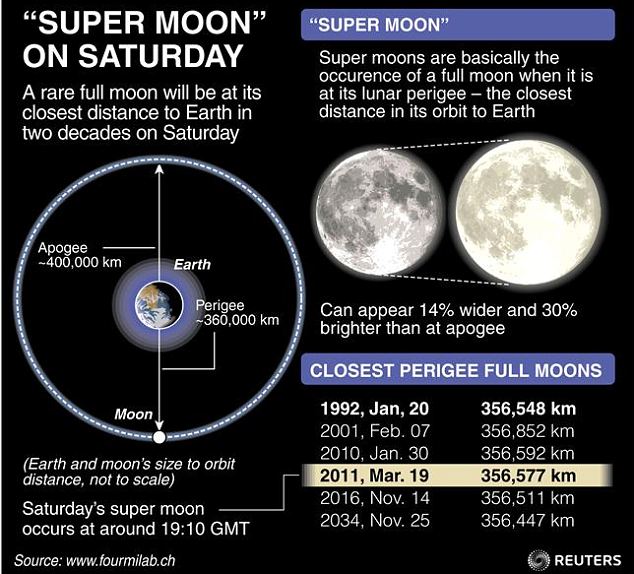
Tonight’s event will be the closest full moon in almost 20 years

Keep your fingers crossed for clear skies tonight – a full moon of rare size and beauty will rise in the east at sunset.

The natural phenomenon happens when the full Moon coincides with when it travels closest to Earth on its orbit.

‘The last full Moon so big and close to Earth occurred in March of 1993,’ said Geoff Chester of the US Naval Observatory in Washington DC.

Full Moons vary in size because of the elliptical (or oval) shape of the Moon’s orbit. At its furthest point (the apogee) it is around 252,731miles away from us, but it is only around 226,426miles at its closest point (the perigee).

So nearby perigee moons, like the one we will see tonight, is around 14 per cent bigger and 30 per cent brighter than lesser moons that occur on the apogee side of the moon’s orbit.

However, it will be difficult to detect the change once the moon is high in the sky as the human eye is unble to put it in context without any nearby objects to compare it to.

Therefore the most impressive view of the moon will be seen when it is close to the horizon due to the ‘moon illusion’. It appears larger as you will automatically compare it to the hills and houses nearby.

‘I’d say it’s worth a look and so close to the Spring Equinox

Lnks: http://www.dailymail.co.uk/sciencetech/article-1367474/Super-moon-spectacle-light-skies-tomorrow-night-theres-need-worry-lunacy.html#ixzz1H1i0CPkD
Sponsors:  The Stonehenge Tour Company

Merlin @ Stonehenge (Happy Equinox)

The Stonehenge Stone Circle Website


Stonehenge Druids – The mysterious guardians of the ancient Celtic knowledge.

7 02 2011
Druids_celebrating_at_Stonehenge

Druids_celebrating_at_Stonehenge

The Druids were the priests of the Celtic religion during the Iron Age

The Druids were the priests of the Celtic religion during the Iron Age which was before the Romans invaded Britain.

The Druids has been popularly associated with Stonehenge ever since an earlier researcher John Aubrey said in 1666 that stone circles were built and used by Druids as places where they conducted their rituals.

Today we know that this ancient Druid connection to Stonehenge is not true.

Druids and most of what we know of them today have been written about by Julius Ceasar and Pliny during the Gaelic wars.

According to Ceasar Druids chose to conduct their rituals in densely wooded areas and did not built special places to perform their ceremonies. Druid comes from the Celtic word for “knowing the oak tree

Pliny writes mostly about the Druids practicing medicine and sorcery.

According to him the Druids held the mistletoe plant in the highest veneration. Groves of oak were their chosen retreat. Mistletoe grows on the oak trees and a priest dressed in a white robe would cut it with a golden knife. It was the custom that two white bulls were to be sacrificed on the spot.

Druidic lore consisted of a large number of verses to be learned by heart and a novice would apparently train for up to 20 years to prepare for his duties as a guardian of the sacred knowledge.

It is interesting that many Druids were women. Celtic woman enjoyed more freedom and rights than women in any other contemporary society. They had the right to enter a battle and even divorce their husbands.

The modern version of the Druids is known as The Ancient Order of Druids and was formed in 1781. Neo Druidism is apparently based on Freemasonry.

The Ancient Order of Druids was not able to hold a ceremony at Stonehenge until 1905 and at this occasion 650 of them arrived for a mass initiation.

They erected their own marquee and were well stocked with food and drink.

Druids Autumb Equinox

Druids Autumb Equinox

Apparently they used a secret password to keep outsiders outside. Sir Edmund Antrobus the then owner of Stonehenge was also one of the 258 novices present to be initiated.

After the feasting the initiates were blindfolded and led into the stone circle while an anthem which was especially composed for the event was played.

The ceremony was lead by GA Lardner, Most Noble Grand Arch Brother of the Order who waved his battleaxe over a so called sacred fire. After he recited the sacred oath the blindfolds were removed and everyone apparently had a hearty singsong of the anthem.

Over the years a number of famous names have had involvement with the Druids.

Here are some of their members;

Winston Churchill – Prime Minister

Ludwig van Beethoven – Composer.

Benjamin Franklin – Politician and American President.

Salvador Dali –Artist.

More recently Rowan Williams, the Archbishop of Canterbury who is the head of the Anglican Church was initiated as a member.

Today Druids mostly gather at Stonehenge during the summer and winter solstice days.

which was before the Romans invaded Britain. The Druids has been popularly associated with Stonehenge ever since an earlier researcher John Aubrey said in 1666 that stone circles were built and used by Druids as places where they conducted their rituals. Today we know that this ancient Druid connection to Stonehenge is not true. Druids and most of what we know of them today have been written about by Julius Ceasar and Pliny during the Gaelic wars. According to Ceasar Druids chose to conduct their rituals in densely wooded areas and did not built special places to perform their ceremonies. Druid comes from the Celtic word for “knowing the oak tree” Pliny writes mostly about the Druids practicing medicine and sorcery. According to him the Druids held the mistletoe plant in the highest veneration. Groves of oak were their chosen retreat. Mistletoe grows on the oak trees and a priest dressed in a white robe would cut it with a golden knife. It was the custom that two white bulls were to be sacrificed on the spot. Druidic lore consisted of a large number of verses to be learned by heart and a novice would apparently train for up to 20 years to prepare for his duties as a guardian of the sacred knowledge. It is interesting that many Druids were women. Celtic woman enjoyed more freedom and rights than women in any other contemporary society. They had the right to enter a battle and even divorce their husbands. The modern version of the Druids is known as The Ancient Order of Druids and was formed in 1781. Neo Druidism is apparently based on Freemasonry. The Ancient Order of Druids was not able to hold a ceremony at Stonehenge until 1905 and at this occasion 650 of them arrived for a mass initiation. They erected their own marquee and were well stocked with food and drink. Apparently they used a secret password to keep outsiders outside. Sir Edmund Antrobus the then owner of Stonehenge was also one of the 258 novices present to be initiated. Image Credit After the feasting the initiates were blindfolded and led into the stone circle while an anthem which was especially composed for the event was played. The ceremony was lead by GA Lardner, Most Noble Grand Arch Brother of the Order who waved his battleaxe over a so called sacred fire. After he recited the sacred oath the blindfolds were removed and everyone apparently had a hearty singsong of the anthem. Over the years a number of famous names have had involvement with the Druids. Here are some of their members; Winston Churchill – Prime Minister Ludwig van Beethoven – Composer. Benjamin Franklin – Politician and American President. Salvador Dali –Artist. More recently Rowan Williams, the Archbishop of Canterbury who is the head of the Anglican Church was initiated as a member. Today Druids mostly gather at Stonehenge during the summer and winter solstice days.

External links:
The British Druid Order – http://www.druidry.co.uk/
The Council of Druid Orders – http://www.cobdo.org.uk/
The Druid Network – druidnetwork.org
Stonehenge Guide – stonehengeguide.com
Stonehenge Tours – StonehengeTours.com

Merlin @ Stonehenge
The Stonehenge Stone circle Website


Stonehenge Winter Solstice 21stDecember 2010

21 12 2010

I went to Stonehenge this morning hoping to witness the Lunar eclipse between 7.30am and 8am.  Sadly there was freezing fog and a snowy sky?  It was a pleasant surprise to find that English Heritage decided to grant access into Stonehenge today as well as tomorrow (22nd)  There were a few hundred ‘happy’ people, a pagan wedding and a small Druid ceremony.  It was extremely cold but well worth it. 
I have uploaded these photos for your perusal – hot off the press!  They anticipate 2-3000 people for tomorrows Solstice celebrations – See you there!

This slideshow requires JavaScript.


Happy Solstice
Merlin @ Stonehenge
The Stonehenge Stone Circle Website


Geminid meteor shower set for clear skies

13 12 2010

With cloudless skies possible over Stonehenge and many parts of Britain, this year’s shooting stars could be particularly memorable

Lovers of the night sky could be in for a treat tonight as clear conditions are predicted for one of the best astronomical shows of the year.

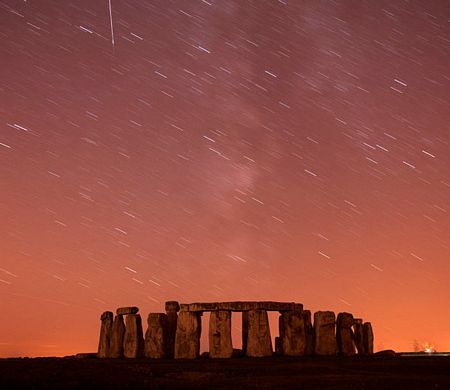
Some experts believe the annual Geminid meteor shower is becoming more spectacular – though if it is, nobody is sure why – and with cloudless skies possible in many parts of the country, this year’s event could be a particularly memorable one.

At its peak and in a clear, dark sky, up to 100 meteors – or shooting stars – may be seen every hour. The best time to see it is expected to be late on Monday night and in the early hours of Tuesday after the moon has set.

In comparison with other showers, Geminid meteors travel fairly slowly, at about 22 miles per second. They are bright and have a yellowish hue, making them distinct and easy to spot.

Meteors are the result of small particles entering Earth’s atmosphere at high speed, burning up and super-heating the air around them, which shines as a characteristic short-lived streak of light. In the case of the Geminids, the debris is associated with the asteroidal object 3200 Phaethon, which many astronomers believe to be an extinct comet.

National Trust list of the best places to watch the shower

• Stonehenge area in Wiltshire – chalk downland and crystal clear skies.

 Teign Valley in Devon, within Dartmoor national park.

• Penbryn Beach, on the Ceredigion coast in west Wales.

• Wicken Fen nature reserve in Cambridgeshire – dark skies and nocturnal wildlife.

• Mam Tor in Derbyshire, an escape from the bright lights of cities such as Sheffield.

• Friar’s Crag in Cumbria, jutting out into Derwentwater.

See you at Stonehenge tonight

Merlin @ Stonehenge
The Stonehenge Stone Circle website