New light on Stonehenge. Latest theories about when and why Stonehenge was built

8 11 2012

Tuesday 13 November 2012. A talk by Professor Mike Parker-Pearson, University of Sheffield. This lecture will present new findings by the ‘Feeding Stonehenge’ project about the people who built Stonehenge, and about the sources of its stones in Wales and north Wiltshire. It will examine the latest theories about when and why Stonehenge was built, and will present new discoveries from Wales as well as the Stonehenge area.

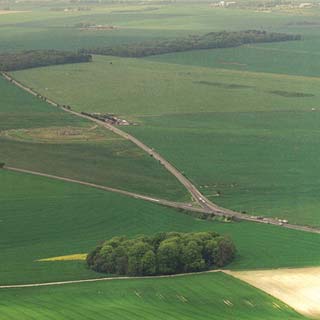
image credit : Adam Stanford of Aerial-Cam

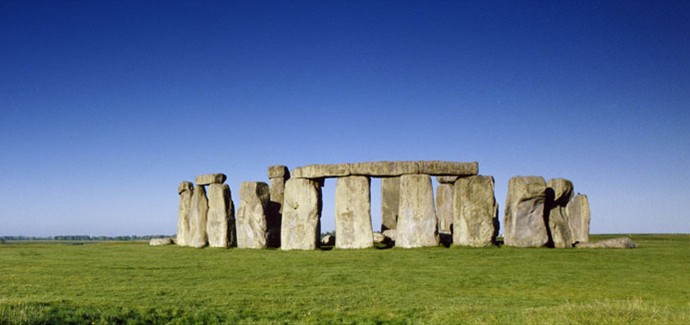
image credit : Adam Stanford of Aerial-Cam

Prof. Mike Parker-Pearson is leader of the Stonehenge Riverside Project and author of Stonehenge: exploring the greatest Stone Age mystery, published by Simon & Schuster in June 2012. (see below)

7.00 pm refreshments, 7.30 pm lecture.


Please note this lecture is at the Guildhall (Market Square)not the Museum. A lecture in the Salisbury Museum Archaeology Lectures (SMAL) series. SMAL lectures are held on the second Tuesday of each month from September to April. Please note earlier start time for this particular lecture. This particular lecture requires booking. This is a fundraising event.

http://www.salisburymuseum.org.uk


Booking:  Booking required. Please contact the Museum to book.

Cost:  In Advance: £8.00; On the Night : £10.00.

Stonehenge: Exploring the Greatest Stone Age Mystery

Our knowledge about Stonehenge has changed dramatically as a result of the Stonehenge Riverside Project (2003-2009), led by Mike Parker Pearson, and included not only Stonehenge itself but also the nearby great henge enclosure of Durrington Walls. This book is about the people who built Stonehenge and its relationship to the surrounding landscape. The book explores the theory that the people of Durrington Walls built both Stonehenge and Durrington Walls, and that the choice of stone for constructing Stonehenge has a significance so far undiscovered, namely, that stone was used for monuments to the dead. Through years of thorough and extensive work at the site, Parker Pearson and his team unearthed evidence of the Neolithic inhabitants and builders which connected the settlement at Durrington Walls with the henge, and contextualised Stonehenge within the larger site complex, linked by the River Avon, as well as in terms of its relationship with the rest of the British Isles. Parker Pearson’s book changes the way that we think about Stonehenge; correcting previously erroneous chronology and dating; filling in gaps in our knowledge about its people and how they lived; identifying a previously unknown type of Neolithic building; discovering Bluestonehenge, a circle of 25 blue stones from western Wales; and confirming what started as a hypothesis – that Stonehenge was a place of the dead – through more than 64 cremation burials unearthed there, which span the monument’s use during the third millennium BC. In lively and engaging prose, Parker Pearson brings to life the imposing ancient monument that continues to hold a fascination for everyone

Sponsored by ‘Stonehenge Guided Tours’ – www.StonehengeTours.com

Merlin @ Stonehenge
The Stonehenge News Blog


Improvements to A303 Stonehenge World Heritage Site

1 11 2012

Work which will allow visitors to enjoy an improved experience when visiting the Stonehenge World Heritage Site will start on the A303 in Wiltshire on Monday, 5 November.

Stonehenge road improvementsThe six month scheme will involve improvements to the Longbarrow roundabout at the junction of the A360 and A303. This will allow the closure of the A344, which runs next to the Stonehenge monument.

Highways Agency project sponsor, Mark Arberry, said: “This is an important contribution to the long term management plan for Stonehenge to improve the setting of the monument and ensure its preservation as an iconic World Heritage Site. “The proposed improvements to the northern and eastern approaches to the roundabout will accommodate changes in traffic flows following the A344 closure and the centre of the roundabout itself will be moved.”

New lanes will be added to the roundabout to take the extra traffic caused by the closure of the A344 and the centre of the roundabout itself will be realigned.

English Heritage has been fully consulted during planning for the scheme and an archaeologist will be on site during the excavation work.

Traffic signals will be used for minor advanced works on the A360 north of the roundabout for one week between 9am and 3pm from the 29 October. The main work will require lane closures on the approaches to Longbarrow Roundabout for the duration of the work with a temporary 40mph speed limit in place.. The A360 south of Longbarrow will be closed for up to eight days and nights on dates to be confirmed during either February or March. Clearly signed diversion routes will be in operation using the A345 or the A36 dependant on journey destinations.

The scheme has been planned to cause the least possible disruption but road users are advised to allow extra time for their journeys.

Traffic updates: http://www.fleetdirectory.co.uk/

Stonehenge news blog sponsored by ‘Stonehenge Guided Tours’ www.StonehengeTours.com
F
ollow us on Twitter for updates: https://twitter.com/ST0NEHENGE

Merlin at Stonehenge


Visit Wiltshire. New look website aims to boost tourism in Wiltshire

19 10 2012

Discover a county rich in heritage

VisitWiltshire has launched a brand new tourism website, http://www.visitwiltshire.co.uk  The redesign of the site has focused on building a portal which showcases the best of Wiltshire tourism to give visitors a user-experience that is inspirational, informative, engaging and welcoming.

VisitWiltshire is forecasting that the new website will increase the number of visitors to http://www.visitwiltshire.co.uk by 30 per cent.

The new website will be promoted extensively to VisitWiltshire’s target UK and international markets through a number of digital marketing initiatives launching in October – including, for the first time ever, video advertising on the London Underground.

Fiona Errington, marketing manager for VisitWiltshire, said: “Our aim in developing this site has been to raise awareness of Wiltshire’s fantastic tourism offer, inspiring new visitors, and encouraging repeat visitors to stay longer and explore the whole of the county.

Visit Wiltshire Website Extract
Take some time out and escape to Wiltshire this year. Find out more about this mysterious and beautiful part of the UK, let us be your guide for all the information you will need.

Stonehenge & Avebury

Wiltshire is proud to be the home of Stonehenge and Avebury which form part of a UNESCO World Heritage Site and our mystical landscape.

Take a tour of Stonehenge and discover more about the neolithic man and the landscape they shaped. At Avebury, walk amongst the stones, visit the Alexander Keiller Museum to find out about the arcaeological excavations Keiller did in the 1930s and visit the Avebury Manor and Garden, nearby West Kennet Long Barrow.

Link: http://www.visitwiltshire.co.uk/explore/stonehenge-and-avebury
Link: http://www.thisiswiltshire.co.uk/news/9993296.New_look_website_aims_to_boost_tourism_in_Wiltshire/

Merlin says “Great to see Visit Wiltshire have launched a new web site, which will  help tourism in the West”

News blog sponsored by “Stonehenge Guided Tours” – www.StonehengeTours.com

Stonehenge News Blog


Lasers at Stonehenge. British Archaelogy

12 10 2012

At last, after all these years, we’ve got the very first comprehensive study of the actual stones at Stonehenge. As part of its research into Stonehenge and its landscape that will feed into displays at the new visitor centre, English Heritage commissioned Greenhatch Group surveyors to produce the first complete, high resolution 3D digital model of Stonehenge and its immediate landscape, using lasers and a bit of photogrammetry. (http://mikepitts.wordpress.com/)

At last, after all these years, we’ve got the very first comprehensive study of the actual stones at Stonehenge

Then Marcus Abbott (ArcHeritage) and Hugo Anderson-Whymark (freelance lithics specialist) analysed the data, created new digital images and news ways of seeing them, added some of their own photos and spent time amongst the real stones.

In one sense the results are not surprising: it was obvious to anyone with eyes that that we could learn a lot about Stonehenge with a proper study of the stones. And yes, we have learnt a lot. But just about all the details are revelatory.

There are four different areas where new things are really going to change the way we think about the monument:

  • how the stones were dressed and what the original monument looked like
  • prehistoric carvings – difficult to see and unknown to visitors: the new discoveries have doubled the number of such carvings known in the whole of Britain
  • damage by tourists: the scale of damage done by souvenir collectors in the 18th and 19th centuries had not been recognised before
  • graffiti: dates range between 1721 and 1866, though most were carved 1800–1850 – and they’re almost everywhere.

And this must be just the beginning. There are more details yet to see (there is still scope for new and higher resolution survey), and new things to think about in the vast data set.

http://mikepitts.wordpress.com/

If you know Stonehenge, from this alone you can see at once how much new information has been revealed. Amongst other things, it seems fair to draw from this (and other new data) that the sarsen circle probably WAS complete; and that the whole thing was designed to be seen from the north-east, approaching up the Avenue – so the implication follows that the setting midwinter sun you’d be facing to the south-west was the key alignment.

British Archaeology also published the pioneering Stonehenge laser study done in 2002.

Please follow Mike Pitts excellent archaelogy Blog: http://mikepitts.wordpress.com/
L
ink: http://www.archaeologyuk.org/ba/ba73/index.shtml
L
ink: http://www.wessexarch.co.uk/


British Archaeology magazine


The Council for British Archaeology’s award-winning bi-monthly magazine is the authoritative, in-depth source of information and comment on what’s new, interesting and important in UK archaeology.
Link: http://new.archaeologyuk.org/british-archaeology-magazine

Blog sponsored by ‘Stonehenge Guided Tours’ www.StonehengeTours.com

The Stonehenge News Blog


Arthur Pendragon, Stonehenge and the Solstice

12 10 2012

THE RAVING OUTLAW BIKER-DRUIDS AND THEIR 1575-YEAR-OLD KING

Visit Stonehenge on the summer solstice of any year and you’ll see 20,000 people partying in and around the ancient rock formation. The crowd is usually made up of around one third tourists, one third pilled-up teenagers in sportswear, and one third neo-druids. It’s a genuinely bizarre sight. Don’t get me wrong—I enjoy chewing my own face off at archaeologically significant sites as much as the next guy, but in a time when British disobedients seem to spend more time in police kettles than they do in squats, you have to wonder how all of this is, y’know, allowed.

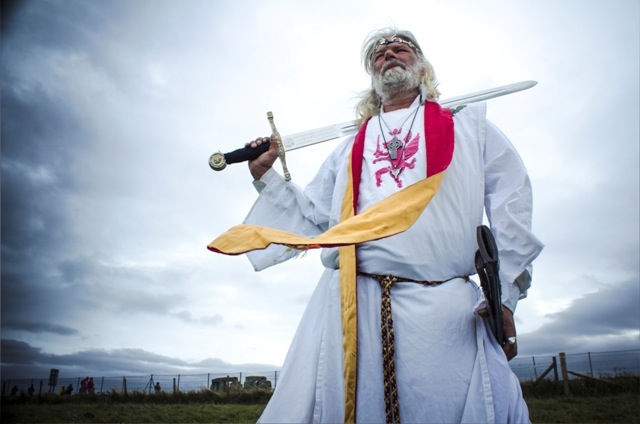
Turns out, it has to do with the guy pictured above, who used to be the leader of an outlaw biker gang, but now claims to be the legendary monarch, King Arthur. Arthur, formerly known as John Rothwell, rose to fame in the 90s when he won his case at the European Court of Human Rights to allow open access to Stonehenge for religious festivals like the summer solstice.

Today, as the elected “Battle Chieftain” of the Council of British Druid Orders, King Arthur and his Loyal Arthurian Warband represent the political wing of Britain’s neo-druid community. I headed down to Stonehenge to visit the only living 1575-year-old king.

Please take the time to read the full article by By Matt Shea, Photos by Andrea Herrada
http://www.vice.com/read/all-hail-king-arthur-uther-pendragon

Stonehenge News Blog sponsored by ‘Stonehenge Guided Tours’ www.StonehengeTours.

Merlin says “Always great see Arthur up at the stones doing his bit”

Stonehenge News Blog


Stonehenge News. Read all about it!

10 10 2012
Once again Stonehenge and Wiltshire is in the spotlight.  The recent revealing 3D laser resilts have uncovered some fascinating facts.  Stonehenge is being talked about across the world which can only be good for South West toursim.  Here is a small selection of Stonehenge Newslinks:

Stonehenge secrets revealed by laser scan
BBC News
Researchers using laser technology at Stonehenge have uncovered evidence which they say shows the importance of the midwinter sunset to its creators. The scan by English Heritage showed significant differences in how various stones were shaped and
 

BBC News
Stonehenge dressed to impress
Stuff.co.nz
A cutting-edge laser scan of Stonehenge has shown how Britain’s enigmatic neolithic monument was built to enhance the dramatic passage of sunlight through the circle of stones at midsummer and midwinter. The slabs were intended to appear at their best 
 
Stonehenge was an ‘art gallery’ suggests new study
TNT Magazine
Laser scans have revealed prehistoric carvings of axe heads, which are invisible to the naked eye. The surface of the 83 remaining stones was scanned using state-of-the-art 3D scanners. These recorded using billions of points of microtopographically. 

TNT Magazine
New Stonehenge secrets revealed
Evening Standard
Professor Clive Ruggles, emeritus professor of achaeo-astronomy at University of Leicester, said: “This extraordinary new evidence not only confirms the importance of the solstitial alignment at Stonehenge, but also show unequivocally that the formal  
Revealed: Early Bronze Age carvings suggest Stonehenge was a huge prehistoric art gallery
Stonehenge News Blog
A detailed laser-scan survey of the entire monument has discovered 72 previously unknown Early Bronze Age carvings chipped into five of the giant stones.

Evening Standard
Lasers find secrets of Stonehenge
This is Bath
They’ve dug under it, mapped it, photographed it and dated it, but a new laser scan of Stonehengehas told scientists even more things they didn’t already know about the ancient Wiltshire monument – including which way the monument ‘faced’. The scan  
The story of British art
The Guardian
From the earliest evocative stone structures at Skara Brae and Stonehenge to the disturbing 20th-century portraits by Francis Bacon and Lucian Freud, the art inspired by the British isles tells a truly spectacular story. Through painting, sculpture  
Midwinter Sun Link to Stonehenge – ITV News
Read Midwinter Sun Link to Stonehenge latest on ITV News. All the Tuesday 9th October 2012 news.#
Midwinter sun linked to Stonehenge – Stonehnege Tours. The latest 3D laser technology has revealed new evidence of the importance of the midwinter sunset to the ancient creators of Stonehenge. 
Laser uncovers new Stonehenge evidence (From Salisbury Journal)
NEW evidence to suggest the importance of the solstices at Stonehenge to its creators has been discovered by English Heritage. A 3D laser scan was used to 
Blog Sponsored by ‘Stonehenge Guided Tours’ www.Stonehengetours.comFor all the latest news on Stonehenge follow us on Twitter:
https://twitter.com/ST0NEHENGE

The Stonehenge News Blog


Stonehenge – New Evidence for its Solstitial Function and Approach

9 10 2012

Using the latest 3D laser scanning technology, an English Heritage analysis of Stonehenge has found new evidence of the importance of the two solstices to its creators, including that of the midwinter sunset.

Approach and View from North East Important
The laser scan has revealed significant differences in the way the stones were shaped and worked. These differences show that Stonehenge was not only aligned with the solstices, but that the view of the monument from the Avenue, its ancient processional way to the north east, was particularly important. To approach and view the stone circle from this direction means that the midwinter sunset had special meaning to prehistoric people, and that they made deliberate efforts to create a dramatic spectacle for those approaching the monument from the north east.

The view of Stonehenge as seen from the north east, a view now found to be most important to the creators.

The view of Stonehenge as seen from the north east, a view now found to be most important to the creators.

Stones in the North East Segment Larger and More Uniform

A detailed analysis of the first comprehensive laser survey of Stonehenge reveals that those stones on the outer sarsen circle visible when approaching from the north east have been completely pick dressed – that is, the brown and grey crust on the surface has been removed exposing a fine, bright grey-white surface. By contrast, the outer faces of surviving uprights in the south-western segment of the circle were not pick dressed.

These stones facing north-east are also the largest and most uniform in shape, unlike the south-western segment of the monument where there are several smaller and more irregular stones. The lintels are also exceedingly well worked and finished, compared to those that survive elsewhere in the monument.

Stones on Solstitial Axis most Carefully Shaped and Dressed

The study also shows that the techniques and amounts of labour used vary from stone to stone. These variations provide almost definitive proof that it was the intent of Stonehenge’s builders to align the monument with the two solstices along a north-east/south-west axis.

The sides of the stones that flanked the solstice axis were found to have been most carefully worked to form very straight and narrow rectangular slots. These stones include two of the north-east facing sarsens in the outer circle, the Great Trilithon in the inner sarsen horseshoe, and a now isolated upright stone in the south-west segment of the outer circle.

Since all other stones have visibly more natural, less neat outlines, this strongly suggests that special effort was made to dress those that flank the NE/SW axis to allow a more dramatic and obvious passage of sunlight through the stone circle on midsummer and midwinter solstices.

Laser scan of the Great Trilithon reveals its extremely straight, neat outline and smooth surface, compared with all the other trilithons. It suggests that Stonehenge creators made deliberate efforts to shape and dress it more carefully due to its special position on the solstice axis, just as they did for other stones that flank this axis.

Laser scan of the Great Trilithon reveals its extremely straight, neat outline and smooth surface, compared with all the other trilithons. It suggests that Stonehenge creators made deliberate efforts to shape and dress it more carefully due to its special position on the solstice axis, just as they did for other stones that flank this axis.

Solstitial Alignment Currently Severed by Road to be Restored

Loraine Knowles, Stonehenge Director at English Heritage, said: “The new presentation of Stonehenge will enable visitors to appreciate the importance of the solstitial alignment far better. It’s why we are closing the A344 – which severs the alignment – to enable the stone circle to be reunited with the Avenue.”

The new Stonehenge visitor centre at Airman’s Corner, 1.5 miles west and out of sight of Stonehenge, is scheduled to open in late 2013.

Findings Exceed Expectations

Analysis of the laser scan has also led to the discovery of many more prehistoric carvings, including 71 new Bronze Age axeheads, which bring the number of this type of carvings known at Stonehenge to 115.

Susan Greaney, Senior Properties Historian at English Heritage, said: “We didn’t expect the results to be so revealing about the architecture of Stonehenge. It has given further scientific basis to the theory of the solstitial alignment and the importance of the approach to the monument from the Avenue in mid winter.

“Analysis of the different techniques used to dress the stones may even help to refine the chronology of the construction. Disappointing to some, the scan has also ruled out many poorly defined lines and hollows previously thought to be possible prehistoric carvings.”

English Heritage commissioned the first comprehensive laser survey on Stonehenge in 2011. Archaeological analysis was then carried out to examine the high-resolution data that was produced for all the stone surfaces.

Link: http://www.english-heritage.org.uk/about/news/stonehenge-solstitial-function/

Blog sponsored bt ‘Stonehenge Guided Tours’ www.StonehengeTour.com

Merlin @ Stonehenge
The Stonehenge News Blog


Stonehenge up close: digital laser scan reveals secrets of the past

9 10 2012

Most detailed analysis yet of prehistoric stone circle shows how masons spent more time making key areas look the best

Like any corner-cutting modern builder, the ancient stonemasons who built Stonehenge lavished the most work and best materials where they would be first seen –shining in the last light of the setting winter solstice sun, or at dawn on the longest day.
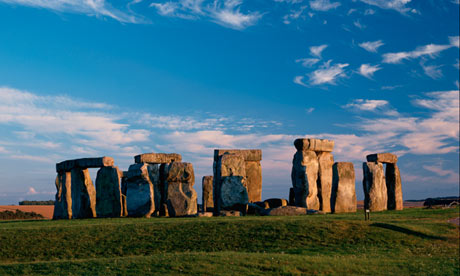
Stonehenge: a digital laser scan has revealed tool marks from 4,500 years ago, and graffiti made by Victorian visitors. Photograph: Yoshihiro Takada/Corbis

Stonehenge: a digital laser scan has revealed tool marks from 4,500 years ago, and graffiti made by Victorian visitors. Photograph: Yoshihiro Takada/Corbis

The first complete 3D laser scan of the stone circle has also revealed tool marks made 4,500 years ago, scores of little axehead graffiti added when the enormous slabs were already 1,000 years old, and damage and graffiti contributed by Georgian and Victorian visitors.

The survey, carried out for English Heritage, exposes numerous details now invisible to the naked eye and will be used in displays for the long-awaited new visitor centre, due to open late next year. It shows the stones in unprecedented precision, from the double-decker bus height sarsens from Salisbury Plain that give the monument its unmistakable profile, to the smaller bluestones brought from west Wales by means still hotly debated, and the stumps of stones that have almost been destroyed.

It also confirms the importance of the prehistoric monument’s alignment on the winter and summer solstice. The largest, most uniform and most imposing stones, carefully shaped and dressed through hundreds of hours of work with stone hammers, were set where they would be seen first by people approaching the monument from north-east along the Avenue, a processional way that would have been particularly spectacular at the midwinter sunset.

In an epic piece of work, the stones facing in that direction were laboriously shaped to appear straight and regular, their original rough brown surfaces hammered away, or pick-dressed, to expose the lighter inner layer of stone, which when newly worked would have shone in the sunlight. The gigantic lintels that bridge the uprights were also elaborately worked to even their size and height.

In contrast, on the opposite side of the circle the builders only bothered to pick-dress the inner faces of the surviving uprights. The backs, they clearly reckoned, would never be studied in detail.

Clive Ruggles, emeritus professor of archaeoastronomy at the University of Leicester, said it was already clear that Stonehenge was one of the earliest examples of a monument aligned on the winter and summer solstices.

“Now we can see how the utmost care and attention was devoted to ensuring the pristine appearance of Stonehenge for those completing their final approach to the monument along the solstitial axis. The effect would have been especially powerful at the two times of year when the sunlight itself shone along the alignment – when those approaching had the midsummer rising sun behind or the midwinter setting sun ahead.”

Some hollows, cracks and lines interpreted in the past as carvings have been revealed as natural features, but what astonished Susan Greaney, an English Heritage historian and expert on Stonehenge, is the extent of surviving tool marks.

“Some are quite visible, and have long been noted, but the surprise to me was that everywhere we looked, on every surface, even on very weathered faces of stones which have been lying on the ground for centuries, we could see evidence of the stone working. On some you can see where different groups worked on different areas of the same stone – and with varying skills.”

Long after the monument was built, when Bronze Age burial mounds rich in grave goods began to be scattered across the plain around Stonehenge, and the archaeological evidence suggests those who could make or trade in metal goods had an almost shamanic status, people carved little images of daggers and axes, many now invisible to the naked eye, into the stones. Scores more have been revealed by the scan, including 71 new axe heads, bringing the total to 115 – doubling the number ever recorded in Britain.

“It is wonderful to have discovered so many more, but what is fascinating is that they are carved without regard to the importance or the siting of the stones – almost as if the people who carved them could no longer quite remember the significance of the monument and how it worked,” Greaney said.

Writing about the project in the new issue of British Archaeology, Marcus Abbott, head of geomatics and visualisation for ArcHeritage, and Hugo Anderson-Whymark, an Oxford based expert on ancient worked stone, note that the 850 gigabytes of data covering hundreds of faces of the stones were equivalent to 750m pages of printed text or 200,000 music files.

“Over the months we have recorded and scrutinised every square centimetre of Stonehenge in unparalleled detail, revealing over 700 areas of stoneworking, rock art, graffiti, damage and restoration.”

They processed the data digitally to strip away weathering and surface texture, and as well as revealing carved details, were able to show that some stones that now appear insignificant were originally much more imposing, but have either broken naturally or been quarried for building stone.

“Fallen stones were particularly vulnerable – the analysis suggests that six have lost tens of tons of stone – and as Stonehenge became a major tourist attraction in the 19th century visitors could actually hire chisels to hack away their own souvenirs.

For Greaney their work answers one of the Stonehenge mysteries – but leaves another unsolved. Some had suggested because some stones are so much less imposing and others are missing, that Stonehenge was never finished.

“I think we can say now that the monument certainly was finished – but where the stone went is still a puzzle. At Avebury you can readily see stone reused in nearby buildings from medieval times on, but Stonehenge is some distance from the nearest village, so it’s much less easy to see where the stone would have been taken – although we have looked far and wide, we have not succeeded in finding evidence of the re-use of the missing stones.”
Source: Maev Kennedy The Guardian,       

Sponsored by ‘Stonehenge Guided Tours’ www.StonehengeTours.com

Merlin @ Stonehenge
The Stonehenge Stone Circle News Blog
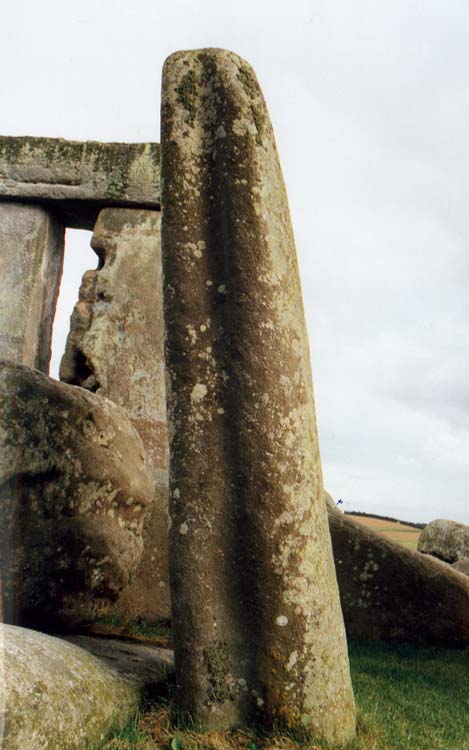


The Solstice connection. Laser scanning uncovers new Stonehenge evidence.

8 10 2012

English Heritage experts have used 3D laser scanning technology to discover new evidence of the importance of the two solstices to its creators.
The laser scan has revealed significant differences in the way the stones were shaped and worked. These differences show that Laser scanning uncovers new Stonehenge evidence Stonehenge was not only aligned with the solstices, but that the view of the monument from the Avenue, its ancient processional way to the north east, was particularly important.

To approach and view the stone circle from this direction means that the midwinter sunset had special meaning to prehistoric people, and that they made deliberate efforts to create a dramatic spectacle for those approaching the monument from the north east.
A detailed analysis of the first comprehensive laser survey of Stonehenge reveals that those stones on the outer sarsen circle visible when approaching from the north east have been completely pick dressed – that is, the brown and grey crust on the surface has been removed exposing a fine, bright grey-white surface. By contrast, the outer faces of surviving uprights in the south-western segment of the circle were not pick dressed.
These stones facing north-east are also the largest and most uniform in shape, unlike the south-western segment of the monument where there are several smaller and more irregular stones. The lintels are also exceedingly well worked and finished, compared to those that survive elsewhere in the monument.
The study also shows that the techniques and amounts of labour used vary from stone to stone. These variations provide almost definitive proof that it was the intent of Stonehenge’s builders to align the monument with the two solstices along a NE/SW axis.
The sides of the stones that flanked the solstice axis were found to have been most carefully worked to form very straight and narrow rectangular slots. These stones include two of the north-east facing sarsens in the outer circle, the Great Trilithon in the inner sarsen horseshoe, and a now isolated upright stone in the south-west segment of the outer circle.
Since all other stones have visibly more natural, less neat outlines, this strongly suggests that special effort was made to dress those that flank the NE/SW axis to allow a more dramatic and obvious passage of sunlight through the stone circle on midsummer and midwinter solstices.
Professor Clive Ruggles, Emeritus Professor of Archaeo-astronomy at University of Leicester, said: “This extraordinary new evidence not only confirms the importance of the solstitial alignment at Stonehenge, but also shows unequivocally that the formal approach was always intended to be from the north-east, up the Avenue towards the direction of midwinter sunset.

“We see how the utmost care and attention was devoted to ensuring the pristine appearance of Stonehenge for those completing their final approach to the monument at the two times of the year when sunlight shines along the alignment – when those approaching had the midsummer rising sun behind or the midwinter setting sun ahead.”

Loraine Knowles, Stonehenge Director at English Heritage, said: “The new presentation of Stonehenge will enable visitors to appreciate the importance of the solstitial alignment far better. It’s why we are closing the A344 – which severs the alignment – to enable the stone circle to be reunited with the Avenue.”

The new Stonehenge visitor centre at Airman’s Corner, 1.5 miles west and out of sight of Stonehenge, is scheduled to open in late 2013.

Analysis of the laser scan has also led to the discovery of many more prehistoric carvings, including 71 new Bronze Age axeheads, which bring the number of this type of carvings known in Stonehenge to 115.

Susan Greaney, Senior Properties Historian at English Heritage, said: “We didn’t expect the results of a laser scan to be so revealing about the architecture of Stonehenge and its function.”

English Heritage commissioned the first comprehensive laser survey on Stonehenge in 2011. Archaeological analysis was then carried out to examine the high-resolution data that was produced for all the stone surfaces.

Link Source:http://www.thisiswiltshire.co.uk/news/9971558.Laser_scanning_uncovers_new_Stonehenge_evidence/?ref=twtrec
Link: High definition surveying. Laser scanning to 3D models & 2D drawing www.terrainsurveys.co.uk/
Link: https://blog.stonehenge-stone-circle.co.uk/2011/09/16/3d-stonehenge-model-unveiled/
Link: https://blog.stonehenge-stone-circle.co.uk/2011/03/10/laser-scan-for-stonehenge-secrets/

Sponsored by ‘Stonehnege Guided Tours’ www.StonehengeTours.com

Merlin @ Stonehenge
The Stonehenge News Blog


Stonehenge Cycle Challenge – 2013

3 10 2012

Join the Stonehenge Cycle Challenge and pedal into history. In September 2013 members of English Heritage will be able to take part in an exclusive sponsored cycle ride, which traces the route of the Stonehenge bluestones from Wales to Wiltshire.

Starting at the Preseli Hills in the Pembrokeshire National Park and ending inside the stone circle at Stonehenge with a celebratory glass of champagne, this really is a monumental ride of a lifetime.

When is it and who can get involved?

This three day event, which runs from 13-15 September 2013, is ideal for keen cyclists with a love of history.

The journey will cover:

  • Preseli Hills to Llandovery on day one (approx. 50 miles)
  • Llandovery to Chepstow via Brecon Beacons on day two (approx. 60 miles) and finally
  • Chepstow to Stonehenge on day three (approx 65 miles).

Cyclists will be able to take in some of the most beautiful Welsh and English countryside with plenty of water stops along the way, as well as much-deserved pub lunches.

Why cycle Stonehenge?

This sponsored ride, open to both individuals and teams, will raise much needed money to help fund improvements to the unique prehistoric landscape surrounding Stonehenge.

These improvements include:

  • A new environmentally sensitive visitor centre 1.5 miles away at Airman’s Corner
  • Removing the current car park and facilities at the Stones and returning these areas to grass
  • Closure of the A344 with the section from Stonehenge Bottom to Byway 12 reverting to grass, allowing Stonehenge to be reunited with its ancient processional way

Find out more about our ambitious plans to transform Stonehenge.

Please note: a registration fee will be charged to cover the cost of the safe running of this event.

How to get involved

If you would like to take part in the Stonehenge Cycle Challenge, you can register your interest by emailing: cycle.stonehenge@english-heritage.org.uk

Or why not support Stonehenge without breaking out into a sweat by donating online.

Blog sponsored by ‘Stonehenge Guided Tours’ – www.StonehengeTours.com

Merlin says “Im out of breath just thinking about it”

Stonehnege News Blog