Experts believe the Stonehenge Altar Stone could have come from as far away as northern England or Scotland. We anticipate an exciting revelation shortly.

22 04 2024

Altared States: The Altar Stone at Stonehenge is one of the most mysterious of the 900 tons of rock that has been deliberately brought to the site by humans over the last 5000 years.

It sits inside the stone circle in a very special position – lying prone, mostly buried in the turf, directly in front of what was once the tallest trilithon on the site of which only a single stone still stands, the slim and elegant Stone 56.

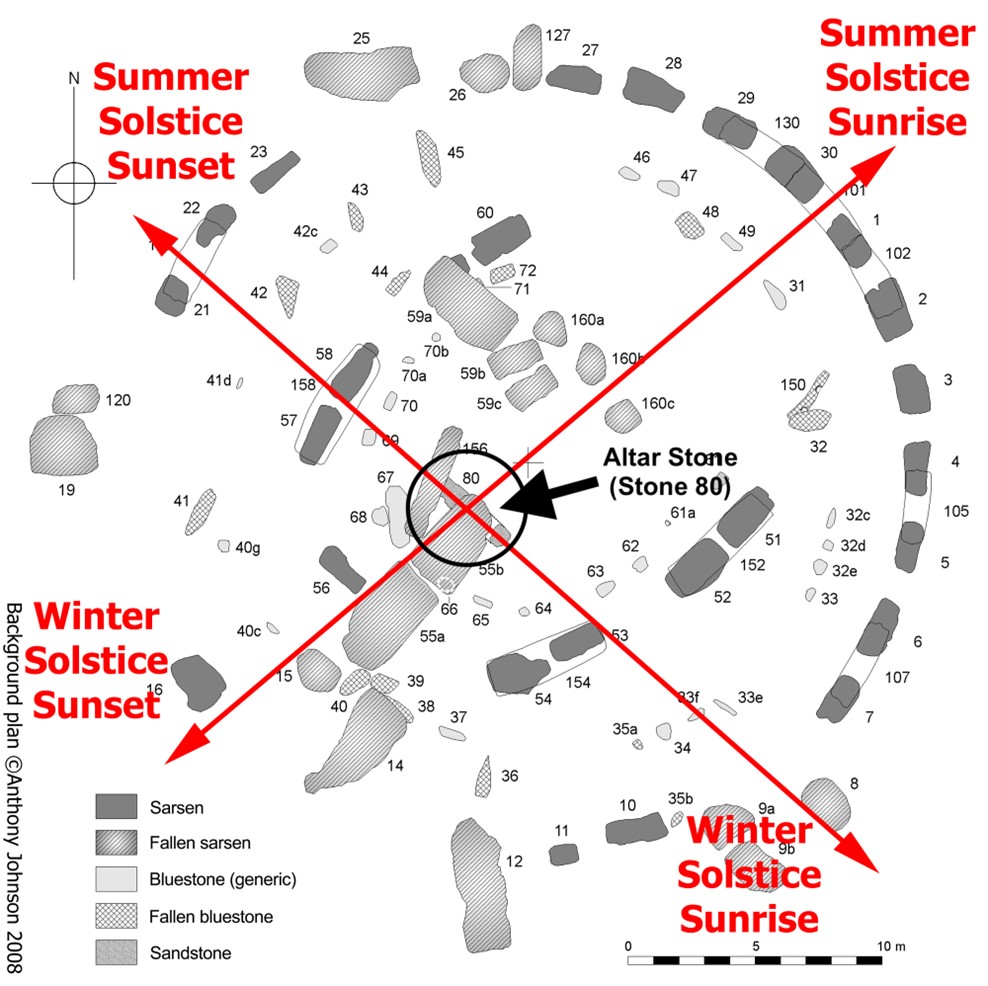
It’s tricky to see as it’s mostly obscured by the collapsed upright and lintel of that tallest trilithon, but this image shows the eastern half of it highlighted in red – the dotted lines indicate that it continues off-picture to the right.

The primary axis of the monument – from Summer Solstice Sunrise to Winter Solstice Sunset – crosses directly over the centre of the Altar Stone, and the secondary axis – from Winter Solstice Sunrise to Summer Solstice Sunset – runs down the midline of this 16’ long x 3’ 6” wide x 1’ 9” deep lump of fine grained greenish sandstone. It therefore lies precisely on the intersection of the main solar alignments at Stonehenge.
It has always been recognised that the Altar Stone is a “foreign” stone, that it is not a locally-sourced sarsen.

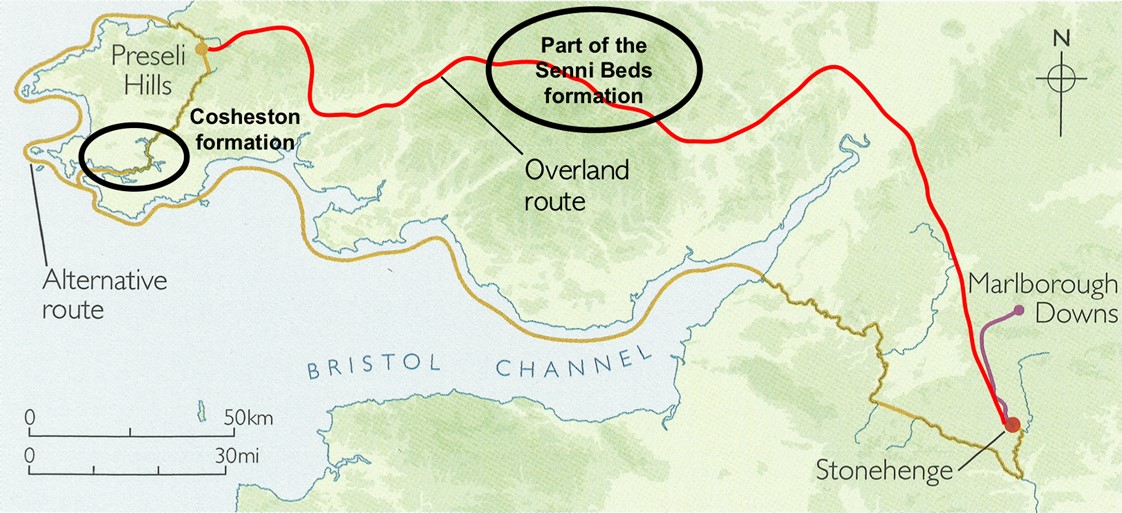
For over a century it had been grouped with the bluestones that originate in the Preseli Hills of Pembrokeshire in south west Wales but – being a sandstone rather than a dolerite or rhyolite – its likely source was thought to be the Cosheston Beds of Old Red Sandstone near Milford Haven.

The suggestion was that it had been collected along the supposed coastal route that the bluestones were assumed to have taken.

However…

As recently as 2020, detailed analysis revealed that the unique Altar Stone didn’t closely match the Cosheston Beds mineralogy. This led to its provenance changing to a possible source in the Bannau Brycheiniog (Brecon Beacons) in south east Wales –  the formation known as the Senni Beds – just north of Abergavenny.

This was particularly interesting because it bolstered the idea that the bluestones had been transported to Stonehenge by a land route rather than being rafted by sea around the coast.
The story didn’t stop there. Further analysis revealed another wrinkle – the Altar Stone has a very high level of barium, much higher than the samples extracted from the Anglo-Welsh basin for comparison. The historical linking of the Altar Stone and bluestones as “foreign” stones had biased researchers towards looking for a South Wales source for it, and the evidence was now pointing a different way.

In 2023, via a paper entitled “The Stonehenge Altar Stone was probably not sourced from the Old Red Sandstone of the Anglo-Welsh Basin: Time to broaden our geographic and stratigraphic horizons?” (https://doi.org/10.1016/j.jasrep.2023.104215) Ixer, Pearce, Bevins et al dropped a bombshell.

Looking at the geological map of Britain, there are only a few possible sources of an Old Red Sandstone with such high levels of baryte cement – the West Midlands, the north of England and… Orkney.

It is far too early to know whether this last possibility is in fact true, but there are established links in the archaeology between Orkney and Stonehenge and it’s an intriguing idea that the Altar Stone may conceivably have made a 500+ mile journey. We expect exciting news this week, you heard here 1st!

GUEST BLOGGER: SIMON BANTON

RELEVANT LINKS:
New mystery over origins of Stonehenge after remarkable discovery – THE GUARDIAN
100-year-old origin theory of Stonehenge’s iconic Altar Stone could be wrong, scientists say – LIVE SCIENCE
Tours of Stonehenge with local guided experts – STONEHENGE GUIDED TOURS
Analyze This: Stonehenge’s ‘Altar Stone’ has mysterious origins – SCIENCE NEWS
Stonehenge Guided Landscape Tours – STONEHENGE TOUR COMPANY
Stonehenge Altar Stone is probably not from Wales – THE PAST

The Stonehenge News Blog
Follow us on Twitter and Facebook for all the latest Stonehenge News and Equinox updates.
http://www.Stonehenge.News


Stonehenge: Eclipse of the Moonmen

21 04 2024

The media has, this week, been running a story about the upcoming Major Lunar Standstill – an event that only occurs only 18.6 years – discussing how academics from a variety of institutions are planning to carry out observations to see if Stonehenge has any alignments to the Moon.

One quote from an article in The Guardian’s piece on this topic says:

“It is also possible that four “station stones” forming a rectangle at the site – two of which are still standing – may have been positioned to mark the major lunar standstill.”

Not a single mention is made, in either this article or in any of the others that have appeared, of the two people who first proposed this hypothesis over 60 years ago – Professor of Astronomy at Boston University, Gerald Hawkins, and amateur astronomer C. A. “Peter” Newham, a retired Group General Manager of the North Eastern Gas Board.

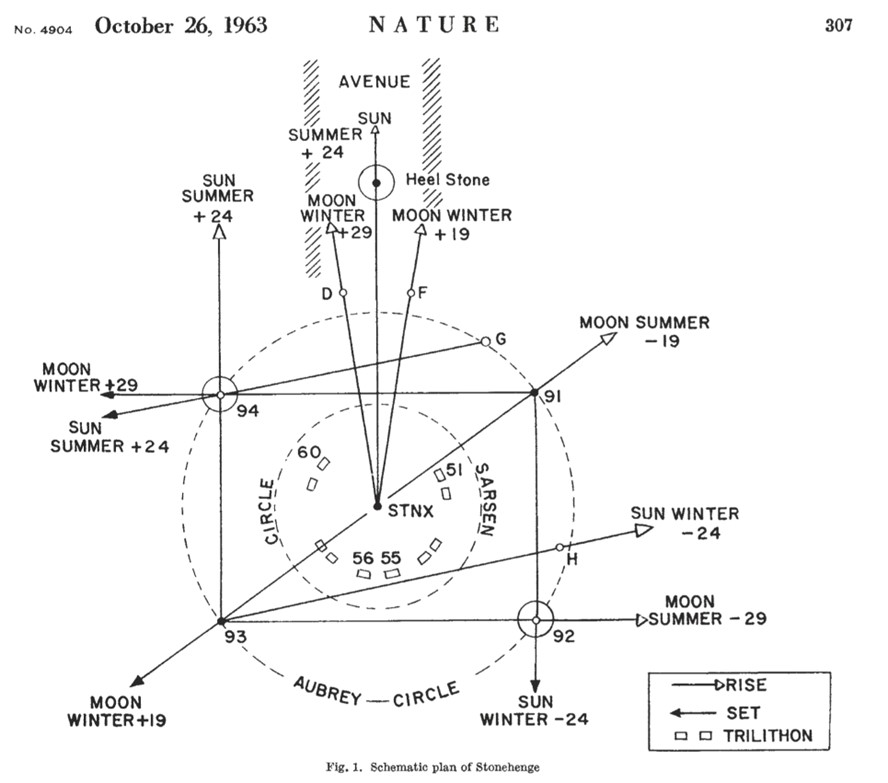
Working independently, and unknown to each other, they each suggested that the long sides of the Station Stone Rectangle at Stonehenge was aligned to the extremest possible southerly Moonrise and northerly Moonset positions on the SE and NW horizons.

Newham’s idea was first reported in a newspaper article about his work which appeared in the 16th March 1963 edition of the Yorkshire Post.

“The first remarkable discovery he made was that a line drawn from mound 94 to 91 would appear to coincide with the point on the horizon where the moon rises at its most southerly point during its 19-year cycle. Conversely, the line from 92 to 93 marks the moonset at its most Northerly setting point.”

Hawkins’ identical realisation was first published in his paper “Stonehenge Decoded” in the journal “Nature” vol 200, 26th October 1963.

It is fascinating that these two individuals arrived at the same conclusion, publishing mere months apart, having never previously corresponded or met with each other. Subsequently, of course, they became very aware of their fellow megalithomaniac and both contributed papers to Nature in the succeeding years.

Prof. Richard Atkinson, the acknowledged authority on all matters Stonehengey at the time, had a clear fondness and respect for Peter Newham in stark contrast to his antipathy towards Gerald Hawkins. He lambasted Hawkins’ work in a letter to Antiquity in 1966 entitled “Moonshine on Stonehenge”, but wrote a touching obituary for Newham following Peter’s death in April 1974 saying:

“He was also the first to give a detailed analysis and interpretation of the enigmatic array of postholes on the entrance causeway of the circular earthwork; and the first again to provide an astronomical explanation of the three huge postholes found during the extension of the Stonehenge car-park in 1966. For this and for much else besides he will be remembered with affection and gratitude.”

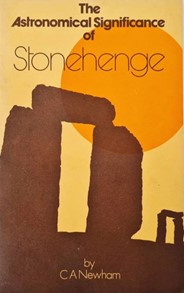
Gerald Hawkins’ insights continue to be unfairly decried in the official story as told in the new Stonehenge Visitor Centre exhibition, but Peter Newham doesn’t even rate a mention – although his excellent little book “The Astronomical Significance of Stonehenge” used to be stocked in the gift shop at the old site and was extremely popular.

As the Major Lunar Standstill of 2024/5 approaches, we should take the chance to remember Peter as one of those gifted amateurs who – by dint of keen observations made by an enquiring mind – recovered some of the lost understanding of this enigmatic monument’s purpose.

Major Standstill Southernmost Moonrise having just risen over Station Stone 91
as seen from the position of Station Stone 94 on 9th July 2006
© Simon Banton

GUEST BLOGGER: SIMON BANTON

RELEVANT LINKS:
Rare lunar event to shed light on Stonehenge’s links to the moon – THE GUARDIAN
Were Stonehenge’s Builders Guided by the Moon? – SMITHSONIAN MAG
Tours of Stonehenge with local guided experts – STONEHENGE GUIDED TOURS
Stonehenge may have aligned with the Moon as well as the Sun – THE CONVERSATION
Mysterious secret behind Stonehenge could be ‘linked to the moon’ say scientists – THE MIRROR
Bid to shed light on whether Moon could have influenced – THE STANDARD
Stonehenge Walking Tours – STONEHENGE TOUR COMPANY

The Stonehenge News Blog
Follow us on Twitter and Facebook for all the latest Stonehenge News and Equinox updates.
http://www.Stonehenge.News


Stonehenge: Tunnel Vision.

12 04 2024

In December 2014 the then coalition UK Government announced to great fanfare that the decades long saga of the on-again-off-again A303 Stonehenge Tunnel project would be revived once more.

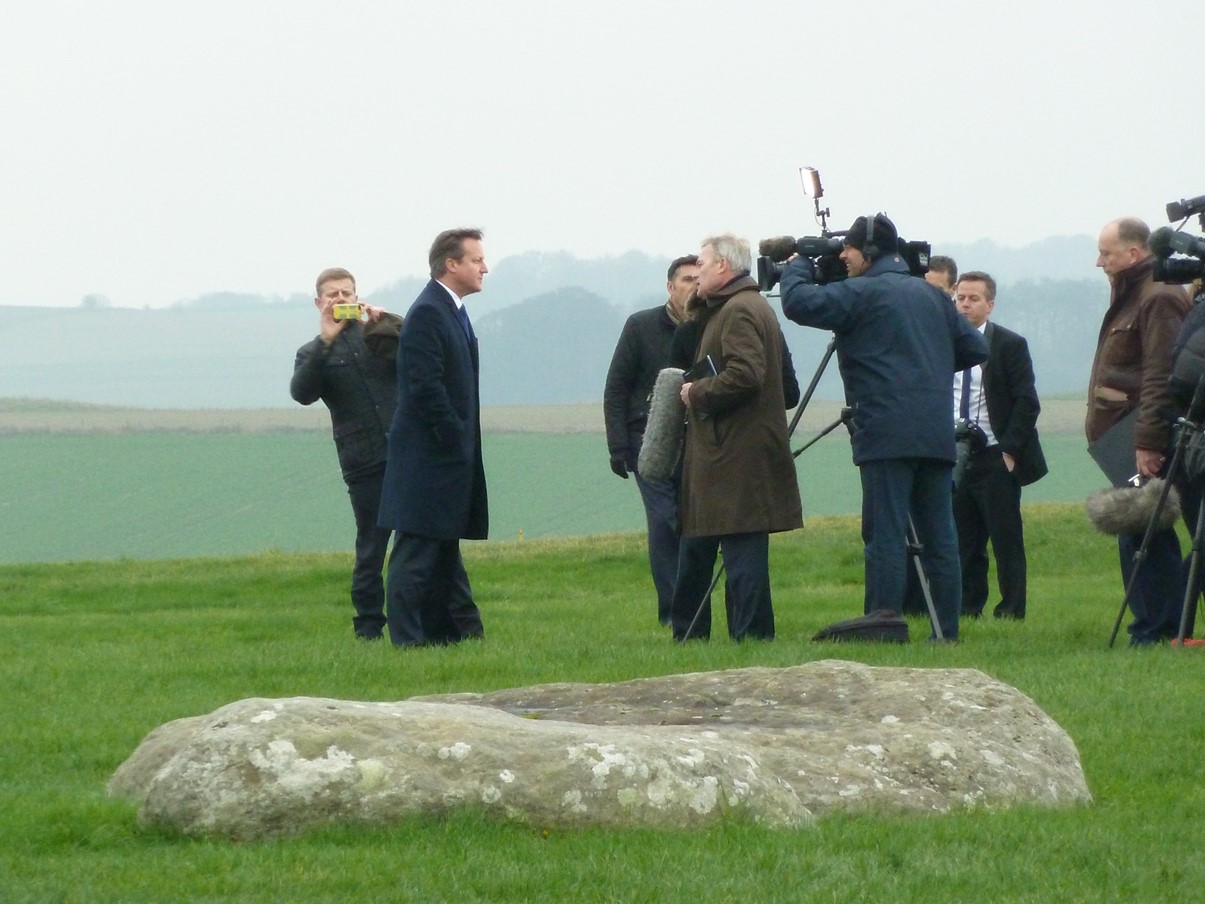
The sound of zombie horses attempting the crawl away from yet another flogging pervaded the World Heritage Site, as first Deputy Prime Minister Clegg then Prime Minister Cameron descended on Stonehenge accompanied by the usual press, TV and English Heritage top brass.

A previous version of the project, estimated at £400M, had been cancelled several years earlier by a Government of a different colour on the basis of the cost, so it was somewhat surprising to learn that its reanimated corpse was now expected to require an eye-watering £1.7B – £2.5B.

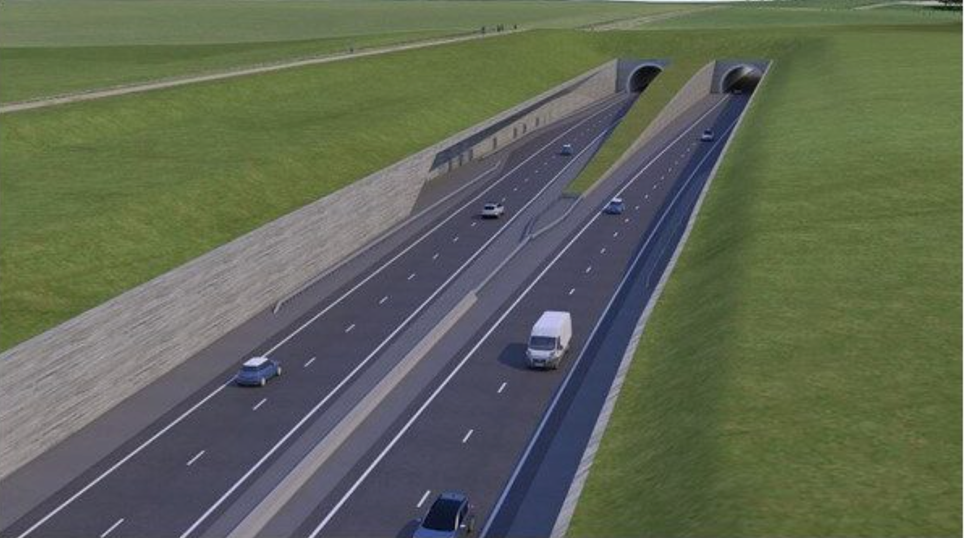
To be fair, according to the plan this time the tunnel will be fully bored rather than cut-and-cover and will be somewhat longer. Not long enough, mind you, to go the full distance from the eastern edge of the World Heritage Site all the way to the western edge.

Instead, it will put its portals in the ground well inside the area of Outstanding Universal Value, obliterating whatever might be in the way.

A brand new dual carriageway will run from the western portal across 1k of farmland, sunk into a trench around 9m deep and 50m wide, to a new junction with the A360 at Longbarrow Roundabout.

At the eastern portal, the new dual carriageway will emerge to soar over the current A303/A345 junction at Countess Roundabout on a 10m high flyover, bringing 60mph HGV traffic noise to the delighted locals.

Almost 10 years on from the announcement, here’s where we are.

After an Enquiry in Public (where the independent Examiners decided against the whole idea), a doleful procession of vacant-eyed Secretaries of State for Transport (some of whom lasted less than 2 months in the job), a determination by one of them to approve the scheme’s Development Consent Order despite UNESCO’s and many others’ misgivings, a Judicial Review into that decision which found the Sec. of State had acted “irrationally” in doing so, then a “re-determination” of the application by a subsequent incumbent which again gave approval, and a further legal challenge (recently lost by anti-tunnel campaigners), we are now awaiting an impending appeal against that ruling.

Over a quarter of a million people have signed petitions against the scheme, crowdfunding an expensive ongoing legal process to the tune of hundreds of thousands of pounds.

UNESCO have threatened that Stonehenge World Heritage Site may be placed on the World Heritage in Danger register (a precursor to delisting) if the scheme goes ahead in its present form.

In the event that the tunnel does get built – estimated costs are now above £3B, and look likely to rise even more over the 5 years the build is optimistically slated to take – one certain outcome is that the casual view of a 4,500 year old global icon of prehistory from the A303 will be lost forever.

From being something freely glimpsed in the magnificent early dawn light surrounded by mist as you crest King Barrow Ridge making your way westwards, or appearing unexpectedly nearby, glowing rose-golden in the rays of the setting Sun as you head past it eastwards, it will become an experience only available to those who are either willing and able to pay the ever-increasing entrance fee or are lucky enough to be capable of walking the couple of miles from the nearest available parking or bus stop.

Meanwhile Stonehenge looks on impassively, perhaps whispering to those who will listen that humanity’s obsession with getting to the next traffic bottleneck a whole 8 minutes faster really may not be worth the cultural, let alone the financial, cost in the long run.

GUEST BLOGGER: Simon Banton (April 2024)

The Stonehenge News Blog
Follow us on Twitter and Facebook for all the latest Stonehenge News and Equinox updates.
http://www.Stonehenge.News
April 2024