Full Moon this Winter Solstice 2010

7 12 2010

The exact time for the Winter Solstice is December 21st, 11.39pm (UK time). The sunset on the 21st is at 3.53pm and the sunrise on the 22nd of December at 8.04am. Exceptionally, we can also expect a full moon on December 21st

Since 1793, when The Old Farmer’s Almanac began tracking heavenly events and seasonal changes, the Moon has been full on the first day of winter just nine times. The next occurrence will be in this coming Winter Solstice


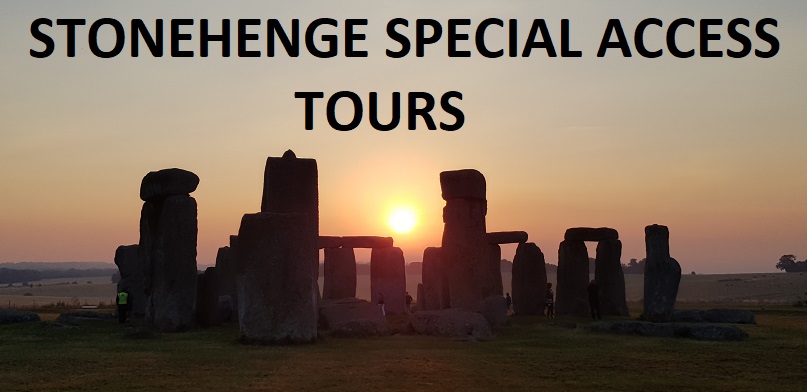
Full moon at Stonehenge this Winter Solstice

Full moon at Stonehenge this Winter Solstice


The rarity of a solstitial full Moon—the average interval is about 19 years—reinforces the Moon’s role as a beacon playing on human history. Although our research could not find a correlation between these lunar events and significant historical happenings on similar dates in the past*, the combination of astronomical forces certainly affect the tides.

As astronomer Bob Berman explains, during this time of proxigean tides [unusually high tides due to the Moon’s phase and proximity to Earth], coastal flooding could occur if there is one more little extra effect, such as a storm at sea, on-shore winds, or low barometric pressure.

If the solstice night is calm and cloudless, with the full Moon beaming down on a blanket of snow, it will be irresistibly attractive, and electrical illumination—even your car’s headlights—may seem superfluous.

Full moon - Winter Solstice

Full moon - Winter Solstice

2010
Spring equinox – Mar 20 at 5.35pm
Summer solstice – Jun 21
at 11.30am
Autumn equinox – Sep 23
at 3.10am
Winter solstice – Dec 21

Merlin @ Stonehenge
The Stonehenge Stone Circle Website


All aboard the ‘Stonehenge Express’

7 12 2010

Two crucial aspects of the Stonehenge proposals have yet to be clarified…

 1. The transit system.

Will it be like one of the two examples shown here ? Not one like the Eden Project, please! That one is called “Percy”. Very tasteful! So more like the Dover Castle one? It may be, if this video is a true representation. But the video one pulls four carriages, not two. Is the vehicle up to it? And what about the livery? Can we be solemnly promised it will never ever carry advertising? And what’s wrong with buses? And what about talk in The Times letters column of Lord Lansdowne saying Stonehenge would be turned into a toytown with visitors approaching in dinky electric vehicles? Isn’t anything that prompts thoughts of Noddyland (which it’s hard not to think of when watching the video) to be absolutely avoided at our national icon? 

http://www.english-heritage.org.uk/daysout/properties/stonehenge/our-plans/our-proposals/

 2. The fences 

Will the fences be removed? Surely it has been decided upon? After all, if the detailed design of the new Visitor Centre and the colour of the transit system coaches have been decided then surely it is inconceivable that the matter of access to the stones (in other words the fences) hasn’t been been decided as well? English Heritage as good as says it has : “The need to care for Stonehenge properly has been recognised for many years. Improvement to its landscape setting and presentation to visitors are identified as priorities in the WHS Management Plan ……… The proposals to address this need have been agreed by a group of key stakeholders led by English Heritage

So what HAS been decided about the fences? The reason the question needs to be asked is because the video appears to show that there will be no fences – and although that would be very nice we have concerns that behind the scenes a different view might have been taken. The practicalities suggest that having no fences at all would prove impossible. Security is one problem. And erosion is another. But the video seems to suggests that nearly a million people a year will be free to walk amongst the stones, not held back by fences, ropes or rules. It seems unlikely.

A lot of people hold the “no fences and free access to the stones” concept very dear. If it is not going to happen then it would be better if people were told, not given a contrary impression by a video. Indeed, the public has the right to know does it not? Open access to the stones may or may not be impractical but open access to information about this matter certainly isn’t!

Exteran Links: http://heritageaction.wordpress.com/

Merlin @ Stonehenge
The Stonehenge Stone Circle Website


Solstice and “The Ancestor”

7 12 2010

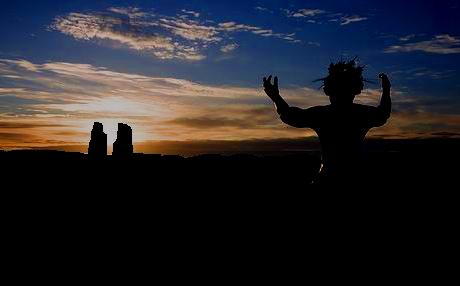
A Winter Solstice celebration is to be held at which  The Ancestor will be receiving his new winter crown and decorations for the festive period….  Could it be the start of something significant?

Few would disagree that when he was set up at Stonehenge for the summer solstice The Ancestor was a marvelously apt symbol, a powerful expression of everyone’s feelings towards sunrise, particularly at the solstices. But clearly he can’t be shipped to Stonehenge twice a year so is there not an opportunity here? 

Everyone knows that vast gatherings at Stonehenge, particularly at summer solstices, pose major logistical, conservation and financial problems for English Heritage, ones that they will be finding increasingly difficult to cope with in the face of the cuts. The pagan community are acutely aware of this and also that the difficulties aren’t caused by them but by others attracted to the event without adequate appreciation of the need to respect the monument.

 So here’s a possible solution:

Suppose the main summer solstice celebration centred not on Stonehenge but elsewhere, around The Ancestor? Could this not take much of the pressure off Stonehenge and perhaps allow a smaller-scale, more seemly gathering at the stones, to the advantage of both pagans and the authorities?

Not that the alternative celebration need be any less valid. As well as The Ancestor there might be the opportunity to erect heel stones at the venue so more people could see the symbolism of the sunrise more accurately – after all, modern pagans are Neo Pagans are they not? Why shouldn’t they (and all of us) have a way to celebrate modern sunrises properly, not long-gone ones inaccurately? 

Who would pay? Well, presumably no-one would mind paying a pound or two at the gate since it wouldn’t be at Stonehenge and would be easily approached without a long cold hike. And the start-up costs? How about asking English Heritage if they’d mind paying that out of the savings they’d make out of not having to run the event at Stonehenge!? Seems like it would be a very good deal for them, the taxpayer, Stonehenge and all pagans.

So there’s the suggestion. Discuss! Could the Solstice be better celebrated by everyone? And could The Ancestor be made into the permanent and universally admired face of modern paganism?

External link: http://heritageaction.wordpress.com/2010/12/03/solstice-and-the-ancestor/

Merlin @ Stonehenge
The Stonehenge Stone Circle Website


Pagan Mistletoe Symbolism and Legend

4 12 2010

Mistletoe and Christmas After Celtic Pagans were converted to
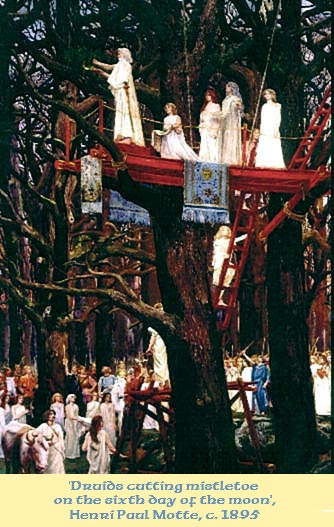
Druids cutting Mistletoe

Druids cutting Mistletoe

Christianity, Catholic bishops, with one exception, didn’t allow the mistletoe to be used in churches because it was one of the major symbols of Paganism. Before the Reformation, a priest at the Cathedral of York brought a bundle of mistletoe into the sanctuary each year during Christmastide and put it on the altar as symbolic of Jesus being the Divine Healer of nations.

‘Mistletoe, one of the most magickal and sacred plants of Paganism, symbolizes life and fertility and protects against poison. It was considered an aphrodisiac. ‘

The English used mistletoe as a Christmas decoration for their homes. In Medieval times, branches of mistletoe were hung from ceilings and put over houses and barn doors to repel evil spirits. People believed the plant could extinguish flames. Although much of the Pagan symbolism was forgotten, the plant represented good will, happiness, good fortune and friendship.

‘The sacred mistletoe is a hemiparasite, partial parasite that grows on branches or trunks of trees and has roots that penetrate into the tree for food. The American plant grows on trees while the European mistletoe can also be a green shrub with small yellow flowers and white berries. The plant contains toxins that can cause physical reactions including gastrointestinal disturbances and a slowed heartbeat.’

Mistletoe Sacred to Celtic Druids

The plant has qualities including the power of healing, rendering poisons harmless, good luck, great blessings, bestowing fertility on humans and animals, protection from witchcraft and banishing evil spirits. Enemies who met Druids under the forest mistletoe laid down their weapons, exchanged friendly greetings and kept a truce until the next day. The Celts suspended mistletoe over doorways or in rooms as a symbol of good will and peace to all who visited.

‘Mistletoe was revered by the ancient Druids both magically and medicinally. It’s possible that modern mistletoe traditions have their roots in ancient beliefs.’

Druid Mistletoe Ceremony

The plant is a fertility symbol and the soul of the oak tree. Belief was that the mistletoe could come to the oak tree during a lightning flash. Mistletoe was gathered at mid-summer and winter solstices. The plant, when it grew on the venerated oak tree, was especially sacred to the Celts. On the sixth night of the full moon after Yule, white-robed Druid priests gathered oak mistletoe by cutting the plant with golden sickles. Two white bulls were sacrificed with prayers that the recipients of mistletoe would prosper.

Mistletoe and the Ancient Druids

Pliny the Elder, a Roman historian interested primarily in natural history, recorded valuable information about the Druids and their religious and healing practices. These ancient priests of Celtic lands revered mistletoe as sacred. Pliny stated in Natural History, XVI, 95 that, “The Druids — that is what they call their magicians — hold nothing more sacred than mistletoe and a tree on which it is growing…Mistletoe is rare, and when found, it is gathered with great ceremony, and particularly on the sixth day of the moon.”

In the scene quoted above, the Druids are preparing for a ritual sacrifice which involves a white-robed priest carrying a golden scythe while climbing an oak tree to ritually cut the mistletoe. According to Pliny, it was the Valonia oak the Druid’s believed was the most sacred tree to gather mistletoe from and that it would heal poison and encourage fertility.

Mistletoe in Celtic Art

Celtic art is resplendent with what are believed to be mistletoe motifs. Some artifacts have been found that resemble human male heads adorned with a crown of comma-shaped leaves that resemble mistletoe. Historians believe these finds may be representations of crowned Druid priests.

External links:
http://www.mistletoe.org.uk/ A survey of Mistletoe use in Britain
http://www.mistletoes-r-us.co.uk/  Mistletoe matters
http://www.archaeology.co.uk/books/blood-and-mistletoe-the-history-of-the-druids-in-britain.htm The History of Druids – Blood and Mistletoe

 Next blog will be about -‘Yule’

Merlin @ Stonehenge
The Stonehenge Stone Circle Website


Could This Be How Stonehenge Was Actually Built? New theory

2 12 2010

One of the most puzzling mysteries is how Stonehenge, the prehistoric circle of stones in England, came to be. We know it was built around 4500 years ago, and the stones came from Wales, some 250km away… but how?

Of course, back then, it wasn’t so easy to transport stuff around the country – especially not 60 bluestones which are said to weigh between two and four tons each. Several theories have been bandied about over the years of how the stones were transported, including sledges; rafts along the rivers; and that Merlin himself used his magic to gather the stones there.

This week, an engineer and former BBC TV presenter, Garry Lavin, tested his theory that wicker baskets made from willows were used to roll the stones all 250kms from the quarry in Preseli Hills, Wales, to Salisbury, in Wiltshire, England. He built one himself, using willow and alder saplings, and enlisted several friends to help roll a one-ton boulder along the ground.

He thinks oxen might’ve helped roll the baskets in some parts, and that rivers could have floated them downstream. But it’s the baskets which Lavin is sure had a huge part in the formation of Stonehenge – and as he’s currently building a maxi-basket to move a five ton stone, we may soon find out the answer. Unless aliens decide to show up and show us otherwise, of course.

Well, your comments ?

Merlin @ Stonehenge
The Stonehenge Stone Circle Website